Come scegliere un trasportatore pneumatico a vuoto antideflagrante: guida completa all'acquisto
La movimentazione di polveri combustibili richiede più attenzione rispetto al normale trasferimento di materiali. Negli impianti chimici, nelle fabbriche di batterie al litio e nella produzione farmaceutica, l’accumulo di polvere e l’elettricità statica possono creare gravi rischi per la sicurezza.
Materiali come la polvere di alluminio, il nerofumo, alcuni materiali per batterie al litio e i pigmenti chimici possono generare polveri combustibili durante la movimentazione. Se queste polveri entrano in contatto con una fonte di innesco, può verificarsi un’esplosione.
Un Trasportatore pneumatico a vuoto antideflagrante aiuta a ridurre questi rischi trasferendo la polvere attraverso tubazioni chiuse in depressione. Limita la dispersione delle polveri, riduce la movimentazione manuale ed è dotato di dispositivi di sicurezza progettati per i materiali pericolosi.
Ma non tutte le macchine definite “antideflagranti” sono adatte al vostro impianto. La progettazione delle apparecchiature, i componenti e i livelli di protezione possono variare notevolmente.
Prima dell’acquisto, verificate se il produttore di trasportatori pneumatici a vuoto conosce il vostro materiale e le vostre condizioni di lavoro. L’apparecchiatura giusta deve essere adatta alle proprietà della polvere, ai requisiti dell’area pericolosa e alla capacità produttiva, non semplicemente avere il prezzo più alto o il maggior numero di dispositivi di sicurezza.
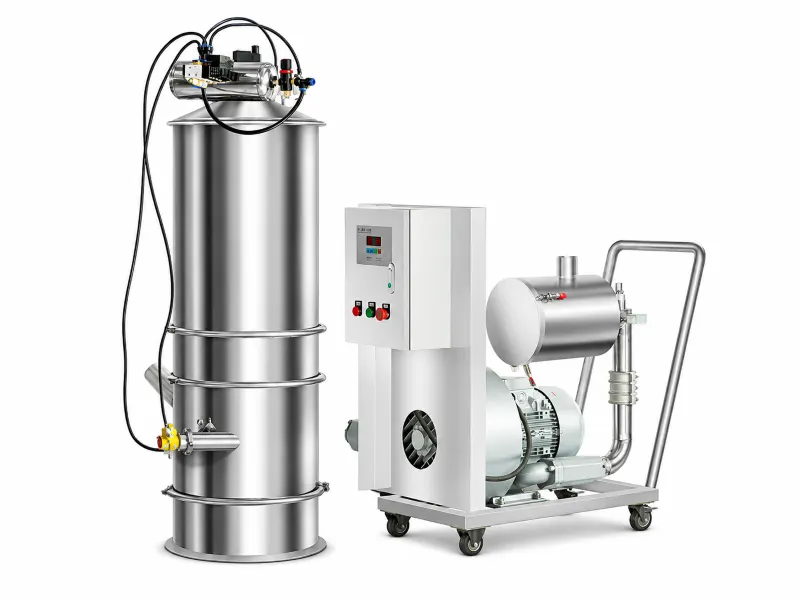
Che cos’è un trasportatore pneumatico a vuoto antideflagrante?
Un trasportatore pneumatico a vuoto antideflagrante è un sistema chiuso per il trasporto di polveri, progettato per applicazioni in cui possono essere presenti polveri combustibili o atmosfere esplosive.
Utilizza una pompa per vuoto o aria compressa per creare una depressione. La polvere attraversa una tubazione chiusa fino a una tramoggia di raccolta, prima di essere scaricata nella fase successiva del processo.
Questo riduce la dispersione di polvere nell’ambiente di lavoro e limita il trasferimento manuale delle polveri. Potete approfondire il principio di funzionamento di base sulla nostra sistema di alimentazione a trasportatore sottovuoto page.
Tuttavia, un sistema chiuso non è automaticamente antideflagrante.
Quando la polvere si muove nelle tubazioni, l’attrito può generare elettricità statica. Se le cariche si accumulano e si scaricano, possono innescare le polveri combustibili.
Gli alimentatori a vuoto standard potrebbero non essere dotati di motori, tubi flessibili, filtri o componenti elettrici adatti alle aree pericolose. Un sistema antideflagrante richiede un’adeguata protezione elettrica, la messa a terra, la tenuta e altre misure di sicurezza.
Durante la scelta occorre considerare l’intero sistema di trasporto, non solo il motore.
Verificate le proprietà del materiale e i requisiti di protezione antideflagrante
Prima di scegliere un trasportatore pneumatico a vuoto antideflagrante, occorre rispondere chiaramente a due domande: Quale materiale dovete trasportare e dove funzionerà l’apparecchiatura?
Comprendete il rischio di esplosione della vostra polvere
Tra i materiali comuni che possono richiedere una protezione speciale figurano:
- Materiali per batterie al litio: Alcune materie prime per batterie e polveri metalliche combustibili.
- Polveri chimiche: Nerofumo, alcuni pigmenti, coloranti e prodotti chimici organici.
- Polveri metalliche: Polvere di alluminio e altre polveri metalliche combustibili.
- Polveri alimentari e farmaceutiche: Alcuni amidi, zucchero in polvere e ingredienti organici.
Anche uno stesso materiale può presentare caratteristiche di esplosività diverse a seconda delle dimensioni delle particelle, dell’umidità e della composizione.
Fornire al fornitore una scheda di dati di sicurezza (SDS) e i dati disponibili sulle prove di esplosione delle polveri. Tra i valori importanti figurano la concentrazione minima esplosiva, l’energia minima di innesco e la severità dell’esplosione delle polveri.
Anche altre proprietà sono importanti. Le polveri appiccicose o umide possono richiedere filtri e tubazioni di progettazione diversa, mentre i materiali abrasivi necessitano di componenti più resistenti all’usura.
Scegliere l’apparecchiatura in base alla zona pericolosa
La classificazione delle zone pericolose dell’officina determina le misure di protezione dalle esplosioni necessarie.
Verificare la marcatura di protezione dalle esplosioni, la certificazione e le condizioni operative previste dell’apparecchiatura. Se il progetto richiede apparecchiature conformi alla direttiva ATEX, i componenti interessati e la progettazione del sistema devono soddisfare i requisiti applicabili.
Ricordare che le polveri combustibili possono formare un’atmosfera pericolosa anche all’interno delle tubazioni di trasporto o della tramoggia di ricezione.
Scegliere il livello di protezione più elevato non è sempre necessario. La soluzione corretta dipende dal materiale, dalla zona di installazione e dalla valutazione dei rischi. Le funzioni di sicurezza essenziali non devono mai essere eliminate solo per ridurre il prezzo.
Trasportatori sottovuoto pneumatici ed elettrici antideflagranti a confronto
Due opzioni comuni sono i trasportatori sottovuoto pneumatici e i sistemi elettrici con motori antideflagranti.
Entrambi possono essere utilizzati nelle applicazioni appropriate, ma le loro fonti di alimentazione e i requisiti operativi sono diversi.
Trasportatore sottovuoto pneumatico
Un trasportatore sottovuoto pneumatico utilizza aria compressa e un generatore di vuoto per creare aspirazione.
Il generatore di vuoto non dispone di un motore elettrico di azionamento, eliminando così tale motore come possibile fonte di innesco elettrica. Questo può essere utile nelle officine soggette a rigide restrizioni sugli impianti elettrici o negli stabilimenti che dispongono già di un’alimentazione stabile di aria compressa.
La nostra trasportatore pneumatico a aspirazione pagina spiega come funziona questo tipo di apparecchiatura.
Tuttavia, le apparecchiature pneumatiche non sono completamente esenti da rischi di esplosione. È comunque necessario prestare attenzione all’elettricità statica, agli accumuli di polvere, all’attrito meccanico e ad altre possibili fonti di innesco.
Anche il consumo di aria compressa influisce sui costi operativi. Assicurarsi che il compressore possa fornire pressione e portata d’aria sufficienti per la capacità di trasporto richiesta.
Trasportatore sottovuoto elettrico antideflagrante
Un sistema elettrico utilizza una pompa per vuoto azionata da un motore per generare una pressione negativa.
Può essere configurato per diverse distanze di trasporto, capacità e durate di funzionamento. Per percorsi di trasporto più lunghi o per un funzionamento frequente, può valere la pena prendere in considerazione un sistema elettrico.
The motor is not the only component that needs protection. Vacuum pumps, control panels, sensors, and other electrical parts installed in hazardous areas must also meet the relevant requirements.
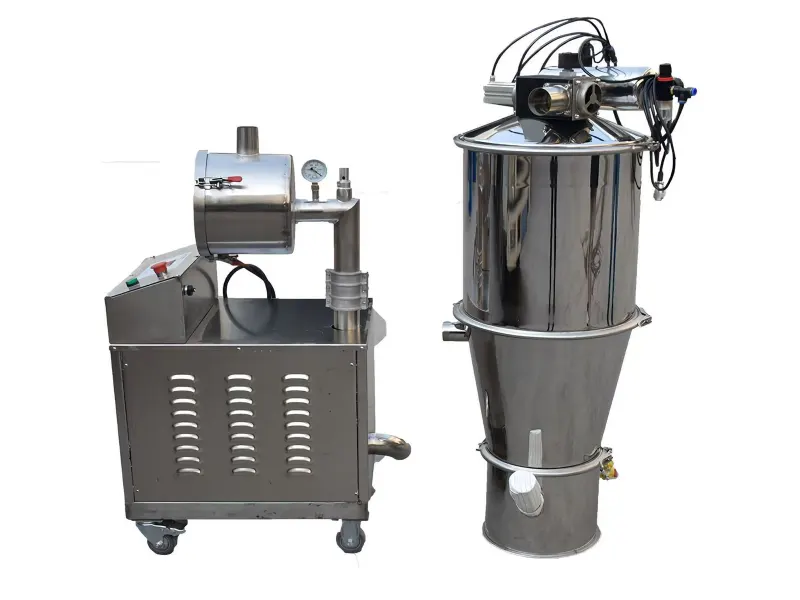
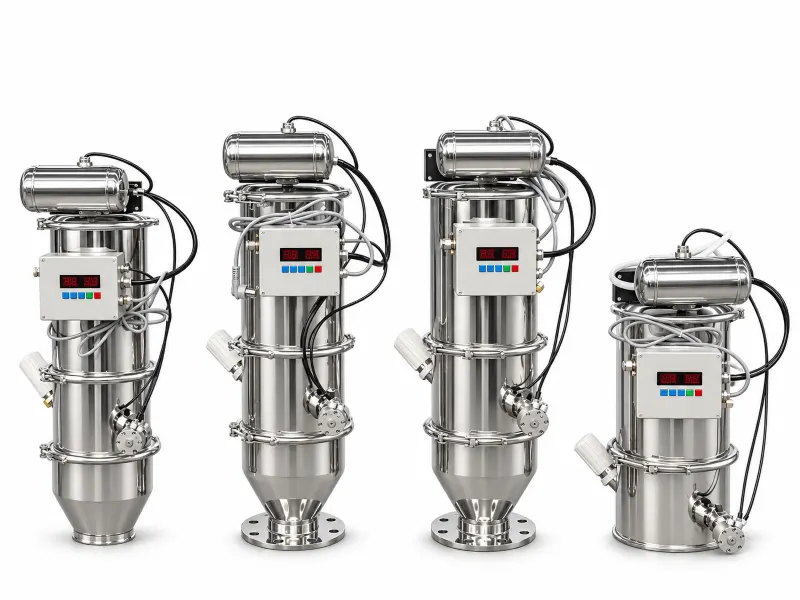
Which Type Should You Choose?
| Voce | Pneumatic Type | Electric Type |
|---|---|---|
| Power source | Compressed air | Electric vacuum pump |
| Main feature | No drive motor in the vacuum generator | Motor-driven vacuum generation |
| Site requirements | Stable compressed air supply | Suitable electrical supply |
| Capacità | Depends on air supply and vacuum generator | Depends on pump and system design |
| Main considerations | Air consumption, pressure, safety | Electrical protection, capacity, energy use |
Neither option is always better.
A produttore di trasportatori pneumatici a vuoto should consider your material, hazardous area, conveying distance, and available utilities before recommending a system.
Key Features to Check Before Buying
The performance and safety of an explosion-proof vacuum conveyor depend on more than its vacuum source. Pay attention to the following components.
Explosion-Proof Electrical Components
For an electric system, check the motor, vacuum pump, control panel, and sensors.
Ask the supplier whether these components are suitable for your hazardous area and whether the required certificates and technical documents are available.
A certified explosion-proof motor does not automatically make the entire conveyor suitable for hazardous environments.
Equipment Materials and Sealing
Material-contact parts are commonly made from 304 or 316L stainless steel.
304 stainless steel works for many general powder applications. For more corrosive materials or stricter cleanliness requirements, 316L may be a better option.
Sealing is equally important. Poorly sealed joints, discharge valves, and pipe connections may allow dust to escape.
For food, pharmaceutical, or multi-product production lines, choose equipment that is easy to open and clean to reduce material residue and cross-contamination.
Anti-Static Pipes and Hoses
Powder moving through pipelines can generate static electricity.
Use suitable conductive or anti-static pipes and flexible hoses based on the material. Metal hoppers, pipelines, and other conductive components should be properly bonded and grounded.
Pipe layout also matters. Too many bends or sudden diameter changes can increase conveying resistance, wear, and powder buildup.
Filters and Pulse-Jet Cleaning
Filters separate powder from the conveying air and help prevent material from entering the vacuum source.
For combustible powders, suitable anti-static or conductive filters may be required.
As powder builds up on the filter surface, suction can decrease and conveying cycles may become longer.
Many systems use pulse-jet filter cleaning to remove collected powder and maintain airflow. The cleaning method and gas supply must also be suitable for the material being handled.
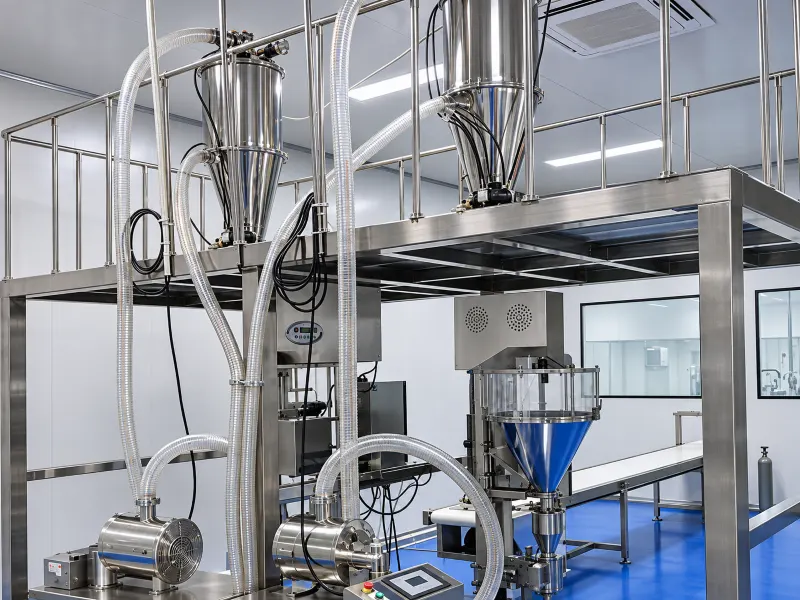
Conveying Performance and Production Line Integration
Even a well-protected explosion-proof vacuum conveyor must deliver the required capacity without frequent blockages.
Material Properties and Conveying Capacity
Particle size, bulk density, moisture, stickiness, and flowability all affect conveying performance.
Dry, free-flowing powders are often easier to handle. Moist or sticky materials may need different suction settings, pipelines, or discharge designs.
The same conveyor can achieve different capacities when handling different powders.
For difficult materials, a conveying test before purchase can help confirm performance.
Conveying Distance and Lifting Height
When requesting a quotation, provide the horizontal conveying distance, vertical lifting height, number of bends, and required capacity in kg/h or t/h.
Longer routes and higher lifts increase resistance, so the vacuum source and pipe diameter must match the actual layout.
For batch conveying systems, remember that suction and discharge take place in separate parts of the cycle. Both affect the average hourly capacity.
Connecting with Other Equipment
Vacuum conveyors often work with bag dump stations, bulk bag unloaders, vibrating screens, storage hoppers, and mixers.
For example, a stazione di svuotamento sacchi senza polvere can feed powder into a closed conveying line, reducing manual handling and dust around the loading area.
If your process also requires screening, see our guide to connecting a vacuum conveyor and vibro sifter.
The entire production line needs to be assessed for dust hazards, not just the conveyor.
A produttore di trasportatori pneumatici a vuoto with system design experience can help plan the pipe route, equipment connections, and maintenance space while reducing areas where powder may collect.
How to Choose a Vacuum Conveyor Manufacturer
Explosion-proof equipment often costs more than standard powder feeders. But two machines that look similar may have very different safety components and performance.
Check Certifications
Some equipment sold as explosion-proof may only be a standard conveyor with a few modified parts.
Ask the produttore di trasportatori pneumatici a vuoto for the relevant certificates, technical drawings, and component list.
Check the equipment model, explosion protection marking, certification scope, and applicable conditions. Where possible, verify the documents through the issuing organization’s official records.
For projects that require safety inspection or approval, confirm the necessary documents before placing an order.
Compare Equipment Configurations
Do not compare quotations based on price alone.
Check the motor, electrical controls, stainless steel grade, filters, sealing parts, and safety features.
Once the equipment meets your safety and production requirements, compare its purchase price, energy consumption, maintenance needs, and spare parts costs.
Check After-Sales Support
Filters may become blocked, seals can wear out, and pipes may eventually need replacement.
Before buying, ask about installation guidance, commissioning, warranty, spare parts, and technical support.
Components that affect explosion protection should not be replaced with ordinary parts without a proper technical assessment.
Information Needed for Equipment Selection
To receive an accurate recommendation, provide the produttore di trasportatori pneumatici a vuoto with the following information:
| Informazione | What to Provide |
|---|---|
| Materiale | Name, particle size, bulk density, moisture, flowability, and explosion properties |
| Hazardous area | Area classification, applicable standards, and available test data |
| Conveying route | Horizontal distance, vertical lift, and number of bends |
| Capacità | Required kg/h or t/h and operating cycle |
| Site conditions | Electrical supply, compressed air, and installation space |
| Equipment connections | Feeding point and receiving equipment |
| Special requirements | Material grade, cleaning, automation, and custom features |
These details help the engineering team choose the right vacuum source, filters, pipelines, and protection measures.
For complex factory layouts, a site review may also help before the final design is confirmed.
Conclusione
Choosing the right Trasportatore pneumatico a vuoto antideflagrante starts with understanding your powder, hazardous area, and conveying requirements. The equipment should be safe, reliable, and easy to maintain.
Looking for a reliable produttore di trasportatori pneumatici a vuoto? Contatta Yuanjing Machinery and share your material, conveying distance, required capacity, and explosion-proof requirements.
Our team can help you choose a suitable powder conveying solution for your production line.
Domande frequenti
Q1: Is a Pneumatic Vacuum Conveyor Safer Than an Electric Model?
Not always. A pneumatic vacuum generator has no electric drive motor, but static electricity, mechanical friction, and dust buildup can still create risks.
An electric system can also be suitable when correctly designed and protected. Safety depends on the complete system, not just the power source.
Q2: Can I Convert a Standard Vacuum Conveyor into an Explosion-Proof Model?
Replacing the motor alone is not enough.
Electrical components, filters, hoses, static control, and other parts may also need changes. A qualified specialist should assess the equipment and confirm the required protection before it is used in a hazardous area.
Q3: Can a Closed Vacuum Conveyor Prevent All Dust Leakage?
Closed vacuum conveying greatly reduces dust release, but zero leakage cannot be guaranteed under every condition.
Sealing, filter performance, feeding methods, and maintenance all affect dust control. For cleaner operation, the system can be combined with a dust-free feeding station and suitable dust collection equipment.
Q4: Does an Explosion-Proof Certificate Guarantee That the Machine Will Pass a Safety Inspection?
No. A certificate covers only the equipment or components within its stated scope.
The complete installation must also meet the relevant requirements for hazardous area classification, electrical protection, grounding, and other safety measures.
Q5: Can an Explosion-Proof Vacuum Conveyor Handle Aluminum Powder, Carbon Black, or Lithium Battery Materials?
A system can be designed for certain grades of these materials, but not every model is suitable.
Aluminum powder and some battery materials can present serious dust explosion risks. The supplier should review the material properties, static control requirements, conveying distance, and capacity.
Additional safety assessments or conveying tests may be needed.
Q6: How Often Should the Filter Be Replaced?
There is no fixed replacement schedule.
Filter life depends on the powder, dust load, operating hours, and cleaning performance. If suction remains weak after cleaning, inspect the filter for blockage or damage.
Use replacement filters that meet the original filtration and anti-static requirements.