How to Choose and Maintain a Dust-Free Bag Dump Station
When an operator tips a bag of flour or baking soda into a estação de despejo de sacos livre de poeira, the extraction fan draws airborne dust away from the bag opening. The powder drops into the hopper and moves on to screening, batching, or conveying. Over several shifts, fine powder can coat the filter cartridges, settle around door seals, and collect in hopper corners. A worn gasket may leave a thin line of powder along a closed joint. Material left just above the outlet can absorb moisture overnight and restrict flow the next morning.
To choose a dust-free bag dump station, tell the manufacturer what goes into each bag, how quickly the operator empties it, and which machine receives the powder. If you already have a station that leaks or feeds unevenly, start by noting exactly where the dust escapes or the material stops moving.
What to check before buying a dust-free bag dump station
Two stations with the same rated capacity can be quite different to clean and service. A drawing will give you the hopper dimensions. A look inside the machine will show whether an operator can reach the welds, corners, and gasket grooves where the last batch tends to leave residue.
| Item | What to look for |
|---|---|
| Loading door, inspection cover, and hopper connections | Find out which gasket material the manufacturer uses at each joint. Is the proposed silicone, polyurethane, or other material suitable for your powder? Check how the clamps close and whether you can replace a worn gasket separately. |
| Filter media and filtration area | Give the manufacturer the powder particle size, moisture content, and tendency to stick. Include the weight per bag and the number of bags operators empty in succession. The manufacturer needs that loading pattern to select the filter media, filtration area, and extraction airflow. |
| Sheet metal and welds | Review the sheet thickness, stiffeners, and support frame. If the line changes products frequently, pay particular attention to the finish of internal welds and corners. Operators will need to clean those surfaces between batches. |
| Hopper and flow aids | For a powder that clumps or bridges over the outlet, check the hopper wall angle and outlet dimensions. A trial with your material can help determine whether the hopper needs a vibrator or agitator. |
| Factory inspection | Request the equipment drawings, material certificates, and agreed test records. These may cover sheet metal, welds, motor insulation, and a no-load run. If the application calls for additional weld inspection, noise measurement, or leak testing, settle the requirements before ordering. |
If the manufacturer offers a smoke test, ask to see the direction of airflow at the loading opening. A fluorescent powder test can help pinpoint a leak. If your purchase specification includes a filtration-efficiency figure, agree on the measurement method, operating conditions, and acceptance criteria before placing the order.
Choosing a hopper and discharge arrangement for your powder
Free-flowing dry powders and granules. Start with the standard hopper. During a trial, watch what happens as the last of the bag empties. Look for powder left on the walls or sitting above the outlet.
Sticky, oily, or moisture-sensitive powders. One bag may empty cleanly even if the next few leave a progressively thicker layer on the hopper wall. When choosing a dust-free bag dump station for these materials, send a representative sample and ask for a trial with several bags in succession. Note where buildup begins before changing the wall angle or adding a vibrator or agitator. For powders that accumulate static charge, generate combustible dust, or present a toxic exposure hazard, give the manufacturer the material properties and site protection requirements. Qualified personnel should assess the complete installation.
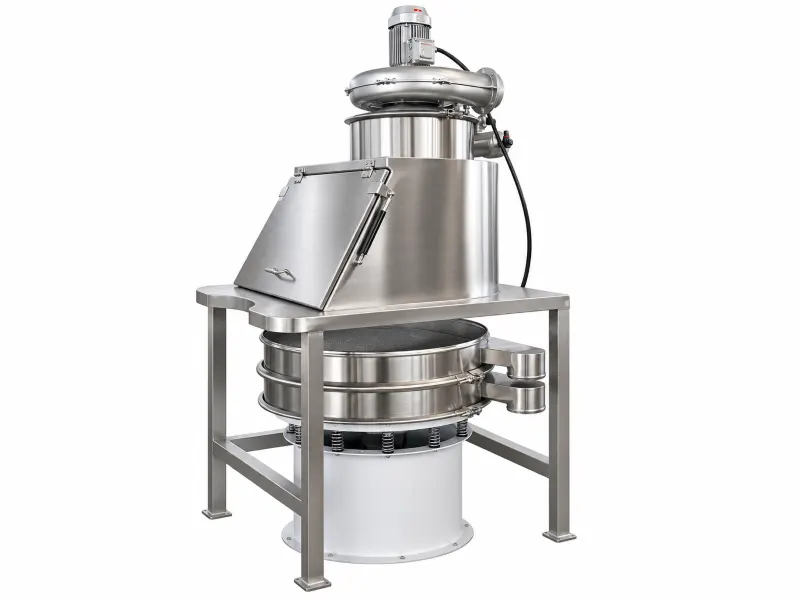
Lines that screen, weigh, or convey powder. Specify the downstream connection dimensions, required screen mesh, conveying distance, and available installation height. A dust-free bag dump station can discharge into a sifter, a weighing and batching system, or a pneumatic conveyor. On a bag dump station with a sifter, the time it takes to empty one bag matters. Several seconds of fast pouring can put more powder on the mesh than the screen can clear, even when the hourly production target looks modest.
For one flour plant, the customer needed to remove lumps and handle about 1,000 kg/h. Yuanjing Machinery paired a dust-free bag dump station with a 40-mesh inline sifter. Screened flour dropped directly into the enclosed line of a transportador a vácuo ZKS. The flour screening and vacuum conveying case study shows how the three machines connected.
Small batches and shared workstations. If the station will move between lines, measure the narrowest aisle and the lowest doorway along its route. At each operating position, check where the unit will be secured, how the outlet will connect, and whether there is room to pull out a full-length filter cartridge. Use those dimensions when discussing a mobile base, casters, and leveling feet with the manufacturer.

What to check before the first bag of each shift
For a dust-free bag dump station, a typical maintenance schedule starts with a pre-shift inspection, followed by cleaning at the end of the shift and a monthly component check. Use the equipment manual and the buildup you see on site to set the interval. A station running several shifts or handling a powder that readily absorbs moisture may need attention sooner.
| Inspection point | Pre-shift check |
|---|---|
| Loading door and gasket | Look for cracks, hardening, or a section of gasket that has slipped out of its groove. Powder trapped on the clamping face can also keep the door from closing evenly. Correct either problem before loading. |
| Control panel and extraction fan | Inspect the buttons, indicator lights, and visible external wiring. Follow the specified startup sequence, then listen for a change in fan noise and watch for unusual vibration. |
| Compressed-air lines | On units with pulse-jet filter cleaning, check hoses and fittings for leaks. Read the supply pressure and compare it with the range in the manual for that unit. |
| Safety grate | Look for pieces of packaging, bag stitching, and hard lumps left from the previous shift. Loose debris can fall through to the hopper or enter the downstream equipment. |
| Hopper and discharge connection | Check that the previous batch has been cleared, the outlet is open, and the receiving sifter or conveyor is ready for material. |
Make visual and operating checks from the normal operating position. Before reaching into the hopper, removing a guard, or opening the filter housing, follow the site’s isolation procedure. Shut down the station, isolate electrical and pneumatic supplies and connected equipment, release stored energy, and verify that the equipment cannot restart unexpectedly.
How to clean a dust-free bag dump station after each shift
Follow the specified filter-cleaning and shutdown sequence. Once the equipment is isolated for cleaning, clear the chamber and hopper. The front wall is easy to see. The underside of the grate, the hopper corners, and the area just above the outlet need a closer look. Flour left in any of these spots can pick up moisture and harden before the next shift.
At a product changeover, clean all product-contact surfaces according to the material and facility requirements. Where dry cleaning is permitted, use a vacuum suitable for the powder or a lint-free cloth. A hygienic chamber designed for wet cleaning can be washed according to the approved procedure. Let it dry fully before loading fresh powder. The control panel, fan motor, and cartridges each have their own cleaning requirements. Wash a filter cartridge only if the manufacturer identifies it as washable.
In the handover log, note whether the pulse-jet system operated and whether extraction improved afterward. “No pulse during cleaning” and “pulse operated, extraction still weak” give the next shift different places to start. Close the loading door once cleaning is complete to keep the chamber dry.
Monthly maintenance checks
Filter cartridges. Inspect the media for heavy deposits, damp patches, and damage. If the cartridge has a membrane coating, check its condition too. Make sure the cartridge sits fully in its mounting and the end seal is intact. Remove deposits using the manufacturer’s approved method. Replace torn media or a failed seal.
Fan and bearings. A change in fan noise or vibration is worth recording while the unit is running. After shutdown and isolation, inspect the fan base and mounting bolts. For bearings that require grease, use the grade, amount, and interval specified in the manual. If a connected conveyor has a gearbox, check its lubrication against its own service instructions.
Hopper vibrator or agitator. Inspect mounting bolts, brackets, and connections for looseness. If the vibrator runs but the hopper takes longer to empty, look inside after isolation. Damp powder, a coating on the walls, or a partial blockage at the outlet can all slow discharge while the vibrator continues to operate.
Chamber, flanges, and gaskets. Check fasteners on the chamber, support frame, flanges, and downstream connections. Correct loose joints according to the equipment instructions. When a gasket starts to harden, crack, or lose its shape, record its specifications. That saves someone from having to measure it during a breakdown.
Troubleshooting dust leakage and uneven hopper discharge
On a dust-free bag dump station, the location of a powder deposit tells you where to begin. Dust that rises as an operator tips a bag points first to bag position, pouring speed, or extraction. A recurring line of powder along a closed flange calls for a close look at that joint.
| What you see | Possible causes | Where to start |
|---|---|---|
| Dust drifts out of the loading opening as a bag is tipped. | The bag opening is outside the capture zone, the operator is pouring too quickly, the cartridges are clogged, or extraction airflow is low. | Watch the position of the bag opening and the speed of the pour. Then check the fan, pulse-cleaning cycle, and cartridges. |
| Powder escapes from the same closed door seam or flange. | A gasket has worn or moved out of its groove. Powder may be trapped on the sealing face, or a clamp may have loosened. | After isolation, clean the mating surfaces. Inspect the gasket and clamp at the point where the powder appears. |
| Flow speeds up and slows down while material accumulates in the hopper. | Damp lumps, wall buildup, or a bridge over the outlet may restrict flow. The downstream machine may also be backing up. | Find the first point of accumulation, then inspect the outlet and receiving sifter or conveyor. |
| The filters stay heavily coated and extraction remains weak after cleaning. | Supply pressure is outside the specified range, an air hose leaks, a pulse valve is faulty, or the filter media is clogged. | Check the air supply and observe the cleaning cycle. Follow the cartridge instructions to determine whether replacement is due. |
| The fan or vibrator develops an unusual noise. | Possible causes include a loose fastener, a shifted support, or bearing deterioration. | Stop and isolate the equipment. Inspect the mountings and bearings, and correct the fault before restarting. |
A useful maintenance entry includes the material, shift, time of the fault, response to filter cleaning, and dates of any part replacements. If a moisture-sensitive powder repeatedly blocks the hopper, write down where the deposit starts and how many bags have been emptied by then. That gives the team something to work with when deciding whether to shorten the cleaning interval or review the hopper geometry.
Before you specify a station
Ask the manufacturer to show you how an operator removes a filter cartridge, reaches the back of the grate, and replaces a door gasket. If your powder has a history of bridging, use the material trial to see whether it clears the proposed outlet after several bags. These checks are easier to make before the station is built into the line.
If you are choosing a dust-free bag dump station or tracking down a recurring leak, contact Yuanjing Machinery with the material name, weight per bag, hourly loading requirement, downstream equipment, and available space. For an existing installation, include photos of the loading opening, hopper outlet, and station in its operating position. A close-up of the spot where powder first appears is particularly helpful.
Perguntas Frequentes
Can a dust-free bag dump station handle every type of powder?
A standard hopper generally suits free-flowing dry powders and granules. For sticky, oily, or moisture-sensitive materials, review the filter media, hopper geometry, and discharge method with the manufacturer. Empty several bags during the trial so you can see whether powder gradually coats the walls or forms a bridge above the outlet.
How often should the filter cartridges be replaced?
The interval depends on dust loading, material moisture, operating hours, and how well pulse cleaning clears the media. If differential pressure across the filter stays high and extraction weakens even though the cleaning cycle operates normally, arrange an inspection. Replace damaged media according to the manufacturer’s instructions. Pressure readings taken while handling the same powder, together with past replacement dates, help you plan when to have spares on hand.
Does a dust-free bag dump station need compressed air?
Models with pulse-jet cleaning usually need an external compressed-air supply. A model that shakes the filters mechanically may have different utility requirements. Before ordering, ask for the required supply pressure, air consumption, and connection size, then compare those figures with the air available at the workstation.
Why does dust escape during pouring if the door gasket is intact?
Watch what happens as the operator turns the bag over. If dust rolls out of the open loading area, check that the bag opening stays within the extraction zone and observe the pouring speed. Next, check the fan and cartridges. If the powder appears along a closed seam, inspect the gasket face and the clamp at that location.
Where should operators check for residue during a food powder changeover?
Look under the safety grate, in hopper corners and gasket grooves, and around the discharge connection. On units where pulse cleaning drops collected powder back into the hopper, include powder retained on the cartridges in the changeover procedure. Complete the site’s cleaning checks before releasing the station for the next batch.
Can a dust-free bag dump station be fitted with a mobile base?
Discuss casters, leveling feet, rail wheels, or a mobile chassis with the manufacturer. Describe the route the station will travel, the condition of the floor, and how operators will secure it at each stop. Include the locations of the electrical supply, compressed-air connection, and downstream inlet so the proposed base fits the workstations as well as the route between them.