So wählen Sie einen explosionsgeschützten Vakuumförderer: Ein vollständiger Kaufratgeber
Der Umgang mit brennbaren Pulvern erfordert mehr Sorgfalt als der gewöhnliche Materialtransport. In Chemieanlagen, Lithiumbatteriefabriken und der pharmazeutischen Produktion können Staubablagerungen und statische Elektrizität erhebliche Sicherheitsrisiken verursachen.
Materialien wie Aluminiumpulver, Industrieruß, bestimmte Lithiumbatteriematerialien und chemische Pigmente können bei der Handhabung brennbaren Staub erzeugen. Trifft dieser Staub auf eine Zündquelle, kann es zu einer Explosion kommen.
Ein Explosionsgeschützter Vakuumförderer trägt dazu bei, diese Risiken zu verringern, indem Pulver unter Unterdruck durch geschlossene Rohrleitungen transportiert wird. Dadurch wird die Staubfreisetzung begrenzt, der manuelle Umgang reduziert und es stehen Sicherheitsfunktionen für Gefahrstoffe zur Verfügung.
Doch nicht jede als “explosionsgeschützt” bezeichnete Maschine eignet sich für Ihren Betrieb. Bauweisen, Komponenten und Schutzniveaus können stark variieren.
Prüfen Sie vor dem Kauf, ob der Hersteller des Vakuumförderers Ihr Material und Ihre Arbeitsbedingungen versteht. Die richtige Anlage sollte zu den Eigenschaften Ihres Pulvers, den Anforderungen des explosionsgefährdeten Bereichs und Ihrer Produktionskapazität passen – statt einfach nur den höchsten Preis oder die meisten Sicherheitsfunktionen aufzuweisen.
Was ist ein explosionsgeschützter Vakuumförderer?
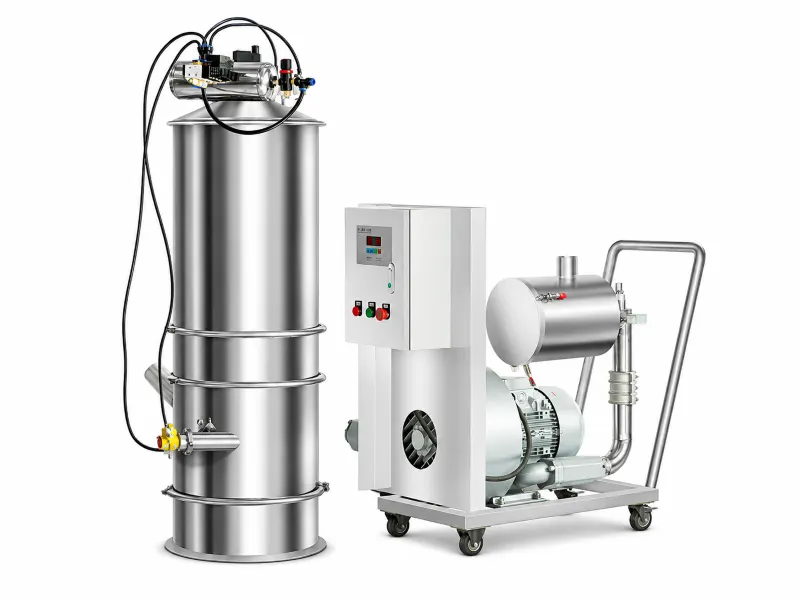
Ein explosionsgeschützter Vakuumförderer ist ein geschlossenes Pulverfördersystem für Anwendungen, bei denen brennbarer Staub oder explosionsfähige Atmosphären auftreten können.
Er erzeugt mithilfe einer Vakuumpumpe oder Druckluft einen Unterdruck. Das Pulver wird durch eine geschlossene Rohrleitung in einen Aufnahmebehälter transportiert und anschließend an den nächsten Prozess übergeben.
Dadurch gelangt weniger Staub in den Arbeitsbereich und der manuelle Pulvertransport wird reduziert. Mehr über das grundlegende Funktionsprinzip erfahren Sie auf unserer Vakuum-Förderband-Zuführsystem page.
Allerdings, ist ein geschlossenes System nicht automatisch explosionsgeschützt.
Wenn sich Pulver durch Rohrleitungen bewegt, kann durch Reibung statische Elektrizität entstehen. Wenn sich elektrische Ladungen ansammeln und entladen, können sie brennbaren Staub entzünden.
Standard-Vakuumförderer verfügen möglicherweise nicht über geeignete Motoren, Schläuche, Filter oder elektrische Komponenten für explosionsgefährdete Bereiche. Ein explosionsgeschütztes System benötigt geeignete elektrische Schutzmaßnahmen, Erdung, Abdichtung und weitere Sicherheitsvorkehrungen.
Bei der Auswahl muss das gesamte Fördersystem berücksichtigt werden – nicht nur der Motor.
Materialeigenschaften und Anforderungen an den Explosionsschutz prüfen
Vor der Auswahl eines explosionsgeschützten Vakuumförderers müssen zwei Fragen eindeutig beantwortet werden: Welches Material fördern Sie, und wo wird die Anlage betrieben?
Das Explosionsrisiko Ihres Pulvers verstehen
Zu den gängigen Materialien, die besondere Schutzmaßnahmen erfordern können, gehören:
- Lithiumbatteriematerialien: Bestimmte Batterierohstoffe und brennbare Metallpulver.
- Chemische Pulver: Industrieruß, einige Pigmente, Farbstoffe und organische Chemikalien.
- Metallpulver: Aluminiumpulver und andere brennbare Metallpulver.
- Lebensmittel- und Pharmapulver: Bestimmte Stärken, Zuckerpulver und organische Inhaltsstoffe.
Selbst dasselbe Material kann je nach Partikelgröße, Feuchtigkeit und Zusammensetzung unterschiedliche Explosionseigenschaften aufweisen.
Stellen Sie dem Lieferanten ein Sicherheitsdatenblatt (SDB) und verfügbare Prüfdaten zur Staubexplosion zur Verfügung. Wichtige Werte sind die Mindestexplosionskonzentration, die Mindestzündenergie und die Stärke der Staubexplosion.
Auch andere Eigenschaften sind wichtig. Klebrige oder feuchte Pulver können andere Filter und Rohrleitungsausführungen erfordern, während abrasive Materialien verschleißfestere Komponenten benötigen.
Stimmen Sie die Ausrüstung auf den explosionsgefährdeten Bereich ab
Die Einteilung der explosionsgefährdeten Bereiche in Ihrem Betrieb bestimmt, welche Explosionsschutzmaßnahmen erforderlich sind.
Prüfen Sie die Explosionsschutzkennzeichnung, die Zertifizierung und die vorgesehenen Betriebsbedingungen der Ausrüstung. Wenn Ihr Projekt ATEX-konforme Ausrüstung erfordert, müssen die betreffenden Komponenten und die Systemauslegung die geltenden Anforderungen erfüllen.
Denken Sie daran, dass sich auch innerhalb der Förderleitungen oder des Aufgabebehälters eine explosionsfähige Staubatmosphäre bilden kann.
Die höchste Schutzstufe ist nicht immer erforderlich. Die richtige Lösung hängt vom Material, dem Aufstellungsbereich und der Risikobeurteilung ab. Wesentliche Sicherheitsmerkmale dürfen niemals allein zur Senkung des Preises entfernt werden.
Pneumatische und elektrische explosionsgeschützte Vakuumförderer im Vergleich
Zwei gängige Optionen sind pneumatische Vakuumförderer und elektrische Systeme mit explosionsgeschützten Motoren.
Beide können für geeignete Anwendungen eingesetzt werden, unterscheiden sich jedoch hinsichtlich ihrer Energieversorgung und Betriebsanforderungen.
Pneumatischer Vakuumförderer
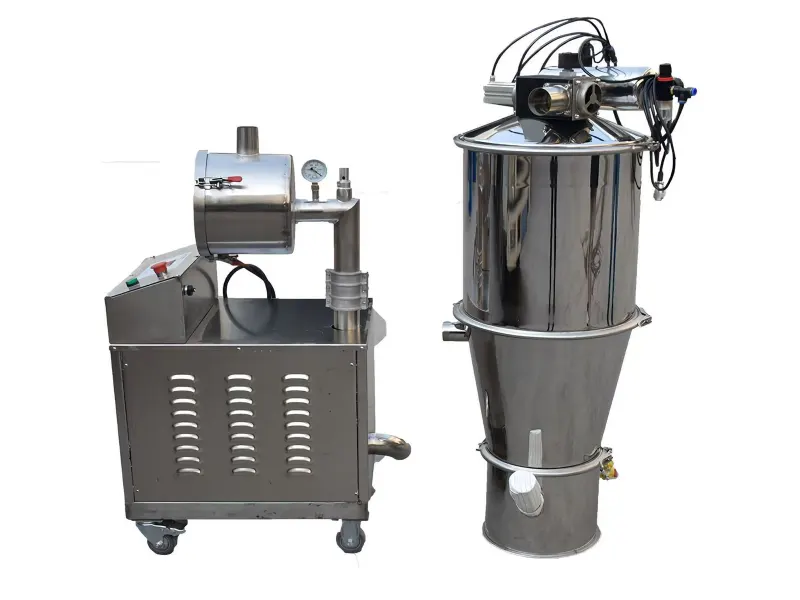
Ein pneumatischer Vakuumförderer nutzt Druckluft und einen Vakuumerzeuger, um Saugkraft zu erzeugen.
Der Vakuumerzeuger besitzt keinen elektrischen Antriebsmotor, sodass dieser Motor als mögliche elektrische Zündquelle entfällt. Dies kann in Betrieben mit strengen Beschränkungen für elektrische Betriebsmittel oder in Fabriken mit bereits vorhandener stabiler Druckluftversorgung von Vorteil sein.
Unsere pneumatic vacuum feeding conveyor Die Seite erklärt, wie diese Art von Ausrüstung funktioniert.
Pneumatische Ausrüstung ist jedoch nicht vollständig frei von Explosionsrisiken. Statische Elektrizität, Staubablagerungen, mechanische Reibung und andere mögliche Zündquellen müssen weiterhin berücksichtigt werden.
Der Druckluftverbrauch wirkt sich ebenfalls auf die Betriebskosten aus. Stellen Sie sicher, dass Ihr Kompressor genügend Druck und Luftvolumenstrom für die erforderliche Förderleistung bereitstellen kann.
Elektrischer explosionsgeschützter Vakuumförderer
Ein elektrisches System nutzt eine motorbetriebene Vakuumpumpe, um Unterdruck zu erzeugen.
Es kann für unterschiedliche Förderstrecken, Förderleistungen und Betriebszeiten ausgelegt werden. Bei längeren Förderstrecken oder häufigem Betrieb kann ein elektrisches System eine geeignete Wahl sein.
Der Motor ist nicht die einzige Komponente, die geschützt werden muss. Auch Vakuumpumpen, Schaltschränke, Sensoren und andere elektrische Bauteile, die in explosionsgefährdeten Bereichen installiert sind, müssen die geltenden Anforderungen erfüllen.
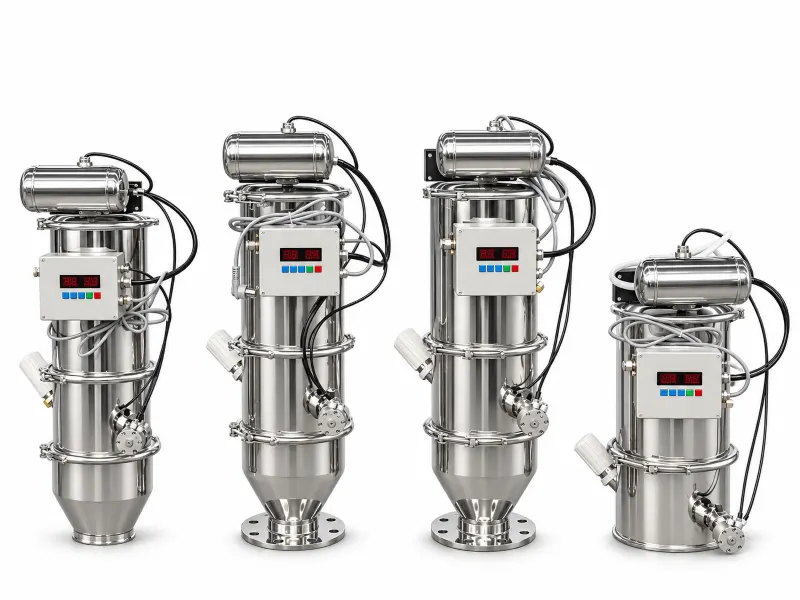
Which Type Should You Choose?
| Position | Pneumatic Type | Electric Type |
|---|---|---|
| Power source | Compressed air | Electric vacuum pump |
| Main feature | No drive motor in the vacuum generator | Motor-driven vacuum generation |
| Site requirements | Stable compressed air supply | Suitable electrical supply |
| Kapazität | Depends on air supply and vacuum generator | Depends on pump and system design |
| Main considerations | Air consumption, pressure, safety | Electrical protection, capacity, energy use |
Neither option is always better.
A Hersteller des Vakuumförderers should consider your material, hazardous area, conveying distance, and available utilities before recommending a system.
Key Features to Check Before Buying
The performance and safety of an explosion-proof vacuum conveyor depend on more than its vacuum source. Pay attention to the following components.
Explosion-Proof Electrical Components
For an electric system, check the motor, vacuum pump, control panel, and sensors.
Ask the supplier whether these components are suitable for your hazardous area and whether the required certificates and technical documents are available.
A certified explosion-proof motor does not automatically make the entire conveyor suitable for hazardous environments.
Equipment Materials and Sealing
Material-contact parts are commonly made from 304 or 316L stainless steel.
304 stainless steel works for many general powder applications. For more corrosive materials or stricter cleanliness requirements, 316L may be a better option.
Sealing is equally important. Poorly sealed joints, discharge valves, and pipe connections may allow dust to escape.
For food, pharmaceutical, or multi-product production lines, choose equipment that is easy to open and clean to reduce material residue and cross-contamination.
Anti-Static Pipes and Hoses
Powder moving through pipelines can generate static electricity.
Use suitable conductive or anti-static pipes and flexible hoses based on the material. Metal hoppers, pipelines, and other conductive components should be properly bonded and grounded.
Pipe layout also matters. Too many bends or sudden diameter changes can increase conveying resistance, wear, and powder buildup.
Filters and Pulse-Jet Cleaning
Filters separate powder from the conveying air and help prevent material from entering the vacuum source.
For combustible powders, suitable anti-static or conductive filters may be required.
As powder builds up on the filter surface, suction can decrease and conveying cycles may become longer.
Many systems use pulse-jet filter cleaning to remove collected powder and maintain airflow. The cleaning method and gas supply must also be suitable for the material being handled.
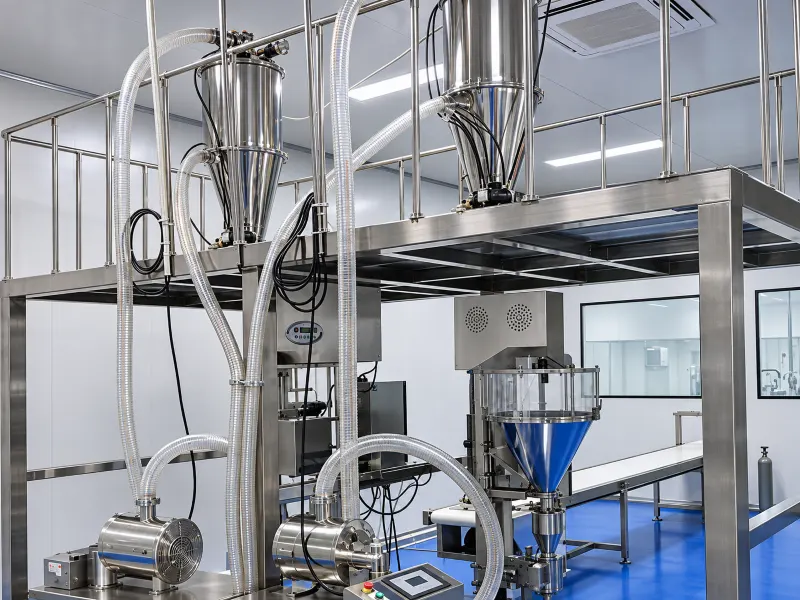
Conveying Performance and Production Line Integration
Even a well-protected explosion-proof vacuum conveyor must deliver the required capacity without frequent blockages.
Material Properties and Conveying Capacity
Particle size, bulk density, moisture, stickiness, and flowability all affect conveying performance.
Dry, free-flowing powders are often easier to handle. Moist or sticky materials may need different suction settings, pipelines, or discharge designs.
The same conveyor can achieve different capacities when handling different powders.
For difficult materials, a conveying test before purchase can help confirm performance.
Conveying Distance and Lifting Height
When requesting a quotation, provide the horizontal conveying distance, vertical lifting height, number of bends, and required capacity in kg/h or t/h.
Longer routes and higher lifts increase resistance, so the vacuum source and pipe diameter must match the actual layout.
For batch conveying systems, remember that suction and discharge take place in separate parts of the cycle. Both affect the average hourly capacity.
Connecting with Other Equipment
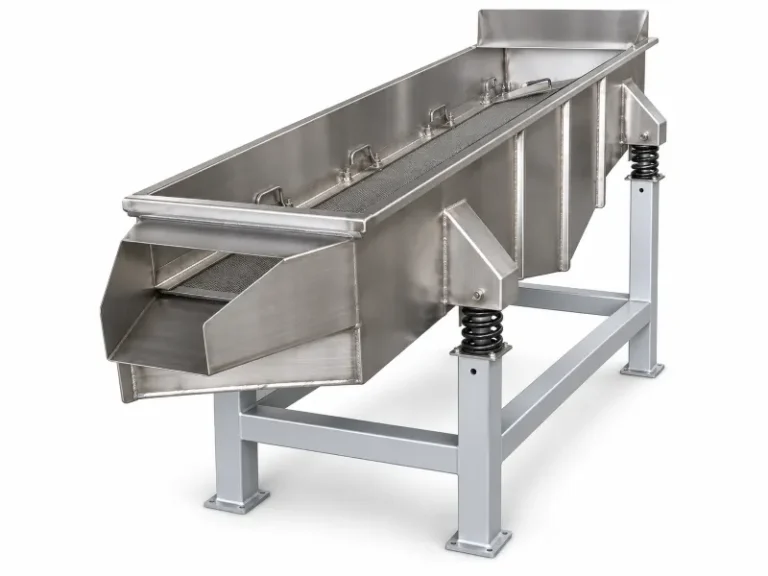
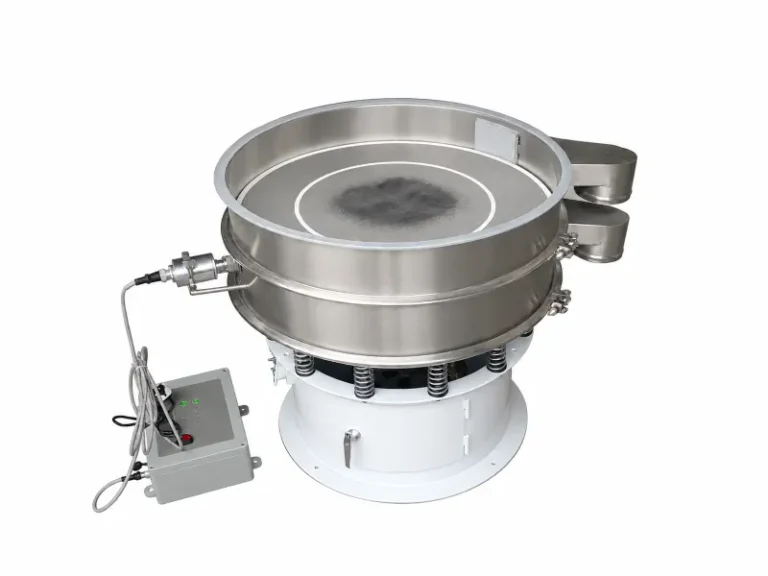
Vacuum conveyors often work with bag dump stations, bulk bag unloaders, vibrating screens, storage hoppers, and mixers.
For example, a staubfreie Sackentleerungsstation can feed powder into a closed conveying line, reducing manual handling and dust around the loading area.
If your process also requires screening, see our guide to connecting a vacuum conveyor and vibro sifter.
The entire production line needs to be assessed for dust hazards, not just the conveyor.
A Hersteller des Vakuumförderers with system design experience can help plan the pipe route, equipment connections, and maintenance space while reducing areas where powder may collect.
How to Choose a Vacuum Conveyor Manufacturer
Explosion-proof equipment often costs more than standard powder feeders. But two machines that look similar may have very different safety components and performance.
Check Certifications
Some equipment sold as explosion-proof may only be a standard conveyor with a few modified parts.
Ask the Hersteller des Vakuumförderers for the relevant certificates, technical drawings, and component list.
Check the equipment model, explosion protection marking, certification scope, and applicable conditions. Where possible, verify the documents through the issuing organization’s official records.
For projects that require safety inspection or approval, confirm the necessary documents before placing an order.
Compare Equipment Configurations
Do not compare quotations based on price alone.
Check the motor, electrical controls, stainless steel grade, filters, sealing parts, and safety features.
Once the equipment meets your safety and production requirements, compare its purchase price, energy consumption, maintenance needs, and spare parts costs.
Check After-Sales Support
Filters may become blocked, seals can wear out, and pipes may eventually need replacement.
Before buying, ask about installation guidance, commissioning, warranty, spare parts, and technical support.
Components that affect explosion protection should not be replaced with ordinary parts without a proper technical assessment.
Information Needed for Equipment Selection
To receive an accurate recommendation, provide the Hersteller des Vakuumförderers with the following information:
| Informationen | What to Provide |
|---|---|
| Material | Name, particle size, bulk density, moisture, flowability, and explosion properties |
| Hazardous area | Area classification, applicable standards, and available test data |
| Conveying route | Horizontal distance, vertical lift, and number of bends |
| Kapazität | Required kg/h or t/h and operating cycle |
| Site conditions | Electrical supply, compressed air, and installation space |
| Equipment connections | Feeding point and receiving equipment |
| Special requirements | Material grade, cleaning, automation, and custom features |
These details help the engineering team choose the right vacuum source, filters, pipelines, and protection measures.
For complex factory layouts, a site review may also help before the final design is confirmed.
Fazit
Die Wahl der richtigen Explosionsgeschützter Vakuumförderer starts with understanding your powder, hazardous area, and conveying requirements. The equipment should be safe, reliable, and easy to maintain.
Looking for a reliable Hersteller des Vakuumförderers? Contact Yuanjing Machinery and share your material, conveying distance, required capacity, and explosion-proof requirements.
Our team can help you choose a suitable powder conveying solution for your production line.
FAQ
Q1: Is a Pneumatic Vacuum Conveyor Safer Than an Electric Model?
Not always. A pneumatic vacuum generator has no electric drive motor, but static electricity, mechanical friction, and dust buildup can still create risks.
An electric system can also be suitable when correctly designed and protected. Safety depends on the complete system, not just the power source.
Q2: Can I Convert a Standard Vacuum Conveyor into an Explosion-Proof Model?
Replacing the motor alone is not enough.
Electrical components, filters, hoses, static control, and other parts may also need changes. A qualified specialist should assess the equipment and confirm the required protection before it is used in a hazardous area.
Q3: Can a Closed Vacuum Conveyor Prevent All Dust Leakage?
Closed vacuum conveying greatly reduces dust release, but zero leakage cannot be guaranteed under every condition.
Sealing, filter performance, feeding methods, and maintenance all affect dust control. For cleaner operation, the system can be combined with a dust-free feeding station and suitable dust collection equipment.
Q4: Does an Explosion-Proof Certificate Guarantee That the Machine Will Pass a Safety Inspection?
No. A certificate covers only the equipment or components within its stated scope.
The complete installation must also meet the relevant requirements for hazardous area classification, electrical protection, grounding, and other safety measures.
Q5: Can an Explosion-Proof Vacuum Conveyor Handle Aluminum Powder, Carbon Black, or Lithium Battery Materials?
A system can be designed for certain grades of these materials, but not every model is suitable.
Aluminum powder and some battery materials can present serious dust explosion risks. The supplier should review the material properties, static control requirements, conveying distance, and capacity.
Additional safety assessments or conveying tests may be needed.
Q6: How Often Should the Filter Be Replaced?
There is no fixed replacement schedule.
Filter life depends on the powder, dust load, operating hours, and cleaning performance. If suction remains weak after cleaning, inspect the filter for blockage or damage.
Use replacement filters that meet the original filtration and anti-static requirements.