Getting test sieve selection by material right: Flour, metal powders and soil
More flour left on a sieve does not always mean a coarser batch. Moisture can turn fine particles into lumps. Metal powder may pass slowly because the apertures are blocked, while soil and coal samples bring different concerns: particle shape, sieve strength and whether the test portion represents the batch.
The starting point for test sieve selection by material is the result you need—not the finest mesh available. Choose the apertures and screening medium for that measurement, check the contact materials, then confirm that the sieves fit the shaker and the intended procedure.
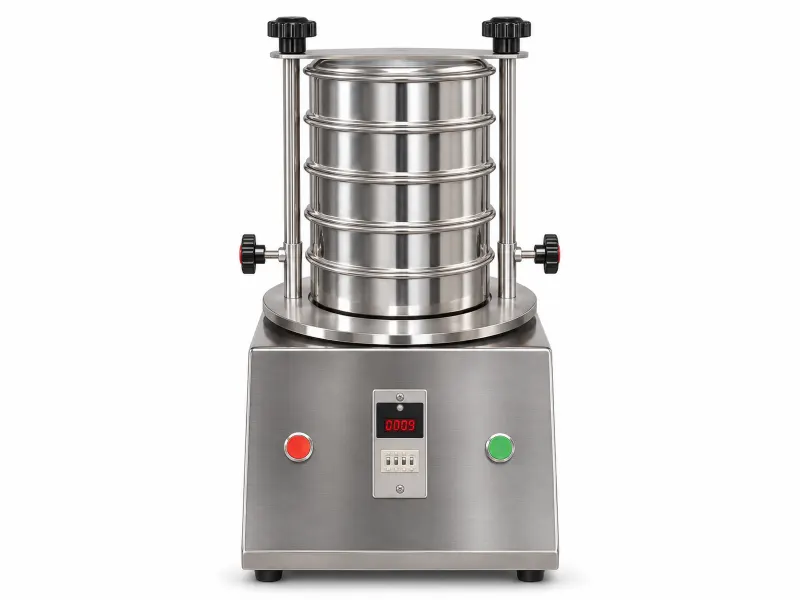
Where to start
- Flour and powdered sugar: Woven wire mesh is a common option. Check moisture, lumps and cleaning requirements.
- Metal powders and pigments: Look at contact materials and aperture blinding before adding assisted sieving.
- Soil, aggregate and coal: Follow the specified aperture sequence. Perforated plate sieves may suit the coarse fractions.
- Zirconia and phosphor powders: Establish any restrictions on metal contact before considering nylon mesh.
What does the test need to tell you?
A test sieve separates a sample through openings of defined dimensions. With a stack of sieves, you can weigh the material retained at each level and calculate the particle size distribution.
That does not mean every test needs a full stack.
| Testing objective | Question to answer | What this means for the sieve setup |
|---|---|---|
| Oversize residue inspection | How much material exceeds the specified size? | Select the aperture required for that limit |
| Partikelgrößenverteilung | What proportion falls within each size fraction? | Use the aperture sequence specified by the method |
| Batch consistency checks | Has the particle size distribution changed? | Keep the sieves and operating conditions consistent |
| Production screening assessment | How much feed falls within the target fraction? | Use the laboratory results alongside production trials |
The sieve and the shaker do different jobs. The sieve establishes the aperture; the shaker moves the sample across it. Both need to suit the test method.
Comparing four screening media for test sieve selection by material
Woven wire mesh for flour, sugar and routine powder analysis
Woven wire mesh uses interlaced metal wires, usually forming square openings. Plain and twill weaves are both used.
Some product series offer apertures of 0.02–2.36 mm, or 20–2360 μm. This is a product-series range, not the full range of woven wire test sieves. ISO 3310-1:2016 covers nominal apertures from 125 mm down to 20 μm. www.iso.org
Applications include flour, powdered sugar, metal powders, catalysts, pigments and fillers. Corrosion resistance and temperature limits depend on the metal grade and how the sieve is assembled.
Before using a sieve, check:
- The aperture against the test requirement.
- Whether the wire material is acceptable for sample contact.
- Any blocked openings.
- Loose, distorted or damaged mesh.
A frame can look perfectly serviceable while the mesh has a small tear. For fine powder testing, that tear is enough to affect separation.
If you test spices, use these ground pepper mesh size ranges as a starting point, then match the sieve openings to your product specification.
Perforated plate sieves for coarse particles
Perforated plate sieves have openings formed in metal sheet. Round and square holes are common. The plate construction generally provides good rigidity and impact resistance.
General perforated plate manufacturing can cover openings from 0.2 mm to several hundred millimetres. Coarse-particle selection references may also list 2–100 mm. Neither figure is a universal specification for standardized test sieves.
For a laboratory test, use the aperture and hole shape required by the method and supported by the actual sieve specification.
These sieves may suit some fractions of soil, aggregate, coal and granular materials associated with asphalt mixture testing.
Keep the hole shape consistent. An irregular particle can pass through a round opening differently from a square opening of the same nominal size. Changing the hole shape between tests can therefore affect the comparison.
Electroformed sieves for closely controlled apertures
Electroformed sieves are made using an electrochemical process. They can be considered for fine powder testing where close control of aperture dimensions is required.
“High precision” is not enough information for an order. Ask what dimension is controlled and how it has been checked.
| Position | What to establish |
|---|---|
| Nominal aperture | The opening size required by the test |
| Öffnungstoleranz | Permitted variation and the inspection basis |
| Screening surface | Support arrangement and operating limits |
| Inspection records | Relevant inspection or conformity documentation |
| Reinigung | Permitted brushing, ultrasonic cleaning or other procedures |
Aperture manufacturing precision is not the measurement accuracy of the complete test. Sampling, agglomeration, loading and operating conditions still affect the result.
Electroformed surfaces also need careful handling. Scraping, impact or an unsuitable cleaning procedure can damage them, so include maintenance requirements when comparing options.
Nylon mesh where metal contact is restricted
Nylon mesh may be an option for zirconia, phosphor powders and certain specialty chemical additives when the process requires reduced metal contact.
Some products are listed as 10–500 mesh. Confirm the actual aperture dimensions and inspection requirements rather than ordering by mesh count alone.
Specify the frame and mesh separately. PVC may be used for a frame; nylon may be used for the mesh. They are different materials, with different properties.
Do not assume that a nonmetallic sieve is antistatic. For powders that charge or cling to surfaces, check the material specification, static-control measures and screening behaviour.
The availability of nylon mesh and plastic frames—and their compatibility with the intended shaker—also needs confirmation.

What changes with the sample?
Flour, powdered sugar and pharmaceutical powders
When more flour or sugar stays on a sieve, check its condition before concluding that the batch is coarser. Moisture, lumps, blocked openings and an overly thick powder bed can all change the result.
For batch comparisons, keep the following consistent:
- Sampling and sample splitting.
- Pretreatment and moisture condition.
- Test portion mass.
- Aperture sequence.
- Sieving duration and shaker settings.
Food and pharmaceutical work also requires attention to contact components, surface finish, cleaning and cross-contamination.
304 stainless steel is a common choice, but the grade alone does not establish whether the complete assembly is suitable. Seals and other contact components still matter.
For pharmaceutical powders, sieve analysis measures particle size characteristics. It does not replace composition or content-uniformity testing.
Removing lumps from flour on a production line is a different task from measuring its particle size distribution. Our flour screening and vacuum conveying case shows a production arrangement for removing lumps and large impurities before transferring flour to the next process.
Metal powders, catalysts, pigments and fillers
Powder remaining on a screen may be oversized. It may also be agglomerated or sitting over blocked apertures.
Before changing the sieve, inspect the mesh and sample:
- Are particles lodged in the openings?
- Is the powder bed too thick?
- Are there visible agglomerates?
- Does the procedure match the test method?
Where the method allows it, changes to loading or operating conditions may help.If particles repeatedly lodge in the same openings, an ultrasonic test sieve for fine powders can help you check how much the blockage affects the retained mass.
Record any assistance that changes the agglomeration state. A result obtained after dispersion should not automatically be compared with one obtained from an untreated sample.
For the production-side applications, see our guide to ultrasonic screening of fine powders prone to blinding. It discusses adhesion, agglomeration and screening difficulties in chemical, food and metal powders; laboratory use still needs to follow the applicable test method.
Soil, aggregate and coal
Perforated plate sieves may suit some coarse fractions. Choose the screening medium for finer fractions according to the test method.
Sampling deserves as much attention as the sieve. If the test portion does not represent the batch, accurately manufactured apertures will not correct the problem.
For soil and sediment, check the required pretreatment and the treatment of agglomerates. Whether to use wet sieving depends on what the test is intended to measure and the prescribed procedure.
Zirconia, phosphor powders and specialty additives
A restriction on metal contact should apply to all relevant surfaces, not just the mesh. Check the frame, receiving pan, seals and any fittings that can touch the sample.
Replacing the mesh alone may leave other unsuitable contact surfaces in place.
Cement, minerals and filter media
Other applications include cement fineness-related tests, concrete aggregate grading, mineral particle size analysis and filter media grading.
Preparation, aperture sequences and calculations differ between methods. In these applications, test sieve selection by material needs to follow the measurement procedure rather than a generic equipment list.
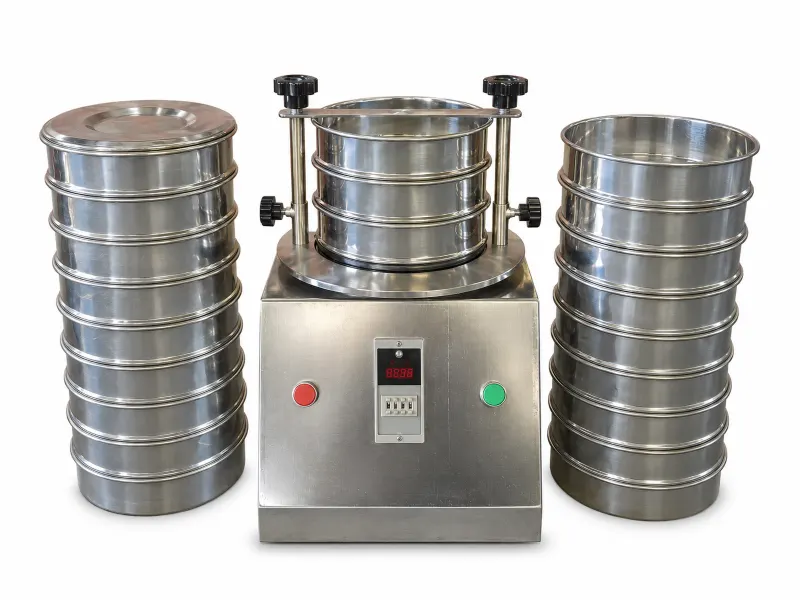
Specifying aperture, mesh count and frame size
Order by aperture where possible
A higher mesh count generally means a finer mesh, but it does not fully define the opening.
For example, 10 mesh describes a relatively coarse mesh and 400 mesh a finer one. The actual aperture also depends on wire diameter and the specification system.
For purchasing and test records, use:
Nominal aperture in mm or μm + applicable standard + sieve identification.
This makes it easier to compare quotations, check delivered sieves and trace test results.
Check the frame dimensions against the shaker
Laboratory frame sizes include Φ75 mm, Φ100 mm and Φ200 mm. Φ200 mm is a common laboratory format.
Some sieve series use full-height frames of approximately 50–60 mm and half-height frames of approximately 25–30 mm. Dimensions and height definitions vary between series.
Yuanjing’s laboratory product page lists 200×50, 300×60 and 400×75 mm size combinations. Confirm what those dimensions refer to, how many sieves the chosen model accepts and how the stack is clamped. General laboratory sizes are not necessarily available configurations for every machine. Yuan Jing
| Faktor | What it affects |
|---|---|
| Test portion mass and bulk density | Powder bed depth and screening area needed |
| Frame diameter | Available area and shaker compatibility |
| Frame height | Room for sample movement and total stack height |
| Number of fractions | Aperture sequence and stack configuration |
| Clamping range | Whether the shaker can secure the stack |
Half-height frames reduce stack height, but they do not remove the shaker’s load and height limits.
Before ordering, finish the test sieve selection by material check with the actual shaker dimensions. A suitable mesh is of little use if its frame cannot be secured correctly.
Once you know the required frame diameter and stack height, see how to choose a lab sieve shaker that fits your sieve stack and sample volume.
Choosing the contact materials
The frame and screening surface may use different materials. Specify both instead of describing the whole assembly simply as “stainless steel.”
| Material | Applications to assess | What to check |
|---|---|---|
| Edelstahl 304 | Routine powders, food ingredients and some pharmaceutical samples | Contact components, finish and cleanability |
| 316 or 316L stainless steel | Some more demanding corrosion conditions | Medium, concentration, temperature and cleaning conditions |
| Copper mesh or brass components | Methods with specific contact-material requirements | Permitted copper contact and contamination concerns |
| Nylon mesh with a plastic frame | Some nonmetallic-contact applications | Temperature, chemical compatibility, deformation and static |
| Specialty alloy mesh | Conditions unsuitable for standard materials | Compatibility with the actual sample |
“Corrosive powder” is not enough detail to select 316 stainless steel. The chemical environment and operating conditions determine whether it is suitable.
Dry sieving, wet sieving or ultrasonic assistance?
Use the procedure required by the test method, then check how it applies to the sample.
| Methode | When it may be considered | Conditions to control |
|---|---|---|
| Dry sieving | Relatively dry, free-flowing powders and granules | Moisture, static, loading and blinding |
| Wet sieving | Methods permitting liquid-assisted dispersion | Liquid compatibility, dissolution or reaction, and fines recovery |
| Ultrasonic-assisted sieving | Fine powders prone to blinding, where assistance is allowed | Mesh compatibility, settings and changes to sample condition |
Mechanical and tapping shakers can help keep operating conditions consistent. Manual sieving may be suitable for small samples or where the method permits it, provided the technique is controlled.
If the method changes, check whether the new results can still be compared with earlier records.
Keeping sieve analysis results comparable
Take a representative test portion
Follow the required sampling, splitting and preparation procedure. Supporting equipment may include a sample splitter, analytical balance and drying oven.
Grinding, aggressive dispersion or heating can change the sample. Do not add these steps unless the procedure permits them.
Inspect and stack the sieves
Check for damage, distortion and blocked apertures. Inspect the frame connections as well.
Place the largest aperture at the top, followed by progressively smaller apertures, with the receiving pan at the bottom. Add the weighed sample, fit the lid and secure the stack.
Control loading and running conditions
Record the test portion mass, method, shaker settings and endpoint.
A suggested operating time on a product page is not a universal test duration. Running longer does not necessarily improve the result.
Weigh the fractions and check recovery
Weigh the material retained on each sieve and collected in the pan.
Where the calculation uses the initial test portion mass:
Individual retained percentage = mass retained on that sieve ÷ initial test portion mass × 100%.
Cumulative retained percentage is the total retained on that sieve and all coarser sieves. Cumulative passing percentage is 100% minus cumulative retained percentage.
Compare the recovered mass with the initial mass. Apply the calculation basis and permitted mass-loss criteria specified by the method.
Clean the sieves and keep the records
Do not push hard objects through apertures or scrape fine mesh. Follow cleaning instructions suitable for the screening medium.
Keep a record of the sample identity and condition, test portion mass, sieve identification, aperture sequence, operating conditions and retained masses.
If you also maintain production screens, our article on screen mesh wear, installation and cleaning covers factors that affect mesh life. For laboratory test sieves, continue to follow the sieve supplier’s cleaning and inspection requirements.
Using laboratory results to plan production screening
Laboratory analysis shows how the feed is distributed between size fractions. It does not directly establish the hourly capacity of a production machine.
In Yuanjings palm powder screening case using laboratory particle size analysis, the customer used a laboratory sieve shaker before selecting production equipment. The stated requirement was 400 kg/h with 200-mesh / 300-mesh classification. The recommended production configuration was a Φ1200 mm ultrasonic vibrating screen.
Those figures belong to that project. For another powder, moisture, agglomeration, feeding conditions and trial results still need to be checked.
Here, test sieve selection by material helps establish the laboratory data needed before production trials.
Send the sample details with your enquiry
To discuss test sieve selection by material, send:
- Material name and condition: Include moisture sensitivity, lumps, static or corrosive properties.
- Measurement objective: Particle size distribution, oversize residue or a defined size fraction.
- Required apertures and method: Preferably in mm or μm, with the test reference.
- Test portion mass: Include sampling and pretreatment requirements.
- Contact-material restrictions: Note any metal-contact limits and cleaning conditions.
- Existing equipment: Shaker model, frame dimensions and required stack.
Review the laboratory sieve shaker configurations for particle size analysis, then use your sample details and test procedure to confirm a suitable setup.
FAQ
What information is needed for test sieve selection by material?
Provide the material and its condition, measurement objective, required apertures, test portion mass, contact-material restrictions and test method. If you already have a shaker, include its model and sieve compatibility requirements.
Do I need a complete set of 37 sieves?
Not necessarily. A set of 37 sieves, including 12 woven wire sieves, is one package configuration—not a universal requirement.
Buy the aperture sequence needed for the method and check whether the lid and pan are included. The number supplied in a set is also different from the number that can be fitted to the shaker at once.
Is a higher mesh count better for fine powder testing?
Only if the finer aperture is needed for the measurement. Otherwise, it may add blinding and agglomeration problems without improving the result.
Does nylon mesh prevent static?
Not by itself. Check the material specification, static-control measures and intended operating conditions.
Do ultrafine powders always need electroformed sieves?
No. Aperture size, tolerance, agglomeration and the test method all affect the choice. Other sieving approaches may be more appropriate for a particular sample.
Can a laboratory shaker replace a production screening machine?
A laboratory shaker is primarily used for sample analysis and inspection. Continuous production equipment must be selected for throughput, feed and discharge arrangements, cleaning and process conditions.