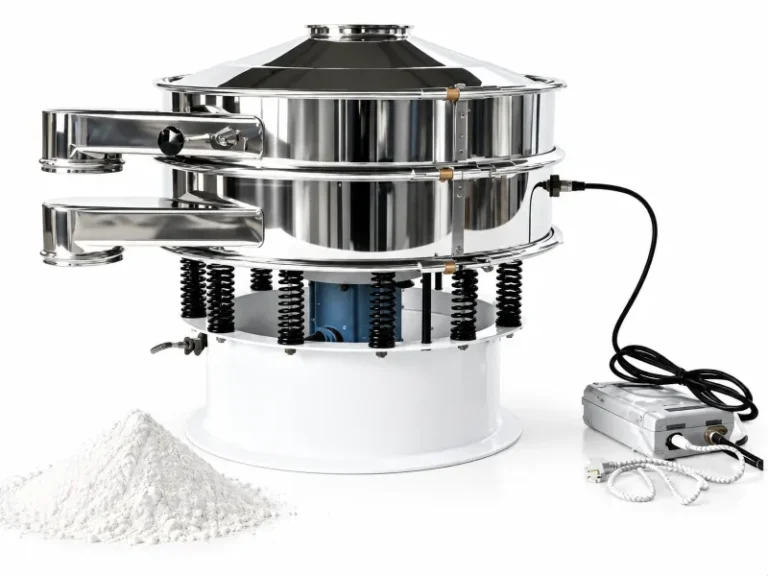
Cribado de almidón de maíz: eliminación de grumos antes de la mezcla y el envasado
Lumps in dry corn starch can disrupt feeding into a mixer or packing machine. Corn starch screening removes oversized clumps and screen-retained debris before the powder enters either stage. The right setup depends on the material to be removed, the required throughput, and the condition of the starch.

Why Screen Corn Starch Before Mixing and Packing?
Screening corn starch before mixing or packing provides a checkpoint for oversized lumps and foreign material. The screen opening determines what passes into the next process and what is retained for removal.
Remove Lumps Formed During Storage and Transport
Corn starch may form lumps when exposed to moisture or compressed during storage and transport. These clumps can disrupt feeding and may be difficult to disperse in the next process. Screening corn starch before mixing separates lumps larger than the selected screen openings, reducing the amount of oversized material entering the mixer. Persistent lump formation also calls for a review of storage conditions and material handling.
Separate Oversized Foreign Material
A sieve can retain foreign material such as wood fragments, stones, or metal pieces when their dimensions prevent them from passing through the screen. This helps reduce the risk of product contamination and damage to downstream equipment. However, particles smaller than the openings, along with some thin or elongated fragments, may pass through. Screening therefore needs to work alongside other foreign-material controls appropriate to the production line.
Meet the Required Size Specification
Where the process requires a defined size separation, select the screen aperture against that specification and check it through material trials. When screening corn starch before packing, the main objective is usually to reject oversized lumps and debris rather than grade the starch into narrow particle size fractions.

What Is a Corn Starch Vibrating Sieve and How Does It Work?
A corn starch vibrating sieve separates dry starch from oversized lumps and foreign material retained by the screen. Vibration moves the powder across the screening surface, allowing material that passes through the openings to enter the next process.
Equipment Design for Dry Corn Starch Screening
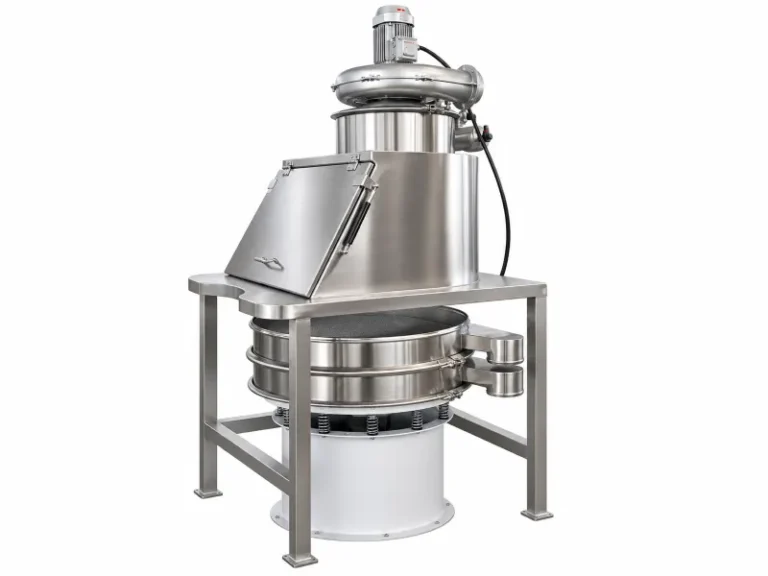
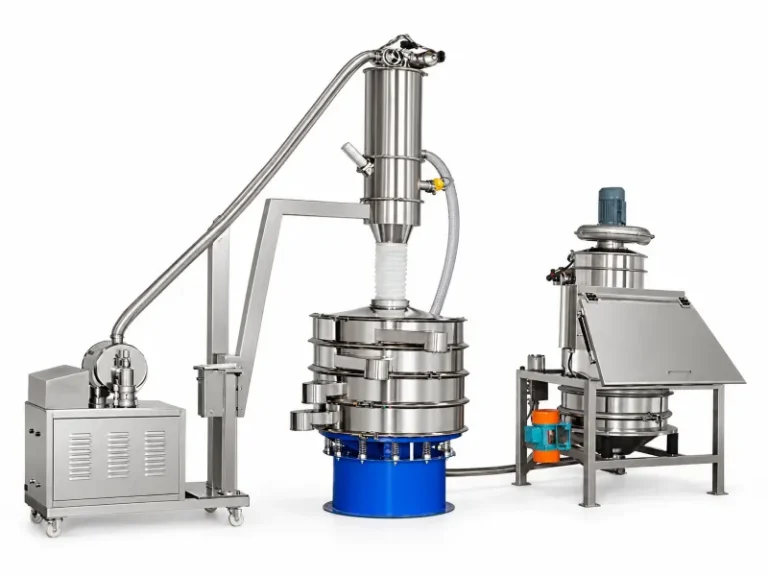
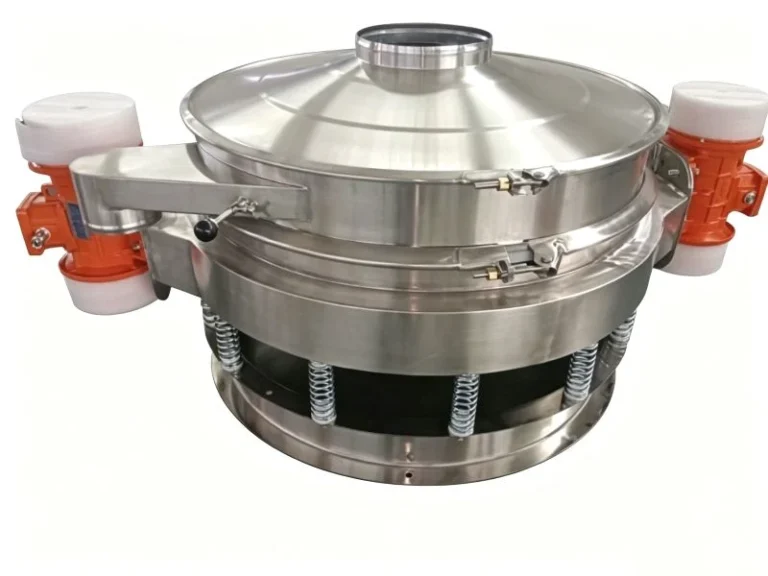
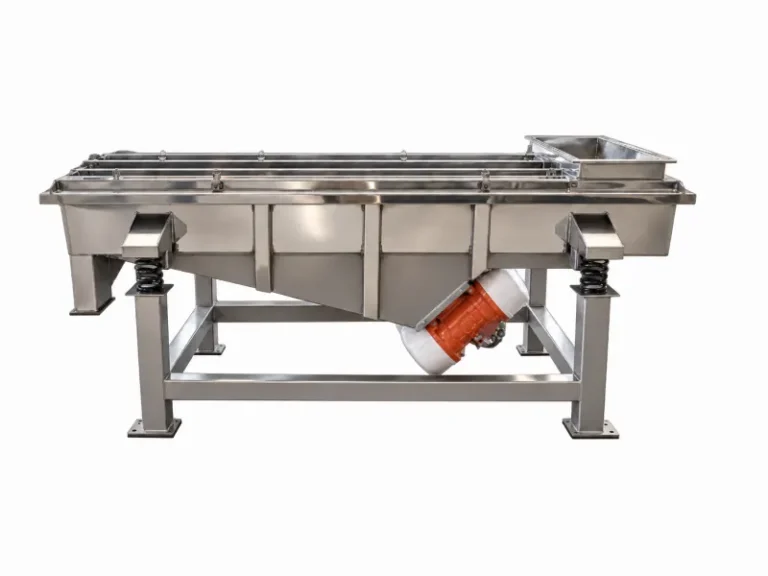
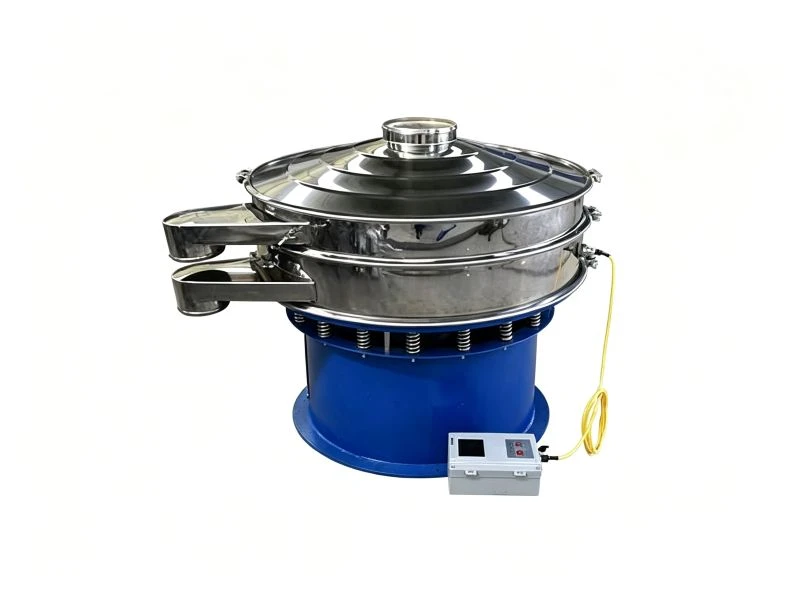
A criba vibratoria rotatoria is one option for this application. Its vibrating motor moves the screen assembly, spreading incoming starch across the mesh and carrying retained material toward the oversize outlet.
An enclosed housing helps contain airborne powder, while stainless steel contact surfaces are commonly specified for food processing applications. When choosing a corn starch screening machine, check the required material grade, surface finish, seals, and access for cleaning. The configuration must suit the product and the plant’s hygiene requirements.
Feeding, Screening, and Oversize Discharge
The screening process has three main stages:
- Feeding: Dry corn starch enters through the inlet. A steady feed helps distribute the powder across the available screening area.
- Screening: Vibration brings the powder into contact with the mesh. Material that passes through the openings falls into the collection section below.
- Oversize discharge: Retained lumps and debris move toward a separate outlet or remain for removal, depending on the sieve design.
A vibrating sieve separates retained lumps from the powder stream. It should not be relied on to grind hard clumps back into usable starch.
Lump Removal vs. Particle Size Classification
The screen specification depends on what the process needs to separate.
| Propósito del cribado | Basis for Screen Selection |
|---|---|
| Removing lumps from corn starch | Allow acceptable powder to pass while retaining unwanted oversized material |
| Particle size classification | Separate material against a defined particle size requirement, with performance confirmed by testing |
How to Choose a Corn Starch Screening Machine and Screen Aperture
Choose a corn starch screening machine around the material you need to remove, the required throughput, and the installation conditions. Mesh count alone is not enough to specify the equipment.
Define the Screening Objective and Aperture
For lump removal, choose a screen opening that allows acceptable starch to pass while retaining unwanted oversize material. A 20-mesh screen may be considered for coarse scalping, while a 60-mesh screen offers a smaller opening. These are starting points for evaluation; the final choice should follow the product specification and a material trial.
Specify the opening in microns together with the mesh count and applicable standard. Our guide to cantidad de malla vs tamaño de micras explains how to specify the screen opening clearly. Use multiple screen decks when the process requires separate size fractions.
Verify Capacity with the Actual Starch
If your line requires 2,000–3,000 kg/h, for example, ask the supplier to confirm that throughput using your starch and the selected screen aperture. Feed consistency, moisture, lump content, and usable screening area all affect corn starch sifting capacity. Machine diameter or a general catalogue rating cannot establish the required output on its own.
Check Materials, Cleaning, and Connections
Specify stainless steel for product-contact surfaces, selecting 304 or 316L according to the product, cleaning chemicals, and plant requirements. Check that the screen is accessible for inspection and replacement, with seals and surfaces that are easy to clean.
Confirm inlet and outlet sizes, discharge height, available space, and connections to the mixer or packing line before ordering.
How to Address Mesh Blinding and Reduced Throughput
Corn starch screening capacity can fall when powder builds up on the mesh or lumps obstruct the openings. Moisture, electrostatic attraction, and uneven feeding may contribute to the problem. Check the material and screen condition before changing the machine settings or adding a cleaning system.
Check the Material and Feeding Conditions
If throughput drops after a batch change, compare the starch’s moisture condition and lump content with the previous batch. Damp agglomerates may collect on the screen, while fine powder can cling to the mesh through electrostatic attraction.
Keep the feed steady and spread it across the screening area. If starch piles up beneath the inlet, reduce the feed rate and check its distribution.
Inspect the Screen and Existing Cleaning System
Stop and isolate the machine before checking for blocked openings, loose mesh, damaged seals, or screen wear. Clean the mesh using a suitable method and confirm that its aperture still matches the screening requirement.
Where fitted, bouncing balls tap the underside of the screen to dislodge trapped particles. Check their condition and movement. They help clear openings, but should not be relied on to break down hard or damp starch lumps.
Test Ultrasonic Deblinding for Persistent Blockage
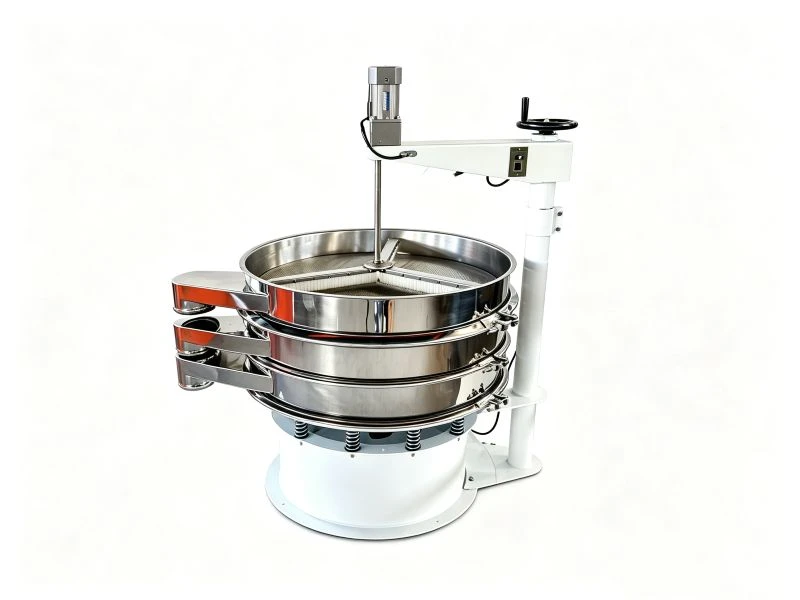
For fine-mesh corn starch sifting, an máquina de tamizado ultrasónico is an option when powder adhesion continues to restrict output. It applies high-frequency vibration to the mesh to reduce particle buildup and keep more openings available for screening.
Compare cleaning options using the same starch, screen aperture, and feed conditions. Record sustained throughput, screen buildup, and acceptable starch lost with the oversize material. Choose the configuration that maintains the required separation during a representative production run.
What Information Should You Provide Before Requesting a Quote?
To request a quote for a corn starch screening machine, provide your material condition, screening objective, and required throughput. Include installation details so the supplier can specify a machine that fits your process.
Corn Starch Screening Specification Checklist
| Information | Details to Provide |
|---|---|
| Estado del material | Dry corn starch, moisture content if known, and whether lumps are present |
| Screening objective | Lump removal, check screening, or particle size classification |
| Required capacity | Normal and peak throughput in kg/h |
| Especificación de la malla | Aperture in microns, or mesh count with the applicable standard |
| Método de alimentación | Manual bag tipping, hopper feeding, or conveyor feeding |
| Installation space | Available dimensions, inlet and outlet heights, and connection sizes |
| Materials and cleaning | Product-contact material, cleaning method, and plant hygiene requirements |
| Suministro eléctrico | Voltage, frequency, and number of phases |
| Supporting information | Representative starch sample, site photos, or a process layout |
If the screen aperture is undecided, describe what must pass through and what needs to be removed. Include whether the sieve will operate before mixing or packing.
Confirm the Configuration with a Material Trial
For corn starch screening trials, use a sample that reflects normal production, including typical lumps. Record the sample condition, screen aperture, feeding method, test duration, and achieved throughput. Check the retained material for unwanted lumps and acceptable starch carried out with them.
These results give the supplier a basis for recommending the screening area and cleaning system.
Request a corn starch screening quotation with your target throughput, screen requirements, and installation details. If the screen aperture is undecided, describe the lumps or oversized material you need to remove.
Preguntas frecuentes
What mesh size is suitable for corn starch screening?
The right mesh size depends on what you need to remove. A 20-mesh screen may suit larger lumps, while a 60-mesh screen retains smaller oversized material. Neither is a universal specification for corn starch. Confirm the actual opening in microns and test whether it passes acceptable starch while retaining the unwanted material.
Which vibrating sieve is suitable for dry corn starch?
A rotary vibrating sieve is one option for removing lumps from dry corn starch. Choose the screening area, mesh opening, and cleaning system around your required throughput and material condition. If fine powder repeatedly blinds the screen, test an ultrasonic configuration before deciding which machine to use.
Can a corn starch screening machine handle 2,000–3,000 kg/h?
That throughput needs to be confirmed for the proposed machine using your starch and screen aperture. A capacity quoted for a coarse screen may not apply to a finer one. Ask the supplier for a material trial that records sustained throughput, screen buildup, and the amount of acceptable starch discharged with the rejects.
Why does corn starch clog the sieve mesh?
Moisture-related agglomerates, fine powder adhesion, and particles lodged in the openings can reduce the available screening area. Excessive or uneven feeding can make the problem worse. Check the starch condition, feed distribution, and screen cleanliness first, then assess whether the existing cleaning system is adequate.
Does corn starch sifting require an ultrasonic sieve?
Not every application needs ultrasound. Mechanical cleaning, such as bouncing balls, may be sufficient for the selected mesh and feed conditions. An ultrasonic sieve is worth testing when persistent powder adhesion or fine-mesh blinding prevents the machine from maintaining the required output. Mesh count alone does not determine the need.
Can a vibrating sieve remove all foreign material from corn starch?
No. A vibrating sieve retains material that cannot pass through its openings. Smaller contaminants and some thin fragments may pass through with the starch. Use screening alongside the