How to Use a Circular Tumbler Screen for Gelatin Granules
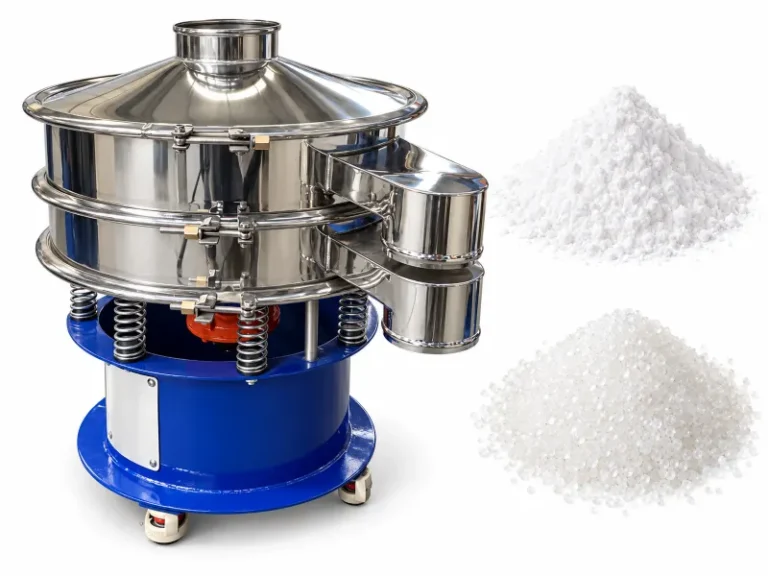
Circular tumbler screen for gelatin granules — which openings do you need if a buyer wants two sizes packed separately? For 0.5–0.8 mm et 0.8–1.2 mm grades, fit three decks with 1.2 mm, 0.8 mm, and 0.5 mm openings, from top to bottom. The two middle outlets collect the finished grades. Oversize pieces leave through the top outlet, and fines fall into the bottom pan.
If the buyer accepts 0.5–1.2 mm granules in a single bag, leave out the 0.8 mm deck. The upper and lower limits stay the same. It is the separate packaging requirement that calls for the third deck. Use the particle size limits and tolerances on the actual order when selecting the mesh.

Where to Install a Circular Tumbler Screen for Gelatin Granules
For dry gelatin sold by particle size, a practical screening point is after milling and before packaging. Take a representative sample from the mill discharge and weigh the material in each size range. For the two-grade order above, that means measuring four fractions: material retained on 1.2 mm, each of the two finished grades, and fines passing 0.5 mm.
The feed sample gives you a starting point for estimating yield. If much of the milled gelatin already passes a 0.5 mm sieve, that portion still counts toward the load on the machine. It contributes nothing to the weight of the two saleable grades.
How Gelatin Moves Across the Screen
Feed dry gelatin evenly near the center of the top deck. As the deck rocks and moves in a circular path, the granules spread toward its edge. Smaller particles pass through the openings. Material retained on the mesh travels to that deck’s outlet.
Particles close to an opening size may touch the mesh several times before they pass. This matters when a batch contains a large proportion of granules near 0.8 mm. If feed builds up on one side of the deck, some particles that could pass the mesh may leave with the coarser grade.
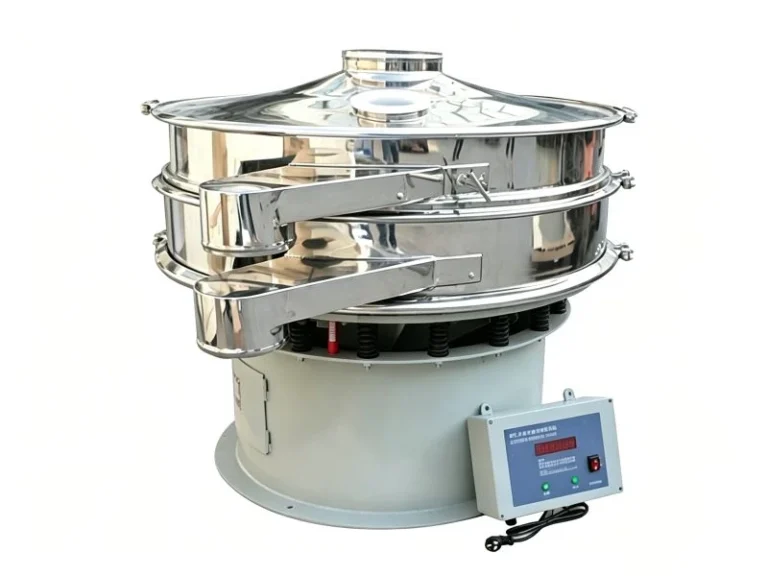
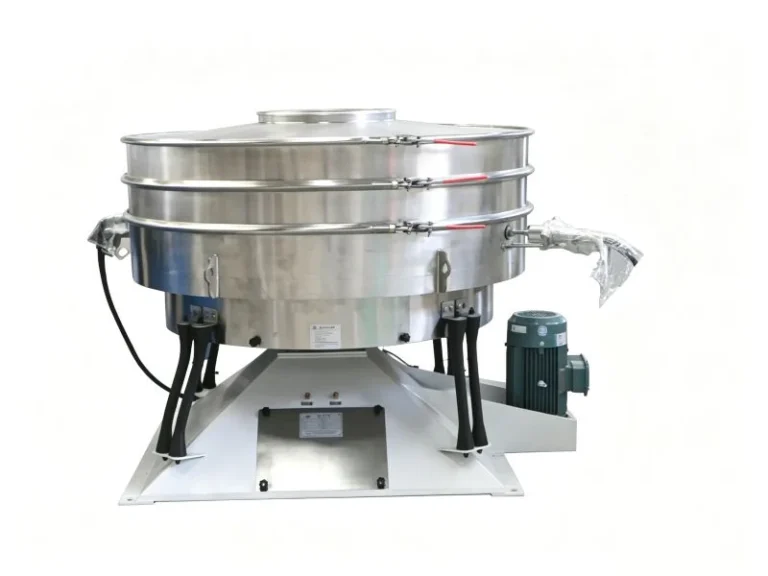
When comparing models, the useful details are the available deck count and cleaning method. The Yuan Jing YBS circular tumbler screen for gelatin granules can be configured with one to five decks. The series offers bouncing balls, rotating brushes, and ultrasonic cleaning. A trial with the actual gelatin will show how long the chosen mesh stays clear and how much fine powder reaches each outlet.

Which Screen Openings Produce Two Finished Grades?
When setting up a circular tumbler screen for gelatin granules, work from the buyer’s size limits down through the deck stack. In this multi-deck tumbler screen configuration, the 1.2 mm deck takes off coarse pieces, the 0.8 mm deck divides the saleable grades, and the 0.5 mm deck removes fines from the smaller product.
| Discharge point | What the screen retains or passes | Material collected |
|---|---|---|
| Top-deck outlet | Retained on 1.2 mm | Oversize pieces or lumps |
| Middle-deck outlet | Passes 1.2 mm and stays on 0.8 mm | Nominal 0.8–1.2 mm grade |
| Lower-deck outlet | Passes 0.8 mm and stays on 0.5 mm | Nominal 0.5–0.8 mm grade |
| Bottom pan | Passes 0.5 mm | Fines |
The ranges in the table are nominal grades. Before releasing either stream for packaging, take an outlet sample and measure how much material falls outside the buyer’s limits.
When is one deck enough?
One deck is enough when the job requires a single size cut. To remove fines from dry gelatin granules, collect the saleable material on top of the mesh. To remove oversize fragments before bagging, collect the saleable material below it. Specify the opening in millimeters, the applicable sieve standard, and which outlet will connect to the bagger.
Troubleshooting a Circular Tumbler Screen for Gelatin Granules
Saleable granules are leaving through the coarse outlet
Take a sample from the coarse outlet and re-sieve it using a test sieve with the same nominal opening as that deck. Weigh the material that passes. This is the portion of the sample that could have gone through the production mesh.
Check where the feed lands, how deep the bed is, and whether granules are lodged in the openings. Try a lower feed rate with the same mesh and cleaning setup, then sample again. Compare both the percentage of misplaced granules and the hourly output of accepted product.
The mesh blocks partway through a run
Compare the material at the feed inlet with the buildup on the affected deck. Lumps already present at the inlet are a reason to check the batch’s drying and storage conditions. If the incoming granules are dry and free-flowing, inspect the blocked openings for particles wedged in the mesh.
For a machine fitted with bouncing balls, record which deck blocks first and how long it runs before cleaning is needed. If fine powder continues to coat a finer mesh, an ultrasonic screen-cleaning system is another option to trial. Keep the feed conditions the same so you can compare cleaning intervals and finished-product quality.
More fine powder is collecting in the bottom pan
A heavier fines bin can have several explanations. The mill may have delivered more powder, the mesh may be recovering fines more effectively, or some granules may have broken during handling.
During steady operation, measure the incoming feed and collect material from all outlets over the same interval. Use the same test sieve to determine the fines fraction in each sample. Multiply each outlet’s discharged mass by its fines mass fraction, then add those amounts together. Compare the result with the mass of fines that entered with the feed. Account for gelatin left in the machine, spillage, and sampling variation before attributing a difference to breakage.

How to Run a Screening Trial Before Purchase
When testing a circular tumbler screen for gelatin granules, give the supplier a representative batch and the same acceptance limits your packaging team will use.
- Define each finished grade. State its size range and permitted percentages of oversize and undersize particles. Specify whether the hourly target applies to incoming feed or accepted product.
- Keep a feed sample. Record the batch number, particle size distribution, and moisture content if available. Include a representative difficult batch if your production material sometimes contains excess fines or tends to block the mesh.
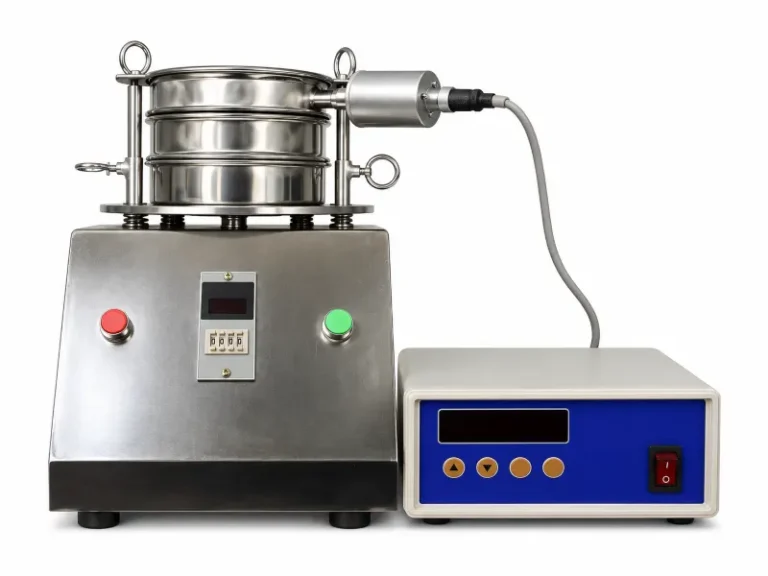
- Collect from every outlet. Wait for steady discharge, then use the same collection interval for all streams. Record the openings, cleaning method, elapsed time, and mass from each outlet. Check total discharge against feed mass and note any residue left inside.
- Verify sustained output. Re-sieve both finished grades and calculate the mass meeting specification per hour. Take another set of samples later in the run to see whether the separation changes as the mesh loads up.
A target of 500 kg/h needs a clear definition. If it means feed from the mill, the trial must establish that the machine can handle that incoming load. If it means accepted product at the bagger, the supplier also needs to know the proportion of each saleable grade in the feed and how much of each grade the buyer requires. The 500 kg/h figure illustrates how to write the requirement. Actual capacity depends on the trial results.
Conclusion
The right deck layout depends on what goes into each bag. A buyer who accepts a single 0.5–1.2 mm grade needs two screen openings. Packing 0.5–0.8 mm et 0.8–1.2 mm separately adds a third opening at 0.8 mm. A trial with your own gelatin can show how much material from each outlet meets the buyer’s specification at your target feed rate.
For help selecting a circular tumbler screen for gelatin granules, send your screening requirements to Yuan Jing. Include your target grades, the amount of fines each grade can contain, and the output you need in kg/h. Let us know whether that figure refers to mill feed or finished product ready to pack, so we can recommend a deck layout and discuss what to measure in a screening trial.
FAQ
1. Do I need a 400-mesh screen to remove gelatin fines?
Start with the buyer’s lower size limit. If the order defines fines as material passing a 0.5 mm test sieve, plan the trial around that opening. A much finer screen can retain particles the buyer wants removed, allowing them to travel to the finished-product outlet.
2. What should I check on a circular tumbler screen for gelatin granules used in food or pharmaceutical processing?
Review the materials that touch the gelatin, including the mesh and gaskets. When evaluating a stainless steel tumbler screen, ask to see how it comes apart. Check whether an operator can inspect the frame joints, the underside of each deck, and the discharge spouts for residue between batches. Agree on any required qualification documents and cleaning records before purchase.
3. What does a supplier need to size a circular tumbler screen for gelatin granules?
Provide a representative sample, the feed particle size distribution, the required finished grades, and the throughput target. State how much oversize and undersize each grade may contain. If the current machine blocks, include a photo of the affected deck and the time it took to block when you send Yuan Jing your screening requirements. Use the same sample and acceptance limits for each quotation.
4. How do I check separation when many granules are close to 0.8 mm?
Sample both finished outlets during the same interval. Re-sieve each sample at 0.8 mm. For the 0.8–1.2 mm grade, weigh what passes through to find the undersize portion. For the 0.5–0.8 mm grade, weigh what stays on the sieve to find the oversize portion. Divide each weight by its own sample mass and compare the percentage with the tolerance for that grade.
5. Can I keep the same feed rate after a batch change?
Use the previous setting as a starting point. Keep a sample of the new feed, let discharge stabilize, and check both finished outlets. If the new batch contains more lumps, fines, or particles close to the cut size, adjust the feed rate in steps. Collect a separate set of samples at each setting and compare accepted output.
6. Can oversize gelatin go straight back to the mill?
Inspect the retained material first. Clean, traceable granules from the same batch that are simply too large can be assessed for remilling under the plant’s approved rework procedure. Set aside lumps, foreign material, and anything of uncertain origin for quality review. Record returned gelatin separately to avoid counting it twice in the batch yield.