견과류용 직선형 진동 선별기: 파손된 알맹이 분리부터 크기별 분급까지
탈각 후 견과류 한 배치에는 온전한 알맹이, 부서진 조각, 껍질 파편, 미세 입자가 섞여 있을 수 있습니다. 포장 전에 가공업체는 제품을 크기별로 분리해야 할 수도 있습니다.
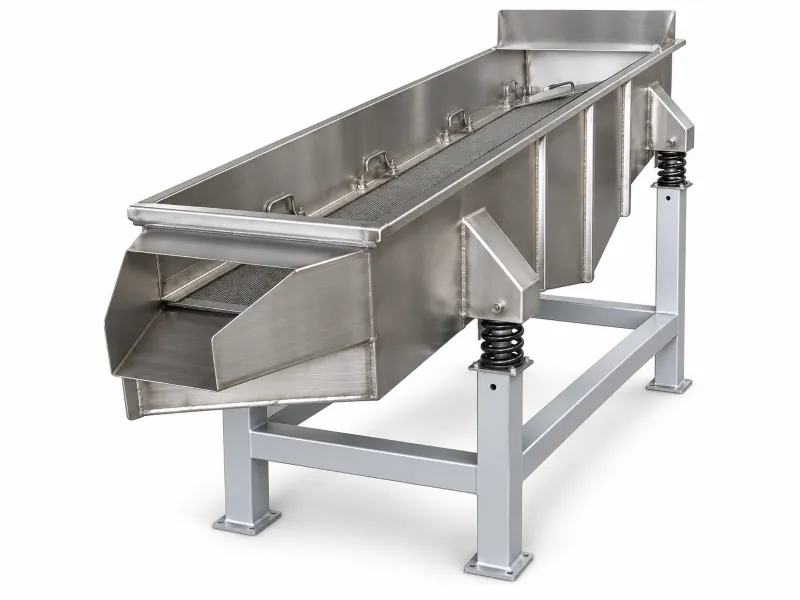
A 견과류용 선형 진동 스크린 정해진 크기의 구멍이 있는 스크린 위로 원료를 통과시켜 이러한 작업을 수행합니다. 작은 입자는 구멍을 통과하고, 큰 조각은 별도의 배출구로 이동합니다. 스크린 한 단은 원료를 한 가지 크기 기준으로 분리합니다. 여러 단을 사용하면 투입 원료를 여러 크기 그룹으로 나눕니다.
한계는 크기입니다. 정상품 알맹이와 크기가 비슷한 돌이나 껍질 파편은 같은 배출구로 나올 수 있습니다. 스크린 선별만으로는 이러한 물질을 확실하게 제거할 수 없습니다.
견과류 가공 라인에서 스크린 선별의 위치
견과류용 직선 진동 스크린은 탈각 후, 가공 단계 사이 또는 포장 전에 설치할 수 있습니다. 적절한 위치는 파편이 발생하는 지점과 다음 공정에서 일정한 크기의 제품이 필요한 지점에 따라 달라집니다.
탈각 후 작은 파편 제거
탈각과 취급 과정에서는 온전한 알맹이 외에도 여러 물질이 생깁니다. 투입 원료에는 부서진 알맹이, 작은 껍질 조각, 먼지도 포함될 수 있습니다.
적절한 크기의 구멍을 사용하면 작은 물질은 스크린을 통과하고 큰 알맹이는 배출구 쪽으로 이동합니다. 각 흐름은 별도로 수거됩니다.
아몬드와 캐슈너트의 경우 스크린을 통과한 물질을 확인해야 합니다. 그중에는 다른 제품 규격에 적합한 사용 가능한 알맹이 조각이 있을 수 있습니다. 구멍이 너무 크면 정상품 알맹이가 통과하여 손실될 수도 있습니다.
이때 모양도 중요합니다. 길거나 납작한 조각은 놓인 방향에 따라 구멍을 통과할 수도 있고 스크린 위에 남을 수도 있습니다.
포장 전 크기 선별
다단 견과류 크기 선별기는 크기가 혼합된 원료를 분리하여 각각 수거하고 포장할 수 있게 합니다.
여러 크기 등급의 아몬드를 판매하는 가공업체에는 각 그룹을 구분하는 명확한 기준이 필요합니다. 온전한 알맹이와 작은 조각을 분리하는 캐슈너트 가공업체에는 다른 구성이 필요할 수 있습니다.
견과류용 선형 진동 스크린은 크기에 따라 분류합니다. 색상, 성숙도, 곰팡이 및 내부 품질은 다른 검사 또는 선별 방법이 필요합니다.
다음 공정으로 원료 이송
스크린은 원료를 분리하면서 배출구 쪽으로 이동시킵니다. 이를 통해 탈각, 수집 및 포장 단계를 연결할 수 있습니다.
설치 전에 배치를 확인하세요. 투입 높이는 원료가 첫 번째 데크에 떨어지는 방식에 영향을 미치며, 배출구 위치에 따라 각 분획이 적체 없이 수집 지점에 도달할 수 있는지가 결정됩니다.
Yuanjing의 선형 진동 스크린 장비 두 개의 진동 모터를 사용하며, 스크린 크기, 데크 수 및 구조 옵션을 구성할 수 있습니다.
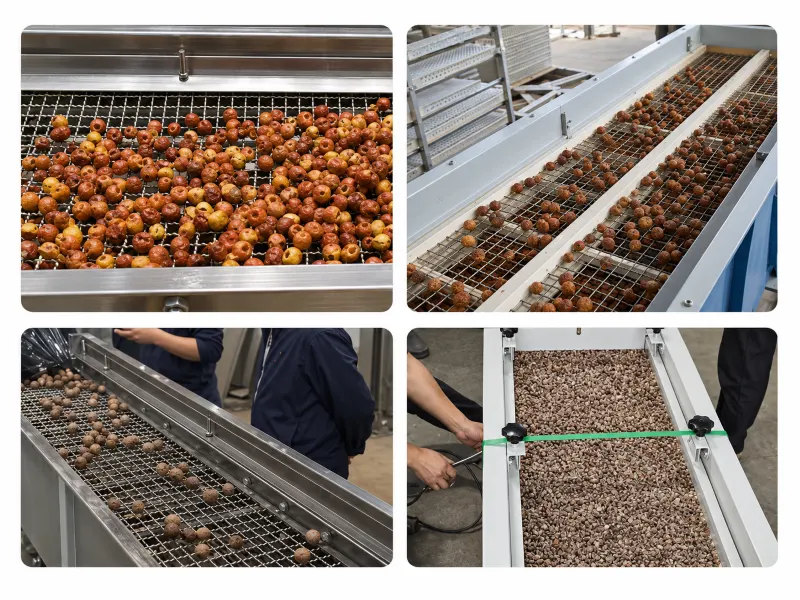
견과류용 선형 진동 스크린은 어떻게 작동하나요?
견과류용 선형 진동 스크린은 일반적으로 스크린 박스, 스크린 프레임, 망 또는 스크리닝 플레이트, 진동 모터 2개, 방진 스프링 및 지지 프레임으로 구성됩니다.
모터는 서로 반대 방향으로 동기 회전합니다. 이들이 합쳐서 발생시키는 가진력은 스크린 본체를 직선 경로로 움직입니다. 진동과 중력은 투입 원료를 펼쳐 배출단으로 이동시킵니다.
구멍을 통과한 원료는 다음 데크 또는 스크린 통과물 수집 구역으로 떨어집니다. 스크린에 남은 원료는 배출구까지 계속 이동합니다. 추가 데크에서는 더 작은 구멍으로 이 과정이 반복됩니다.
투입 원료의 분포는 스크린을 얼마나 효과적으로 활용할 수 있는지에 영향을 미칩니다. 원료가 한곳에 쌓이면 일부 입자는 구멍에 도달하지 못한 채 앞으로 이동합니다.
단일 데크 또는 다중 데크?
공정에 필요한 분리 작업부터 확인하세요. 그런 다음 데크 수를 선택합니다.
| 가공 작업 | 구성 방식 | 시험 가동 중 확인할 사항 |
|---|---|---|
| 큰 낱알에서 작은 조각 제거 | 한 가지 크기 기준으로 분리하는 단일 데크 | 스크린 통과물과 함께 손실되는 규격에 맞는 낱알 |
| 규격보다 큰 원료, 목표 제품 및 미세물을 분리 | 세 가지 분획을 만드는 2단 데크 | 두 크기 경계에서의 분리 상태 |
| 포장할 여러 크기 등급 준비 | 제품 사양에 맞춘 다중 데크 | 각 배출구에서의 크기 균일성 |
| 견과류의 종류나 크기 변경 | 접근 및 교체가 쉬운 스크린 | 청소, 잔류 물질 및 제품 전환을 위한 접근성 |
원본 문서에서는 단층 구조와 2~6층 구성을 설명합니다. Yuanjing의 제품 페이지에는 다음 층수의 구성이 나열되어 있습니다 1~6층.
6층 견과류용 선형 진동 스크린은 이론적으로 최대 7개의 크기 분획을 생산할 수 있습니다. 그렇다고 해서 판매 가능한 등급이 7개라는 뜻은 아닙니다. 일부 배출구에는 미세 입자, 너무 큰 이물질 또는 추가 처리가 필요한 물질이 모일 수 있습니다.
층이 추가될 때마다 청소하고 점검해야 할 표면도 늘어납니다. 작업자가 하부 층에 접근하고 스크린을 분리할 수 있는지 확인하세요.
Yuanjing의 선형 진동 체 선택 가이드 covers screen area, material characteristics, and deck selection in more detail.
Almonds, Cashews, Walnuts, and Pine Nuts Need Different Settings
A linear vibrating screen for nuts should be selected using the material that will actually enter it. In-shell walnuts behave differently from shelled almonds or cashew fragments.
| 재질 | 선별 작업 | Watch for |
|---|---|---|
| Almond kernels | Size grading and small-fragment removal | Kernel loss and surface scuffing |
| Cashews | Broken-piece separation and size grading | Additional breakage |
| In-shell walnuts | Size separation and removal of differently sized debris | Openings that do not match the walnut size distribution |
| Macadamia products | Separation with controlled impacts | Damage at the inlet, deck transfers, and outlets |
| Pine nuts | Separation with sufficient screening time | Fast rolling, uneven movement, or accumulation |
Walnut Screening: What Do 10 mm, 16 mm, and 22 mm Openings Tell You?
The source document gives a walnut-processing example using 10 mm, 16 mm, and 22 mm openings.
These are example size boundaries, not a standard configuration for every walnut variety. Measure a representative batch first, then define the acceptable range for each fraction.
For successive multi-deck grading, larger openings would generally sit above smaller ones. Material passing through the upper screen then reaches the next separation.
A walnut passing through an opening has met a size-related condition. That result alone does not establish whether it is immature or belongs to a premium commercial grade.
Almonds and Cashews: Check Where Damage Occurs
When a linear vibrating screen for nuts handles shelled almonds or cashews, inspect the entire route through the machine.
Start at the feeder. A large drop onto the first deck may damage kernels before screening begins. Then check movement across the screen, transfers between decks, and discharge into the receiving equipment.
The source document discusses vibration adjustment to reduce almond surface damage and lower transfer drops for damage-sensitive macadamia applications.
Test these arrangements with the actual product. Comparing the broken-kernel proportion before and after screening helps show whether the process is adding damage.
Pine Nuts: Watch How Quickly They Leave
Pine nuts can roll along the screen quickly. If they reach the outlet before enough separation occurs, review feed distribution and the permitted operating settings.
The source document suggests retaining strips as one possible way to extend residence time. Before adopting them, check whether they cause accumulation or make cleaning harder.
Stainless Steel Construction and Screen Cleaning
Define Which Parts Contact the Product
For a stainless steel linear vibrating screen for nuts, the material specification should identify the product-contact components.
These may include the inside of the screen box, screen frames, screening surfaces, discharge chutes, and seals. “Stainless steel construction” on its own leaves room for misunderstanding.
The source document discusses 304 and 316 stainless steel. Yuanjing’s food processing screening and conveying solutions describe 304 or 316L stainless steel material-contact parts.
Choose the final specification with the cleaning method, cleaning chemicals, and operating environment in mind.
Investigate Blockage Before Choosing a Cleaning Device
Fine particles, moisture, and surface residues can block screen openings.
The source document describes elastic ball cleaning: balls beneath the screening surface strike it to help release trapped particles. Suitability depends on the opening size, screen structure, and product.
Confirm the ball material and installation details in the equipment specification. During a trial, note where blockage starts and how quickly it reduces the open screening area.
Leave Room for Cleaning
An enclosed linear vibrating screen for nuts can help contain dust and fragments. Operators still need to open it, inspect retained material, and clean the internal surfaces.
For a plant that changes nut varieties or product sizes regularly, removable screens and accessible outlets can make a substantial difference to changeovers. Review how the cleaning work will be done before approving the layout.
Verify Capacity with Your Own Material
The capacity of a linear vibrating screen for nuts depends on the feed, openings, deck arrangement, and feeding conditions. Machine dimensions alone cannot establish throughput for whole almonds, in-shell walnuts, or cashew pieces.
The source document suggests a 50 kg sample for preliminary testing under different settings. Use that as a starting point for planning the trial. The actual quantity required depends on the machine, feed arrangement, and test duration.
Include the fragments, fines, and impurities normally found in production. A sample consisting only of clean, whole kernels will not reveal how the machine handles the usual feed.
| Trial item | Record | What it helps establish |
|---|---|---|
| 공급 원료 상태 | Variety, size distribution, moisture, and surface condition | Whether the sample represents production |
| 원료 공급 | Feed rate and distribution across the width | Whether loading is stable |
| Outlet fractions | Weight and composition of each stream | Whether the required separation is achieved |
| Acceptable product loss | Usable kernels entering unwanted fractions | Whether openings need adjustment |
| Added breakage | Broken-kernel proportion before and after screening | Whether handling damages the product |
| Screen condition | Blinding, accumulation, and uneven travel | Whether operation remains stable |
Keep the opening sizes, operating settings, and feed rate alongside the results. Operators can then compare later batches against the same conditions.
If throughput falls or material builds up, Yuanjing’s guide to improving linear vibrating screen efficiency explains the effects of feed distribution, screen condition, and vibration settings.
Routine Checks
Routine inspection of a linear vibrating screen for nuts should cover the screens, motor mountings, isolation components, and product-contact areas.
Check for:
- Loose, damaged, or persistently blocked screens.
- Material trapped around frames and outlets.
- Loose motor-mounting bolts.
- Dust obstructing motor ventilation.
- Damaged or uneven isolation springs.
- Unusual noise, vibration, or bearing temperature.
Use the equipment and motor manuals to set lubrication procedures, maintenance intervals, and shutdown criteria.
When output drops, inspect the feed as well as the machine. A change in moisture, fragment content, or feeding rate may explain the problem even when the screen is undamaged.
Discuss Your Nut Screening Requirements with Yuanjing
Whether the job is broken kernel separation after shelling, almond size grading, or cashew screening before packaging, begin with the feed and the required outlet fractions.
For an existing line, describe any blockage, product loss, mixed grades, or additional breakage. These details help define the screen openings, deck arrangement, and material-transfer requirements.
Contact Yuanjing Machinery about your nut screening requirements with your material details and production targets.
자주 묻는 질문
Can a Linear Vibrating Screen for Nuts Remove Impurities and Grade Sizes at the Same Time?
Yes, when the separations depend on size. Multiple decks can retain larger material, collect target size fractions, and discharge smaller fragments separately. Results depend on the size difference between acceptable nuts and the unwanted material.
Can It Remove All Stones and Shell Fragments?
No. Stones and shell pieces similar in size to acceptable nuts may leave through the same outlet. The contamination present determines whether additional separation methods are needed.
Will More Decks Improve the Result?
More decks provide more size boundaries. They also add cleaning work, access requirements, and material transfers. Use the number needed for the required fractions.
Can Almonds and Cashews Use the Same Openings?
Their shapes, sizes, and broken-kernel distributions differ. An existing screen configuration may provide a starting point for testing, but the trial results should determine the final openings.
What Information Is Needed to Select a Linear Vibrating Screen for Nuts?
Provide the nut type, whether it is shelled or in-shell, representative photographs or samples, target throughput, unwanted material, and required product sizes. Include the installation space and inlet and outlet heights.