Liniowy przesiewacz wibracyjny do orzechów: od oddzielania połamanych jąder po sortowanie według wielkości
After shelling, a batch of nuts may contain whole kernels, broken pieces, shell fragments, and fine particles. Before packaging, processors may also need to separate the product into different sizes.
A linear vibrating screen for nuts handles these tasks by passing material across screens with selected openings. Smaller particles fall through; larger pieces continue toward a separate outlet. One deck provides a single size separation. Multiple decks divide the feed into several fractions.
The limitation is size. A stone or shell fragment close in size to an acceptable kernel may leave through the same outlet. Screening alone cannot reliably remove that material.
Where Screening Fits in a Nut Processing Line
A linear vibrating screen for nuts can be installed after shelling, between processing stages, or before packaging. The right position depends on where fragments are generated and where the next process requires a defined product size.
Removing Small Fragments After Shelling
Shelling and handling leave more than whole kernels. The feed may also contain broken kernels, fine shell pieces, and dust.
With a suitable opening, smaller material passes through the screen while larger kernels travel to the discharge end. Each stream is collected separately.
For almonds and cashews, inspect what falls through. Some of it may be usable kernel pieces suitable for another product specification. It is also possible to lose acceptable kernels through an opening that is too large.
Shape matters here. A long or flat piece can pass through an opening in one orientation and remain on the screen in another.
Sortowanie przed pakowaniem
A multi-deck nut grading machine separates mixed sizes for individual collection and packing.
An almond processor selling several size grades needs a defined boundary between each group. A cashew processor separating whole kernels from smaller pieces may need a different arrangement.
A linear vibrating screen for nuts classifies by size. Color, maturity, mold, and internal quality require other inspection or sorting methods.
Transferring Material to the Next Process
As the screen separates material, it also moves it toward the outlets. This allows the machine to connect shelling, collection, and packaging stages.
Check the layout before installation. Feed height affects how material lands on the first deck, while outlet positions determine whether each fraction reaches its receiving point without backing up.
Firma Yuanjing linear vibrating screen equipment uses dual vibration motors, with configurable screen dimensions, deck counts, and construction options.
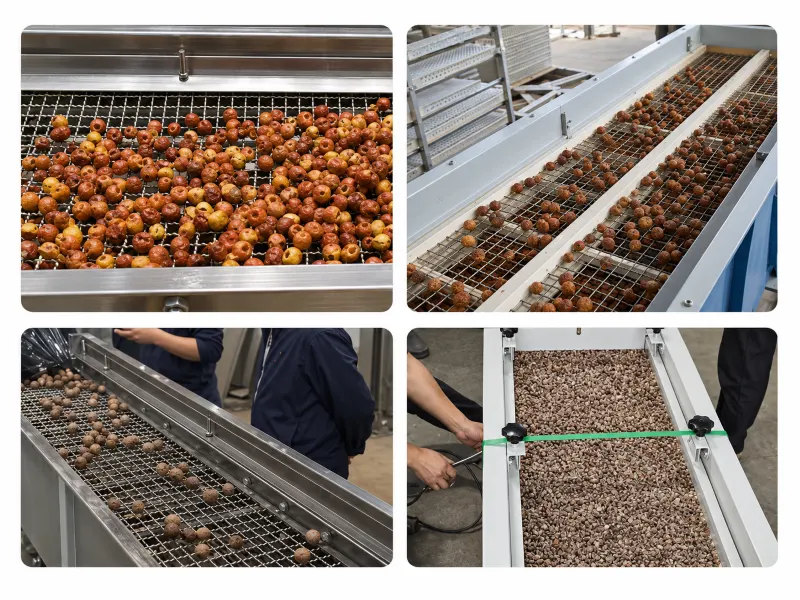
How Does a Linear Vibrating Screen for Nuts Work?
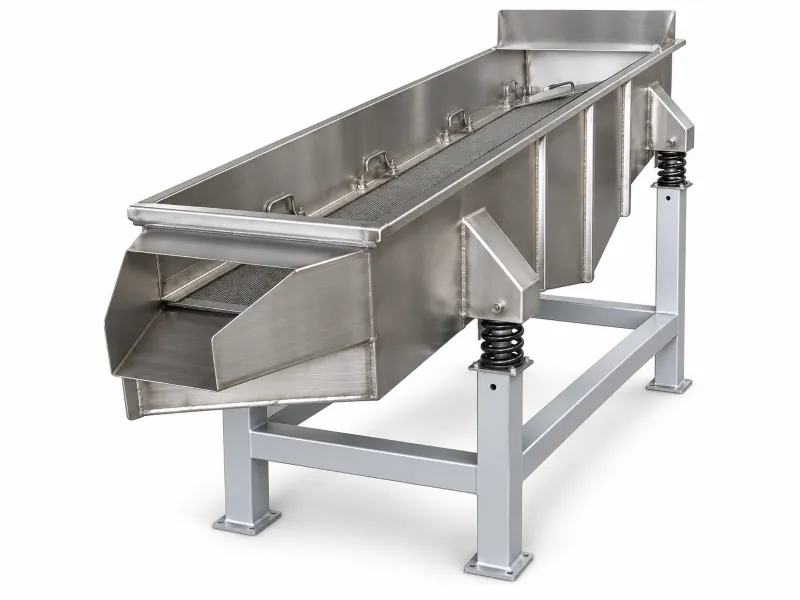
A linear vibrating screen for nuts typically consists of a screen box, screen frames, mesh or screening plates, two vibration motors, isolation springs, and a support frame.
The motors rotate synchronously in opposite directions. Their combined excitation force moves the screen body along a linear path. Vibration and gravity spread the feed and carry it toward the discharge end.
Material that passes through the openings falls to the next deck or the undersize collection area. Material retained on the screen continues to its outlet. Additional decks repeat the process at smaller openings.
Feed distribution affects how much of the screen can do useful work. If material lands in a concentrated pile, some particles cannot reach the openings before moving onward.
Single Deck or Multiple Decks?
Start with the separations the process needs. Then choose the deck count.
| Processing task | Configuration approach | Co sprawdzić podczas prób |
|---|---|---|
| Remove small fragments from larger kernels | One deck for a single size separation | Acceptable kernels lost with the undersize |
| Separate oversized material, target product, and fines | Two decks producing three fractions | Separation at both size boundaries |
| Prepare several sizes for packaging | Multiple decks matched to product specifications | Size consistency at each outlet |
| Change between nut varieties or sizes | Accessible, replaceable screens | Cleaning, retained material, and changeover access |
The source document describes single-deck designs and 2–6-deck arrangements. Yuanjing’s product page lists configurations with 1–6 decks.
A linear vibrating screen for nuts with six decks can theoretically produce up to seven size fractions. That does not mean seven saleable grades. Some outlets may collect fines, oversized debris, or material that needs further processing.
Each extra deck also adds a surface to clean and inspect. Make sure operators can reach the lower decks and remove the screens.
Firma Yuanjing przewodnik po wyborze sita wibracyjnego liniowego covers screen area, material characteristics, and deck selection in more detail.
Almonds, Cashews, Walnuts, and Pine Nuts Need Different Settings
A linear vibrating screen for nuts should be selected using the material that will actually enter it. In-shell walnuts behave differently from shelled almonds or cashew fragments.
| Materiał | Zadanie przesiewania | Watch for |
|---|---|---|
| Almond kernels | Size grading and small-fragment removal | Kernel loss and surface scuffing |
| Cashews | Broken-piece separation and size grading | Additional breakage |
| In-shell walnuts | Size separation and removal of differently sized debris | Openings that do not match the walnut size distribution |
| Macadamia products | Separation with controlled impacts | Damage at the inlet, deck transfers, and outlets |
| Pine nuts | Separation with sufficient screening time | Fast rolling, uneven movement, or accumulation |
Walnut Screening: What Do 10 mm, 16 mm, and 22 mm Openings Tell You?
The source document gives a walnut-processing example using 10 mm, 16 mm, and 22 mm openings.
These are example size boundaries, not a standard configuration for every walnut variety. Measure a representative batch first, then define the acceptable range for each fraction.
For successive multi-deck grading, larger openings would generally sit above smaller ones. Material passing through the upper screen then reaches the next separation.
A walnut passing through an opening has met a size-related condition. That result alone does not establish whether it is immature or belongs to a premium commercial grade.
Almonds and Cashews: Check Where Damage Occurs
When a linear vibrating screen for nuts handles shelled almonds or cashews, inspect the entire route through the machine.
Start at the feeder. A large drop onto the first deck may damage kernels before screening begins. Then check movement across the screen, transfers between decks, and discharge into the receiving equipment.
The source document discusses vibration adjustment to reduce almond surface damage and lower transfer drops for damage-sensitive macadamia applications.
Test these arrangements with the actual product. Comparing the broken-kernel proportion before and after screening helps show whether the process is adding damage.
Pine Nuts: Watch How Quickly They Leave
Pine nuts can roll along the screen quickly. If they reach the outlet before enough separation occurs, review feed distribution and the permitted operating settings.
The source document suggests retaining strips as one possible way to extend residence time. Before adopting them, check whether they cause accumulation or make cleaning harder.
Stainless Steel Construction and Screen Cleaning
Define Which Parts Contact the Product
For a stainless steel linear vibrating screen for nuts, the material specification should identify the product-contact components.
These may include the inside of the screen box, screen frames, screening surfaces, discharge chutes, and seals. “Stainless steel construction” on its own leaves room for misunderstanding.
The source document discusses 304 and 316 stainless steel. Yuanjing’s food processing screening and conveying solutions describe 304 or 316L stainless steel material-contact parts.
Choose the final specification with the cleaning method, cleaning chemicals, and operating environment in mind.
Investigate Blockage Before Choosing a Cleaning Device
Fine particles, moisture, and surface residues can block screen openings.
The source document describes elastic ball cleaning: balls beneath the screening surface strike it to help release trapped particles. Suitability depends on the opening size, screen structure, and product.
Confirm the ball material and installation details in the equipment specification. During a trial, note where blockage starts and how quickly it reduces the open screening area.
Leave Room for Cleaning
An enclosed linear vibrating screen for nuts can help contain dust and fragments. Operators still need to open it, inspect retained material, and clean the internal surfaces.
For a plant that changes nut varieties or product sizes regularly, removable screens and accessible outlets can make a substantial difference to changeovers. Review how the cleaning work will be done before approving the layout.
Verify Capacity with Your Own Material
The capacity of a linear vibrating screen for nuts depends on the feed, openings, deck arrangement, and feeding conditions. Machine dimensions alone cannot establish throughput for whole almonds, in-shell walnuts, or cashew pieces.
The source document suggests a 50 kg sample for preliminary testing under different settings. Use that as a starting point for planning the trial. The actual quantity required depends on the machine, feed arrangement, and test duration.
Include the fragments, fines, and impurities normally found in production. A sample consisting only of clean, whole kernels will not reveal how the machine handles the usual feed.
| Trial item | Record | What it helps establish |
|---|---|---|
| Feed condition | Variety, size distribution, moisture, and surface condition | Whether the sample represents production |
| Podawanie | Feed rate and distribution across the width | Whether loading is stable |
| Outlet fractions | Weight and composition of each stream | Whether the required separation is achieved |
| Acceptable product loss | Usable kernels entering unwanted fractions | Whether openings need adjustment |
| Added breakage | Broken-kernel proportion before and after screening | Whether handling damages the product |
| Stan sita | Blinding, accumulation, and uneven travel | Whether operation remains stable |
Keep the opening sizes, operating settings, and feed rate alongside the results. Operators can then compare later batches against the same conditions.
If throughput falls or material builds up, Yuanjing’s guide to poprawa wydajności liniowego sita wibracyjnego explains the effects of feed distribution, screen condition, and vibration settings.
Routine Checks
Routine inspection of a linear vibrating screen for nuts should cover the screens, motor mountings, isolation components, and product-contact areas.
Check for:
- Loose, damaged, or persistently blocked screens.
- Material trapped around frames and outlets.
- Loose motor-mounting bolts.
- Dust obstructing motor ventilation.
- Damaged or uneven isolation springs.
- Unusual noise, vibration, or bearing temperature.
Use the equipment and motor manuals to set lubrication procedures, maintenance intervals, and shutdown criteria.
When output drops, inspect the feed as well as the machine. A change in moisture, fragment content, or feeding rate may explain the problem even when the screen is undamaged.
Discuss Your Nut Screening Requirements with Yuanjing
Whether the job is broken kernel separation after shelling, almond size grading, or cashew screening before packaging, begin with the feed and the required outlet fractions.
For an existing line, describe any blockage, product loss, mixed grades, or additional breakage. These details help define the screen openings, deck arrangement, and material-transfer requirements.
Contact Yuanjing Machinery about your nut screening requirements with your material details and production targets.
Czy potrzebuję ultradźwiękowego przesiewacza wibracyjnego do drobnego proszku?
Can a Linear Vibrating Screen for Nuts Remove Impurities and Grade Sizes at the Same Time?
Yes, when the separations depend on size. Multiple decks can retain larger material, collect target size fractions, and discharge smaller fragments separately. Results depend on the size difference between acceptable nuts and the unwanted material.
Can It Remove All Stones and Shell Fragments?
No. Stones and shell pieces similar in size to acceptable nuts may leave through the same outlet. The contamination present determines whether additional separation methods are needed.
Will More Decks Improve the Result?
More decks provide more size boundaries. They also add cleaning work, access requirements, and material transfers. Use the number needed for the required fractions.
Can Almonds and Cashews Use the Same Openings?
Their shapes, sizes, and broken-kernel distributions differ. An existing screen configuration may provide a starting point for testing, but the trial results should determine the final openings.
What Information Is Needed to Select a Linear Vibrating Screen for Nuts?
Provide the nut type, whether it is shelled or in-shell, representative photographs or samples, target throughput, unwanted material, and required product sizes. Include the installation space and inlet and outlet heights.