ナッツ用リニア振動ふるい:砕けた実の分離から粒度選別まで
殻むき後のナッツには、形の整った仁、割れた仁、殻の破片、細かい粒子が混在することがあります。包装前に、製品をサイズごとに分ける必要がある場合もあります。
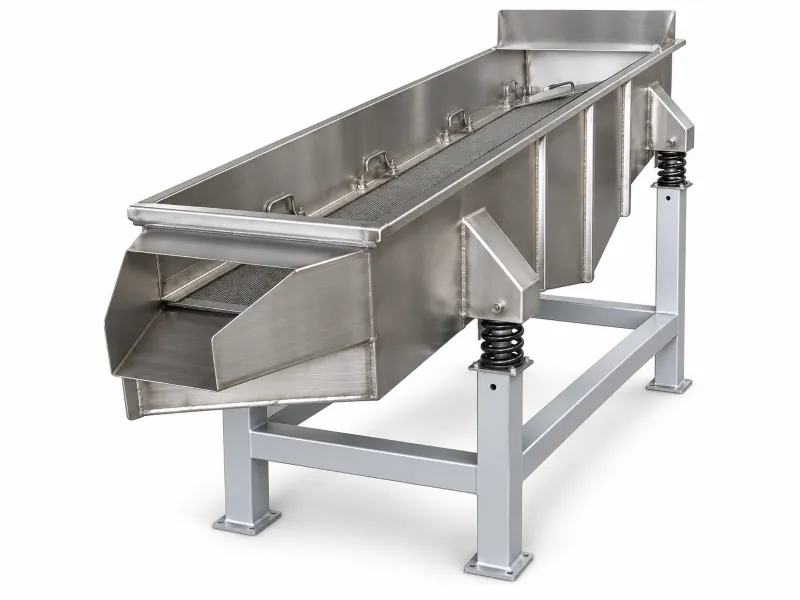
A ナッツ用リニア振動ふるい 所定の開口サイズを持つふるいの上に原料を通すことで、これらの作業を行います。小さい粒子はふるいを通過し、大きいものは別の排出口へ進みます。1段のふるいでは、原料を2つのサイズに分けられます。複数段のふるいでは、原料をいくつかのサイズに分けられます。
ふるい分けの基準はサイズに限られます。製品として許容される仁とほぼ同じサイズの石や殻の破片は、同じ排出口から出てくる可能性があります。ふるい分けだけでは、それらを確実に除去できません。
ナッツ加工ラインにおけるふるい分けの位置づけ
ナッツ用直線振動ふるいは、殻むき後、加工工程の間、または包装前に設置できます。適切な設置位置は、破片が発生する場所や、次の工程で規定された製品サイズが必要になる場所によって異なります。
殻むき後の小さな破片の除去
殻むきや取り扱いの後には、形の整った仁以外のものも残ります。原料には、割れた仁、細かい殻の破片、粉じんも含まれる場合があります。
適切な開口サイズのふるいを使うと、小さいものはふるいを通過し、大きい仁は排出端へ移動します。それぞれ別々に回収します。
アーモンドやカシューナッツの場合は、ふるいを通過したものを確認してください。その中には、別の製品規格に使える仁の破片が含まれている場合があります。また、開口部が大きすぎると、製品として許容される仁が通過して失われる可能性もあります。
ここでは形状も重要です。細長いものや平たいものは、向きによっては開口部を通過し、別の向きではふるいの上に残ることがあります。
包装前のサイズ選別
多段式ナッツ選別機は、混在するサイズを分け、それぞれを回収して包装できるようにします。
複数のサイズ等級を販売するアーモンド加工業者は、各グループの境界を明確にする必要があります。形の整った仁と小さな破片を分けるカシューナッツ加工業者には、別の構成が必要になる場合があります。
ナッツ用リニア振動ふるいは、サイズによって選別します。色、成熟度、カビ、内部品質の確認には、別の検査方法や選別方法が必要です。
次工程への原料の搬送
ふるいは原料を選別すると同時に、排出口へ搬送します。これにより、殻むき、回収、包装の各工程をつなぐことができます。
設置前にレイアウトを確認してください。供給高さは原料が最上段のふるいに落ちる際の状態に影響し、排出口の位置は、各選別物が滞留せずに所定の回収場所へ届くかどうかを左右します。
Yuanjingの リニア振動ふるい装置 は2台の振動モーターを使用し、ふるいの寸法、段数、構造を用途に合わせて設定できます。
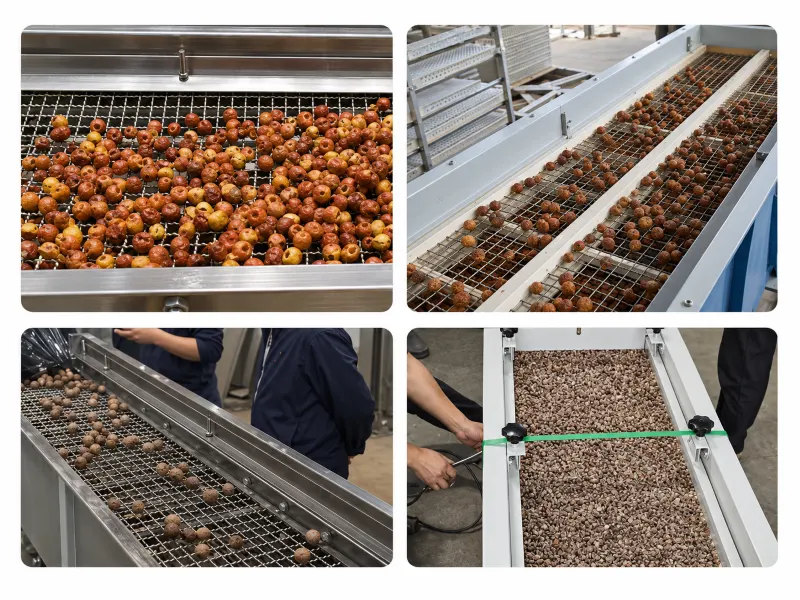
ナッツ用リニア振動ふるいの仕組みとは?
ナッツ用リニア振動ふるいは、一般にスクリーンボックス、ふるい枠、金網またはふるい板、2台の振動モーター、防振ばね、支持フレームで構成されます。
モーターは互いに逆方向へ同期回転します。両者が生み出す加振力によって、ふるい本体が直線状に振動します。振動と重力によって供給された原料が広がり、排出端へと搬送されます。
ふるい目を通過した原料は、次の段または目下品の回収場所に落下します。ふるい上に残った原料は、排出口へ進みます。さらに段を設けることで、より小さなふるい目で同じ工程を繰り返します。
原料の供給分布は、ふるい面をどれだけ有効に使えるかに影響します。原料が一か所に集中して積み重なると、一部の粒子がふるい目に到達する前に先へ移動してしまいます。
1段式と多段式、どちらを選ぶ?
まず工程に必要な選別を明確にし、その後で段数を選びます。
| 加工作業 | 構成の考え方 | 試運転時の確認事項 |
|---|---|---|
| 大きな仁から小さな破片を取り除く | 1段で1つのサイズ境界により選別 | 目下品とともに失われる合格品の仁 |
| 大きすぎる原料、目的の製品、細かい破片を分ける | 2段で3種類に選別 | Separation at both size boundaries |
| 包装用に複数のサイズに分ける | 製品仕様に合わせた多段構成 | 各排出口での粒度の均一性 |
| ナッツの種類やサイズの切り替え | アクセスしやすく交換可能なスクリーン | 清掃、残留物の除去、切り替えのためのアクセス |
原資料では、単層デッキの設計と 2~6層デッキの構成について説明しています。Yuanjingの製品ページに掲載されている構成のデッキ数は 1~6層です.
6層デッキのナッツ用直線振動スクリーンでは、理論上最大 seven size fractions。ただし、7つの販売可能な等級に分けられるという意味ではありません。排出口によっては、微粉、規定サイズを超える異物、または追加処理が必要な材料が集まることがあります。
Each extra deck also adds a surface to clean and inspect. Make sure operators can reach the lower decks and remove the screens.
Yuanjingの リニア振動ふるい選定ガイド covers screen area, material characteristics, and deck selection in more detail.
Almonds, Cashews, Walnuts, and Pine Nuts Need Different Settings
A linear vibrating screen for nuts should be selected using the material that will actually enter it. In-shell walnuts behave differently from shelled almonds or cashew fragments.
| 材質 | Screening task | Watch for |
|---|---|---|
| Almond kernels | Size grading and small-fragment removal | Kernel loss and surface scuffing |
| Cashews | Broken-piece separation and size grading | Additional breakage |
| In-shell walnuts | Size separation and removal of differently sized debris | Openings that do not match the walnut size distribution |
| Macadamia products | Separation with controlled impacts | Damage at the inlet, deck transfers, and outlets |
| Pine nuts | Separation with sufficient screening time | Fast rolling, uneven movement, or accumulation |
Walnut Screening: What Do 10 mm, 16 mm, and 22 mm Openings Tell You?
The source document gives a walnut-processing example using 10 mm, 16 mm, and 22 mm openings.
These are example size boundaries, not a standard configuration for every walnut variety. Measure a representative batch first, then define the acceptable range for each fraction.
For successive multi-deck grading, larger openings would generally sit above smaller ones. Material passing through the upper screen then reaches the next separation.
A walnut passing through an opening has met a size-related condition. That result alone does not establish whether it is immature or belongs to a premium commercial grade.
Almonds and Cashews: Check Where Damage Occurs
When a linear vibrating screen for nuts handles shelled almonds or cashews, inspect the entire route through the machine.
Start at the feeder. A large drop onto the first deck may damage kernels before screening begins. Then check movement across the screen, transfers between decks, and discharge into the receiving equipment.
The source document discusses vibration adjustment to reduce almond surface damage and lower transfer drops for damage-sensitive macadamia applications.
Test these arrangements with the actual product. Comparing the broken-kernel proportion before and after screening helps show whether the process is adding damage.
Pine Nuts: Watch How Quickly They Leave
Pine nuts can roll along the screen quickly. If they reach the outlet before enough separation occurs, review feed distribution and the permitted operating settings.
The source document suggests retaining strips as one possible way to extend residence time. Before adopting them, check whether they cause accumulation or make cleaning harder.
Stainless Steel Construction and Screen Cleaning
Define Which Parts Contact the Product
For a stainless steel linear vibrating screen for nuts, the material specification should identify the product-contact components.
These may include the inside of the screen box, screen frames, screening surfaces, discharge chutes, and seals. “Stainless steel construction” on its own leaves room for misunderstanding.
The source document discusses 304 and 316 stainless steel. Yuanjing’s food processing screening and conveying solutions describe 304 or 316L stainless steel material-contact parts.
Choose the final specification with the cleaning method, cleaning chemicals, and operating environment in mind.
Investigate Blockage Before Choosing a Cleaning Device
Fine particles, moisture, and surface residues can block screen openings.
The source document describes elastic ball cleaning: balls beneath the screening surface strike it to help release trapped particles. Suitability depends on the opening size, screen structure, and product.
Confirm the ball material and installation details in the equipment specification. During a trial, note where blockage starts and how quickly it reduces the open screening area.
Leave Room for Cleaning
An enclosed linear vibrating screen for nuts can help contain dust and fragments. Operators still need to open it, inspect retained material, and clean the internal surfaces.
For a plant that changes nut varieties or product sizes regularly, removable screens and accessible outlets can make a substantial difference to changeovers. Review how the cleaning work will be done before approving the layout.
Verify Capacity with Your Own Material
The capacity of a linear vibrating screen for nuts depends on the feed, openings, deck arrangement, and feeding conditions. Machine dimensions alone cannot establish throughput for whole almonds, in-shell walnuts, or cashew pieces.
The source document suggests a 50 kg sample for preliminary testing under different settings. Use that as a starting point for planning the trial. The actual quantity required depends on the machine, feed arrangement, and test duration.
Include the fragments, fines, and impurities normally found in production. A sample consisting only of clean, whole kernels will not reveal how the machine handles the usual feed.
| Trial item | Record | What it helps establish |
|---|---|---|
| Feed condition | Variety, size distribution, moisture, and surface condition | Whether the sample represents production |
| 供給 | Feed rate and distribution across the width | Whether loading is stable |
| Outlet fractions | Weight and composition of each stream | Whether the required separation is achieved |
| Acceptable product loss | Usable kernels entering unwanted fractions | Whether openings need adjustment |
| Added breakage | Broken-kernel proportion before and after screening | Whether handling damages the product |
| ふるいの状態 | Blinding, accumulation, and uneven travel | Whether operation remains stable |
Keep the opening sizes, operating settings, and feed rate alongside the results. Operators can then compare later batches against the same conditions.
If throughput falls or material builds up, Yuanjing’s guide to improving linear vibrating screen efficiency explains the effects of feed distribution, screen condition, and vibration settings.
Routine Checks
Routine inspection of a linear vibrating screen for nuts should cover the screens, motor mountings, isolation components, and product-contact areas.
Check for:
- Loose, damaged, or persistently blocked screens.
- Material trapped around frames and outlets.
- Loose motor-mounting bolts.
- Dust obstructing motor ventilation.
- Damaged or uneven isolation springs.
- Unusual noise, vibration, or bearing temperature.
Use the equipment and motor manuals to set lubrication procedures, maintenance intervals, and shutdown criteria.
When output drops, inspect the feed as well as the machine. A change in moisture, fragment content, or feeding rate may explain the problem even when the screen is undamaged.
Discuss Your Nut Screening Requirements with Yuanjing
Whether the job is broken kernel separation after shelling, almond size grading, or cashew screening before packaging, begin with the feed and the required outlet fractions.
For an existing line, describe any blockage, product loss, mixed grades, or additional breakage. These details help define the screen openings, deck arrangement, and material-transfer requirements.
Contact Yuanjing Machinery about your nut screening requirements with your material details and production targets.
微細粉体に超音波振動ふるいが必要ですか?
Can a Linear Vibrating Screen for Nuts Remove Impurities and Grade Sizes at the Same Time?
Yes, when the separations depend on size. Multiple decks can retain larger material, collect target size fractions, and discharge smaller fragments separately. Results depend on the size difference between acceptable nuts and the unwanted material.
Can It Remove All Stones and Shell Fragments?
No. Stones and shell pieces similar in size to acceptable nuts may leave through the same outlet. The contamination present determines whether additional separation methods are needed.
Will More Decks Improve the Result?
More decks provide more size boundaries. They also add cleaning work, access requirements, and material transfers. Use the number needed for the required fractions.
Can Almonds and Cashews Use the Same Openings?
Their shapes, sizes, and broken-kernel distributions differ. An existing screen configuration may provide a starting point for testing, but the trial results should determine the final openings.
What Information Is Needed to Select a Linear Vibrating Screen for Nuts?
Provide the nut type, whether it is shelled or in-shell, representative photographs or samples, target throughput, unwanted material, and required product sizes. Include the installation space and inlet and outlet heights.