Przypadek transportu próżniowego proszku aluminiowego: 500 kg/h na wysokości 8 metrów
Przegląd projektu
A customer contacted us for an aluminum powder vacuum conveying system.
The requirements were clear. The material was aluminum powder. The required capacity was 500 kg/h. The powder also needed to be lifted to a height of 8 meters and continuously fed into the next machine.
The customer first asked us a simple question:
“Can your vacuum feeder convey 500 kg/h of aluminum powder to a height of 8 meters?”
The capacity itself was not difficult. The 8-meter vertical height was the main point we needed to consider.
The actual capacity of a vacuum conveyor changes with the material, conveying height, horizontal distance, and pipe layout. A machine that can handle 500 kg/h over a short distance may not reach the same capacity at a height of 8 meters.
So we did not select a standard model based only on the 500 kg/h capacity.
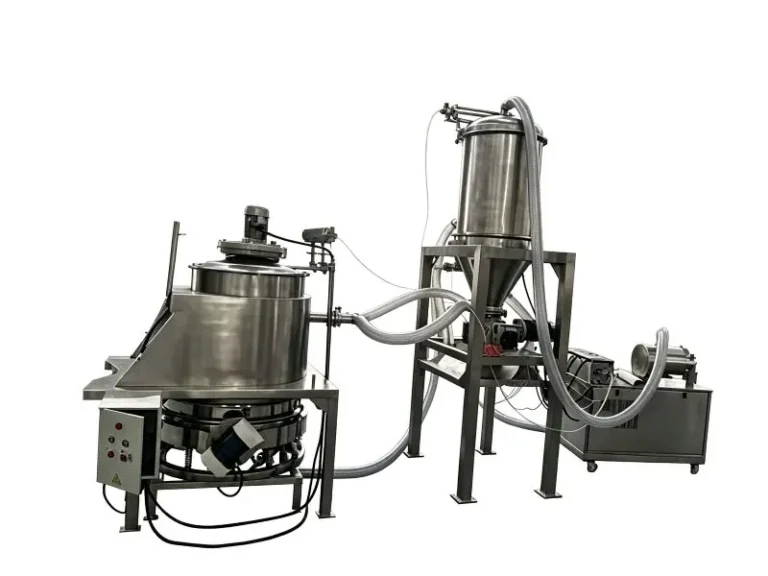
After checking the working conditions with the customer, we recommended our 450 continuous vacuum feeder. The system was configured for the 8-meter conveying height and the required production capacity.

Wymagania klienta
The customer had three main requirements:
- Material: aluminum powder
- Required capacity: 500 kg/h
- Vertical conveying height: 8 m
- Continuous feeding to downstream equipment
During our discussion, the customer was mainly concerned about the conveying height.
The question was:
“Will the 8-meter height reduce the conveying capacity?”
Yes, conveying height can affect the actual capacity.
The capacity of a powder vacuum conveyor is not fixed under every working condition. Vertical height, horizontal distance, material bulk density, particle size, flowability, and pipe bends can all affect the final result.
For this reason, we considered the 500 kg/h capacity and 8-meter height together when selecting the machine.
Why Did We Choose the 450 Continuous Vacuum Feeder?
After receiving the basic information, we discussed the conveying conditions with the customer and checked the suitable model.
The downstream machine needed a continuous supply of aluminum powder. For this reason, we recommended a continuous vacuum feeding system instead of a standard batch feeding solution.
The 8-meter lifting height was also important.
If the vacuum feeder was too small, the actual conveying capacity could drop after installation. It might work well over a short distance but fail to reach the required 500 kg/h at the customer’s actual conveying height.
After evaluating these conditions, we recommended the 450 continuous vacuum feeder.
The system was configured according to the customer’s 8-meter conveying height.
Before confirming the order, we also explained that the rated capacity of a vacuum feeder should not be considered separately from the actual conveying conditions.
The customer agreed with the solution, and we moved forward with the final configuration.
Our Aluminum Powder Conveying Solution
The final solution uses vacuum negative pressure to move the aluminum powder.
The vacuum system draws the powder into the conveying pipe. The material then travels through the closed pipeline and is lifted to the required 8-meter height. From there, it is discharged into the customer’s downstream equipment.
The project had two main targets:
500 kg/h conveying capacity and 8-meter vertical conveying height.
The customer also needed continuous feeding. So we used a continuous vacuum conveying design to match the feeding demand of the downstream process.
This allows the aluminum powder to move directly from the feeding point to the next production stage with less manual handling.
Parametry urządzenia
| Pozycja | Specyfikacja |
|---|---|
| Materiał | Aluminum Powder |
| Sprzęt | Continuous Vacuum Feeder |
| Model | 450 |
| Required Capacity | 500 kg/h |
| Pionowa wysokość transportu | 8 m |
| Metoda transportu | Vacuum Conveying |
| Feeding Type | Continuous |
| Aplikacja | Aluminum Powder Feeding |
| Configuration | Customized for Actual Conveying Conditions |
The 500 kg/h capacity is based on the requirements of this specific project.
Actual vacuum conveying capacity depends on the material, bulk density, particle size, flowability, conveying height, horizontal distance, and pipe layout.
For this reason, we check the actual working conditions before recommending a vacuum feeder model.
What Problems Did This System Solve?
1. Conveying 500 kg/h at an 8-Meter Height
This was the main requirement from the customer.
We did not select the machine based only on the required capacity. We also considered the 8-meter vertical distance.
The final 450 continuous vacuum feeder was selected and configured for these working conditions.
2. Continuous Feeding
The customer was not simply moving aluminum powder from one container to another.
The powder needed to continuously feed the next machine in the production line.
A continuous vacuum feeder was therefore more suitable for this application. It reduces repeated manual feeding and provides a more consistent material supply.
3. Closed Powder Conveying
Aluminum powder can create dust during manual dumping and open transfer.
With vacuum conveying, most of the material transfer takes place inside a closed pipe.
This reduces direct exposure of the powder during transfer and helps keep the working area cleaner.
4. Less Manual High-Level Feeding
The discharge point in this project was 8 meters high.
Manual feeding at this height would be difficult and would not be practical for continuous production.
The vacuum conveyor for aluminum powder moves the material directly from a lower feeding point to the required height. This reduces manual material handling.
Main Features of the 450 Continuous Vacuum Feeder
Continuous conveying
The system is suitable for production lines that need a continuous supply of powder.
8-meter vertical conveying
The system was configured according to the customer’s actual conveying height.
Closed conveying
The aluminum powder moves through a closed pipeline. This helps reduce dust during material transfer.
Less manual handling
The system reduces repeated manual loading and material transfer.
Flexible installation
The pipe layout and connections can be designed according to the feeding point, discharge point, and equipment position.
Easy production line integration
The vacuum feeder can be connected to downstream processing equipment for automatic powder feeding.
Opinie klientów
After installation and operation, the customer checked the two main requirements: conveying capacity and conveying height.
The 450 continuous vacuum feeder was able to convey the aluminum powder to the required 8-meter height and meet the production demand of about 500 kg/h.
The customer also reduced manual material transfer and high-level feeding. The aluminum powder can now move through the conveying pipe directly to the downstream equipment.
From the first question about whether 500 kg/h could be achieved at an 8-meter height to the final machine selection, the key was not simply choosing a larger vacuum feeder.
The important part was selecting the system according to the actual conveying conditions.
Need a Vacuum Conveyor for Aluminum Powder?
Vacuum feeder selection should not be based on capacity alone.
For example, two customers may both need 500 kg/h. One needs to lift the powder 3 meters, while the other needs to lift it 8 meters. The suitable configuration may be different.
The material also matters. Aluminum powder and other powders may have different bulk density, particle size, and flowability.
If you are looking for an aluminum powder vacuum conveyor, continuous vacuum feeder, or powder vacuum conveying system, send us the following information:
- What material do you need to convey?
- What capacity do you need per hour?
- What is the vertical conveying height?
- What is the horizontal conveying distance?
- What equipment will receive the material?
Our team will check your actual working conditions and recommend a suitable vacuum feeder and conveying configuration.
Contact our team and send us your material and conveying requirements. We will help you find a suitable vacuum conveying solution for your production line.