How to Choose a Salt Tumbler Screen for Coarse and Fine Salt Grading
A salt tumbler screen separates salt into consistent particle sizes while removing hard lumps and oversized material. Its gentle circular motion is particularly useful when a producer needs to sell several salt grades and preserve the appearance of the crystals. Applications include food-grade, industrial, and specialty salts.
The first selection question is what happens to the salt on your line. If damp salt coats the mesh halfway through a shift, the useful measure is how long the screen runs between cleaning stops. If fine grains keep turning up in the coarse product, the priority is how much salt at each outlet meets the finished-grade specification.
How Does a Tumbler Screen Separate Coarse and Fine Salt?
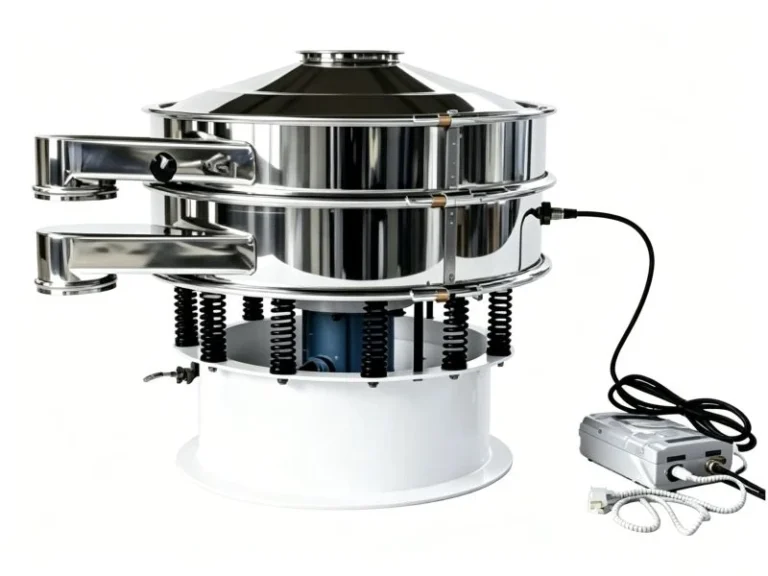
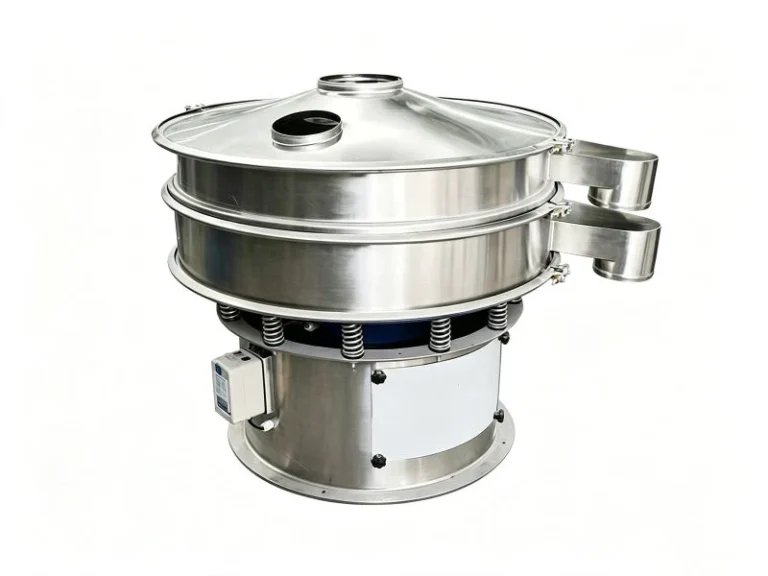
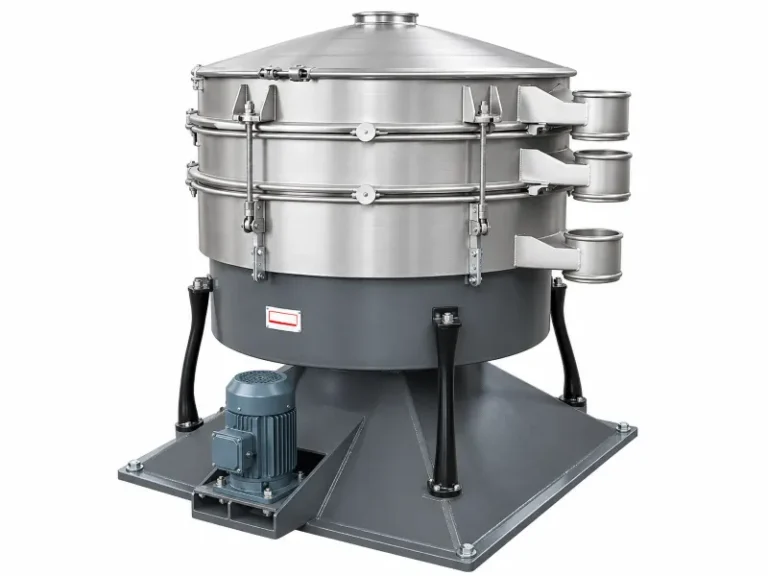
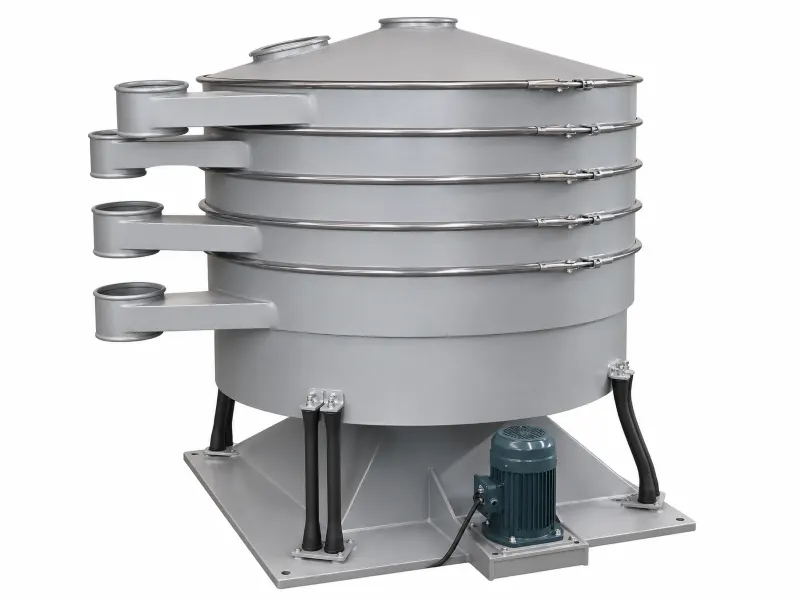
In a sàng quay tròn, an eccentric drive moves the screen housing in a horizontal orbit with a slight upward lift. Salt lands in the center, spreads across the mesh, and gradually travels toward the rim. Smaller grains pass through the openings. Larger crystals continue to the oversize outlet. Stacking decks with different openings allows a single feed stream to produce coarse, medium, and fine salt.
Depending on the machine design, the eccentric offset can range from 25 to 40 mm. The eccentric angle and operating speed influence how quickly salt crosses the deck and how long it has to pass through an opening.
When adjusting the machine, I recommend taking a feed sample and a separate sample from each outlet. Look for fine grains in the coarse fraction, then check whether screening has generated additional powder. This is especially useful with solar salt, where a batch can meet the size specification yet lose some of the crystal appearance the customer values.
How Many Screen Decks Do You Need for Salt Grading?
Start with the products you intend to sell. A line producing three salt grades has a different discharge arrangement from one that simply removes lumps before packaging. If you are also evaluating rotary or linear screens, Yuanjing’s guide to salt classification with vibrating screens gives examples for table salt, sea salt, and fine salt.
| Giai đoạn sàng | What the screen needs to do | What to measure during a trial |
|---|---|---|
| Grading after drying or crushing | Separate one batch into coarse, medium, and fine salt for sale | Particle size at each outlet and the hourly yield of each saleable grade |
| Screening damp salt after centrifuging | Handle salt that clumps and gradually blocks the mesh | Time until blinding begins and the resulting drop in throughput |
| Grading solar salt | Separate crystals by size while preserving their appearance | Crystal condition and the amount of fines before and after screening |
| Final screening before packaging | Remove hard lumps, oversized grains, and larger foreign material | Material retained on the screen and the largest particles in the finished salt |
Multi-grade applications commonly use two to five screen decks. List every fraction that needs its own outlet before choosing the deck count. For example, a plant selling coarse, medium, and fine salt may also need to collect hard lumps separately. That reject stream needs a discharge path of its own.
For a line producing 5–30 metric tons per day, divide the daily target by the hours available for actual screening. Allow for screen changes, washdown, and stops to clear blocked mesh. This gives you the hourly feed rate the machine must sustain within the available floor space.
How Do You Prevent Screen Blinding in Damp or Fine Salt?
For ordinary granular salt, start by testing soft silicone cleaning balls beneath the mesh. About 70% ball fill is one trial starting point. Spread the balls evenly and inspect the deck after a run. Balls that collect in one area strike the same patch repeatedly while openings elsewhere remain blocked.
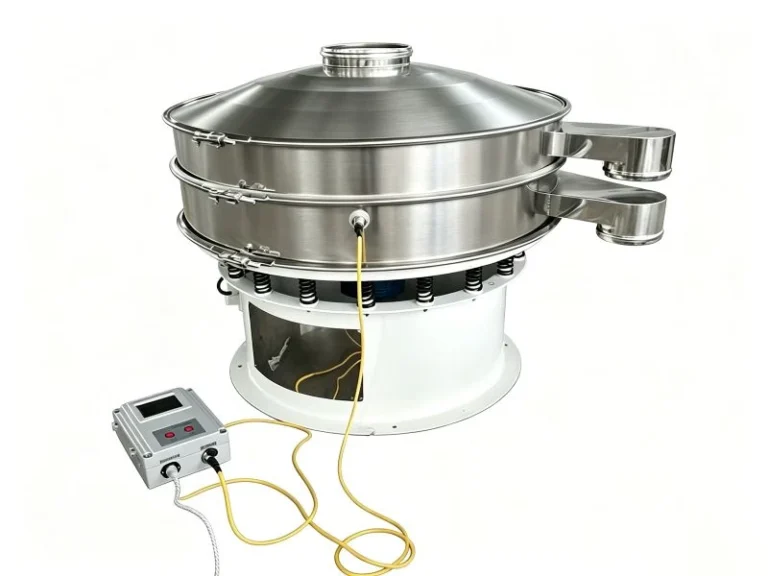
At around 140 lưới, include ultrasonic screen cleaning in the trial. Salt that readily absorbs moisture and forms clumps may justify comparing the two methods at sizes just finer than 100 lưới. With drier salt that blinds slowly, cleaning balls may still be worth testing at around 180 mesh.
Keep the salt batch and feed rate the same for both runs. Record when openings start to block, how long it takes to clean the mesh, and how long the machine runs after restarting. A screen that performs well in the first few minutes can look quite different halfway through a shift.
Which Stainless Steel Parts Should You Inspect on a Salt Screening Machine?
Start at the frame joints, the inside of each discharge outlet, and the areas around the seals. Salt can remain in all three locations after the visible deck looks clean. During inspection, ask to see a screen change and a washdown so you can judge how easily an operator can reach them. The stainless steel circular tumbler screen provides a reference when discussing the equipment configuration.
Product-contact parts may use 304 or 316-series stainless steel, depending on operating conditions. One configuration for dry salt at ambient temperature uses 316L contact parts and screen-frame sheet approximately 3 mm thick. Side-plate thickness depends on the machine design.
If the plant uses warm wash water or salt slurry collects at low points, tell the manufacturer the wash temperature and show where liquid remains. Check whether welds are smooth, whether salt collects in corners, and whether the machine drains fully after washing. Where dust containment matters, also inspect the cover seal, frame joints, and discharge connections.
When Is a Tumbler Screen a Good Fit for a Salt Processing Line?
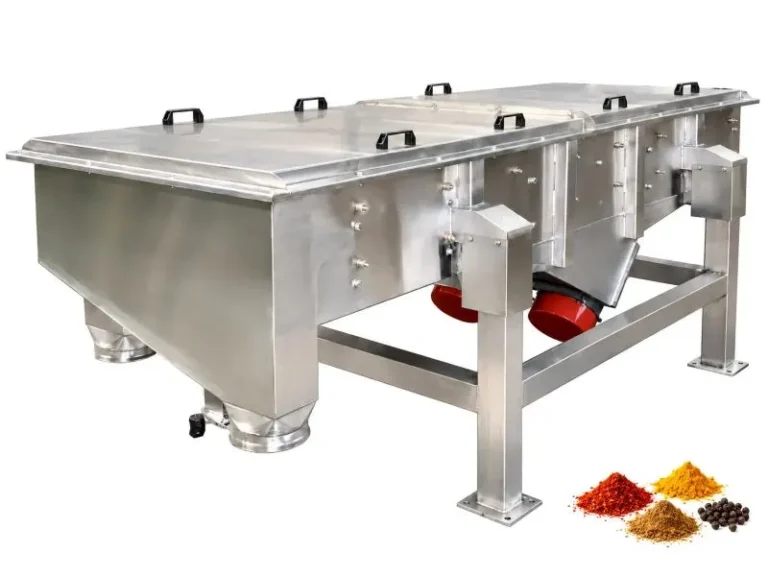
A tumbler screen is worth evaluating when salt leaves the centrifuge damp enough to coat the mesh within half a shift, or when a plant needs several saleable grades from one feed stream. A rectangular multi-deck screener is another option for producing two or three grades in one pass.
An enclosed stainless steel machine can help a plant contain dust while giving operators access for washdown. On a line producing 5–30 metric tons per day, the practical question is how much in-spec salt the equipment can deliver within the existing floor space. For plants handling several products, Yuanjing’s industrial salt sifter specifications also cover food-grade, chemical, and de-icing salt applications.
What Changed on Two Salt Lines After Switching to Tumbler Screening?
Line 1 increased throughput from 2.2 to 3.2–3.5 metric tons per hour
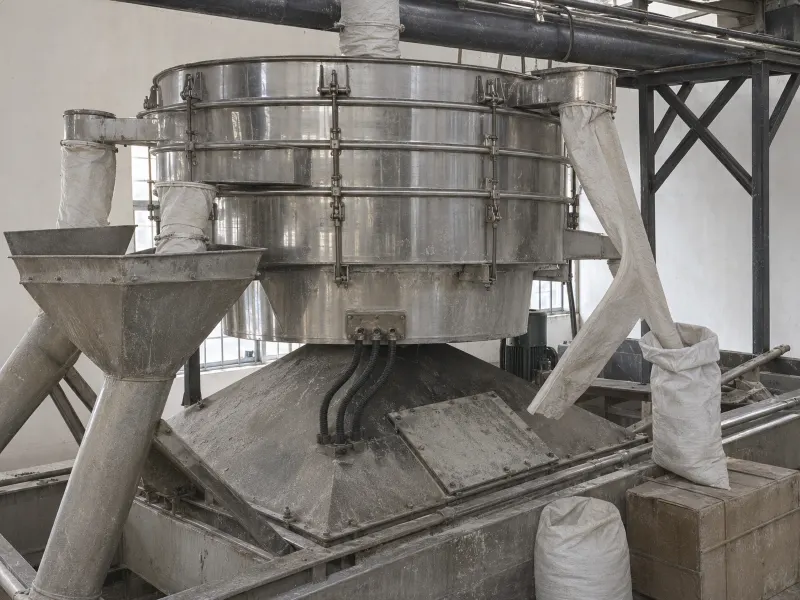
Before the plant installed a multi-deck tumbler screen, throughput fluctuated around 2.2 metric tons per hour. After the change, it stabilized at 3.2–3.5 metric tons per hour. Using 2.2 as the baseline, the increase was approximately 45–59%.
The plant recorded particle-size uniformity of about 85% before the change and reported that the upgraded line met its finished-product requirement. Operators also observed the removal of stones, sand, and sediment. The production record gives no final percentage for either uniformity or impurity removal.
Line 2 ran for more than eight hours between cleaning stops
The second plant focused on downtime caused by mesh blinding. After the upgrade, the screen ran continuously for more than eight hours. Screen changes and cleaning took about one-third of the previous time. The plant recovered approximately 30% of the output it had previously lost to cleaning stops.
Other applications report 90–95% screening efficiency, and some report several times the throughput of a conventional circular vibrating screen with the same screening area. Those comparisons depend on salt moisture, aperture size, feed rate, and how efficiency was calculated. For a purchasing decision, measure the hourly output that meets your specification and count the cleaning stops over a full shift.
What Salt Sample Should You Bring to a Screening Trial?
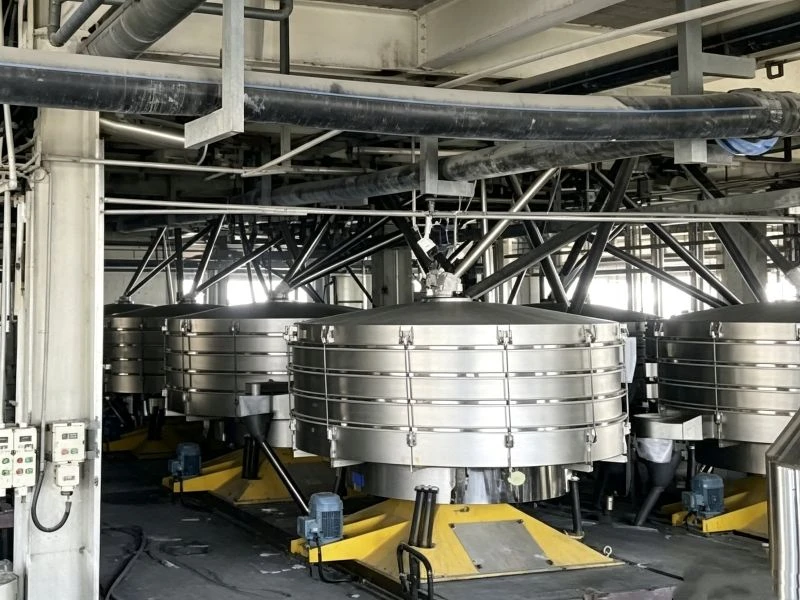
Choose a batch that regularly causes trouble. If freshly centrifuged salt blinds the mesh, test it while it still has its usual moisture content. If coarse and fine salt are difficult to separate, bring the size limits for each finished grade. The current screen opening, hourly feed rate, and cleaning frequency give the trial a baseline.
For a grading trial, collect samples from every outlet. For a blinding trial, maintain the normal production feed rate and record when throughput starts to fall and how long cleaning takes. These results give you a practical basis for selecting the aperture, deck count, and cleaning method.
Kết luận
A good salt grading setup produces the required amount of each saleable grade, preserves the crystals your customers value, and runs long enough between cleaning stops to meet the daily target. The most useful starting point is often a sample from the batch your current screen struggles with.
If you are selecting a new salt tumbler screen or replacing an existing sifter, send your salt type, moisture condition, target capacity, and required particle sizes. If the current machine blinds halfway through a shift or leaves fines in the coarse product, mention that too. Those details help the team assess the deck arrangement, mesh openings, and cleaning options for your line. Contact Yuanjing Machinery to discuss your salt screening requirements or request a quote.
Câu hỏi thường gặp
1. What mesh size should I use for coarse and fine salt?
Use the particle-size limits in your finished-product specification to select the screen openings. For grading, collect samples from each outlet and check that each fraction meets its limits. For a final check before packaging, select the opening according to the largest acceptable grain and inspect both the retained lumps and the finished salt.
2. Can one salt grading machine produce coarse, medium, and fine salt in one pass?
Yes. Two screen decks with different openings can produce three fractions. The top deck retains the coarsest salt, the lower deck retains the middle grade, and the finest salt passes through both. If hard lumps must leave through a separate reject outlet, include that extra separation when specifying the machine.
3. Can a salt tumbler screen handle damp salt straight from a centrifuge?
It can be evaluated for this duty. Bring freshly centrifuged salt to the trial and run it at the intended feed rate. Record how long it takes for the mesh to blind, how much throughput falls, and how long cleaning takes. A dry sample misses the condition most likely to limit output on this type of line.
4. When is ultrasonic screen cleaning worth testing for fine salt?
Around 140 lưới is a practical starting point for a comparison with cleaning balls. If salt absorbs moisture and clumps readily, compare the two methods at sizes just finer than 100 lưới. Run each configuration long enough to see how often it needs cleaning at your normal feed rate.
5. How do I size a salt screening machine for 20 metric tons per day?
Divide the daily tonnage by effective screening hours. For example, 20 metric tons over eight effective hours requires 2.5 metric tons per hour. If an eight-hour shift includes one hour of cleaning and screen changes, the screen has seven effective hours and must handle approximately 2.86 metric tons per hour. If the 20-ton target refers to saleable salt, also account for the fraction discharged as rejects.
6. What information does a supplier need to quote a salt tumbler screen?
Provide the salt type, its condition at the screen inlet, the target hourly rate, and the particle-size limits for each finished grade. Specify whether the job includes removing hard lumps, separating several saleable grades, or both. For a replacement machine, include the existing mesh size, cleaning frequency, available floor space, and any washdown or dust-containment requirements.