Sàng phế liệu thủy tinh và giấy: Nghiên cứu điển hình về sàng rung tuyến tính tùy chỉnh
Screening equipment needs to fit both the material and the production line. In this project, the customer needed to screen glass fragments and paper scraps at a required throughput of 3–5 tonnes per hour. They also needed the discharge outlets to match the receiving positions of the next process.
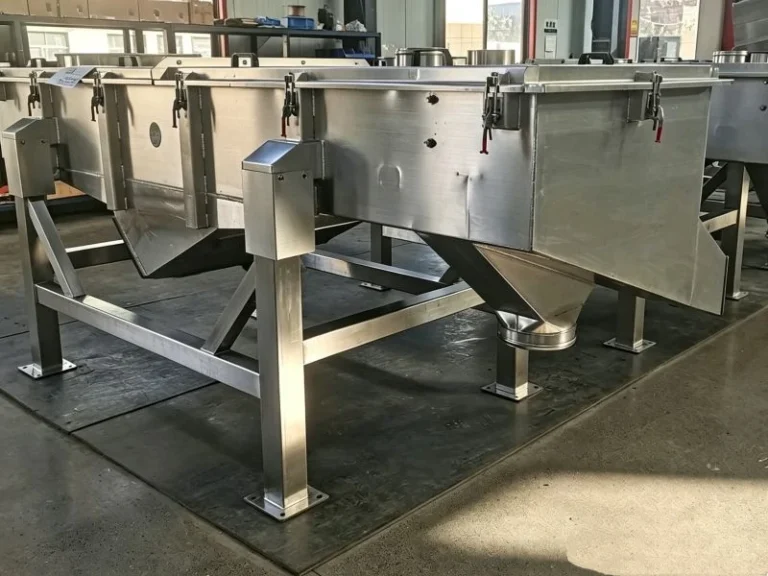
Our solution was a custom linear vibrating screen with a screen surface measuring 1.2 metres wide by 2.5 metres long, 304 stainless steel material-contact parts, and two discharge outlets facing different directions.
The main design considerations were straightforward: support the screen mesh securely for large particles, make future screen maintenance practical, and arrange the outlets around the customer’s production layout.
Tổng quan dự án
The customer’s material contained glass fragments and paper scraps, including relatively large particles. The screening machine needed to connect to a production line and direct the screened fractions to the next stage.
For this application, we selected a sàng rung tuyến tính with a custom mesh assembly and discharge arrangement.
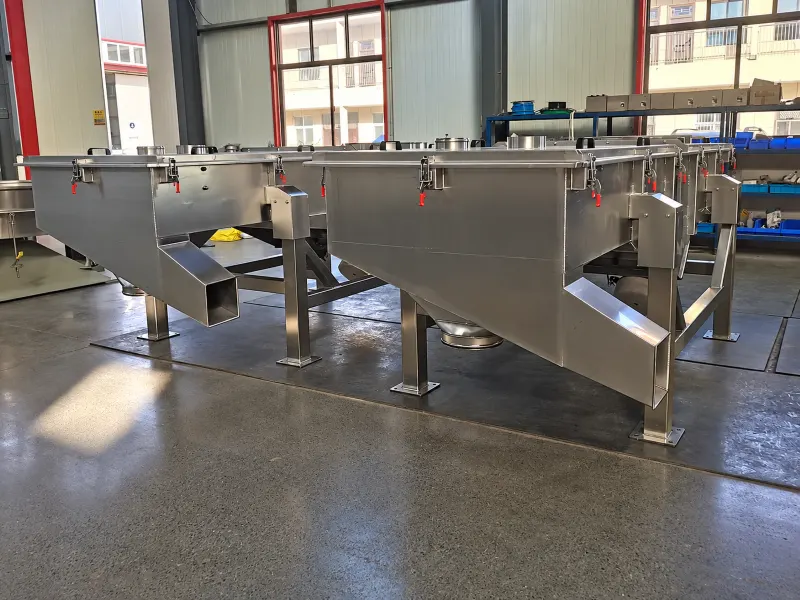
Rather than treating the outlets as a standard detail, the equipment configuration incorporated the customer’s specific requirement: one outlet discharging straight ahead and the other discharging to the left.
Yêu Cầu Của Khách Hàng
A Required Throughput of 3–5 Tonnes per Hour
The customer specified a processing requirement of 3–5 tonnes per hour. This provided the starting point for sizing the equipment and considering its connection to upstream and downstream operations.
The selected screen surface measures 1,200 × 2,500 mm. Actual operating capacity depends on the screen opening size, material composition, particle size distribution, and feeding conditions.
A Secure Screen Assembly for Large Particles
The relatively large glass fragments made the screen structure an important part of the discussion. The mesh needed suitable support and secure attachment to its frame.
The solution also needed to account for future maintenance. Screen replacement should be considered during equipment design, rather than left until the mesh requires servicing.
Discharge Outlets That Match the Site Layout
The customer specifically requested two discharge directions:
- One outlet facing straight ahead.
- One outlet facing the left side.
These positions were required to match the receiving arrangement for the next process. The outlet layout therefore became a key part of the custom design.
304 Stainless Steel Material-Contact Parts
The customer specified 304 stainless steel for the parts in contact with the material. This material requirement was incorporated into the equipment configuration.

Our Solution: Custom Linear Vibrating Screen for Glass
A 1,200 × 2,500 mm Linear Vibrating Screen
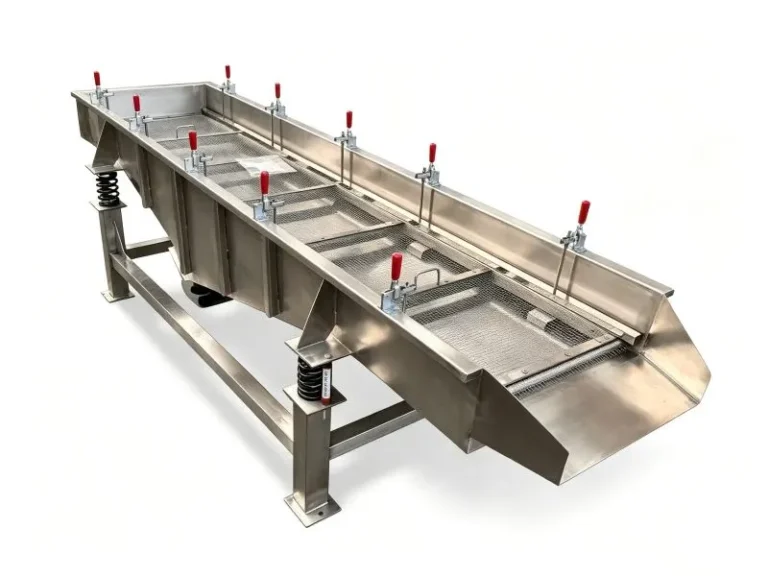
The selected machine provides a rectangular screening surface measuring 1.2 metres wide and 2.5 metres long, with a two-grade screening configuration.
The project brought together the screening requirement and the installation requirement: the machine needed to process the material while directing its outputs toward the appropriate receiving points.
Diamond-Pattern Stainless Steel Woven Mesh
For the large-particle material, we used diamond-pattern stainless steel woven mesh.
The mesh is riveted directly to a metal screen frame, forming an integrated mesh-and-frame assembly. This assembly is then secured to the vibrating screen.
The design gives the mesh a defined supporting structure and secure attachment points. It also allows the frame assembly to be removed for inspection and mesh replacement.
When the mesh itself needs replacing, the riveted connections must be removed and renewed. The maintenance benefit comes from handling the mesh and its supporting frame as an assembly.
Custom Front and Left Discharge Outlets
The customer’s outlet request was incorporated into the machine layout: one discharge outlet faces forward, while the other faces left.
This arrangement helps align the machine with the intended material routes through the production line. Identifying the outlet directions during the design stage also helps avoid unnecessary changes to the receiving arrangement during installation.
For final line integration, outlet height, connection dimensions, and receiving equipment positions should be checked together.
Equipment Specifications
| Mục | Thông số kỹ thuật |
|---|---|
| Equipment | Custom linear vibrating screen |
| Screening material | Glass fragments and paper scraps |
| Required throughput | 3–5 tonnes per hour |
| Screen surface width | 1,200 mm |
| Screen surface length | 2,500 mm |
| Screening configuration | Two grades |
| Material-contact parts | 304 stainless steel |
| Screen mesh | Diamond-pattern stainless steel woven mesh |
| Mesh attachment | Riveted to a metal screen frame |
| Screen assembly | Integrated mesh and frame secured to the machine |
| Discharge directions | One forward-facing outlet and one left-facing outlet |
| Installation requirement | Connection to a production line |
Screen opening size should be selected according to the required particle separation. If the objective is to separate glass from paper by material type, a screening trial is needed to confirm whether their size and shape differences allow the required result.
Key Equipment Features
Supported Mesh Structure
The stainless steel woven mesh is supported by a metal frame and secured with rivets. This configuration addresses the need for a firmly attached screen surface when handling relatively large particles.
Practical Access for Screen Maintenance
The integrated frame assembly can be removed for inspection and servicing. This makes the screen support structure part of the maintenance plan from the beginning.
Custom Discharge Directions
The forward-facing and left-facing outlets reflect the customer’s actual receiving requirements. Their positions were selected to support production line integration.
Clearly Defined Material Specification
304 stainless steel is used for material-contact parts. Keeping this scope clear makes it easier to check the supplied configuration against the customer’s requirements.
Customer Feedback During Design
The customer’s clearest feedback concerned how the machine would connect to the next process. They requested one outlet facing forward and the other facing left so that each discharge stream could reach its intended receiving position.
This input directly shaped the equipment layout. It highlighted that a suitable screening solution depends on both material handling and the space available around the machine.
This case study documents the customer’s requirements and the equipment configuration. Operating results and post-installation feedback have not yet been included.
Discuss Your Screening Project with Our Team
Do you need a linear vibrating screen for glass fragments, paper scraps, or another bulk material?
Share your material photos or videos, required throughput, target particle size, and production line layout. Our team can help you review the screen dimensions, mesh structure, material-contact parts, and discharge arrangement for your application.
Contact our team to discuss a custom screening solution for your production line.