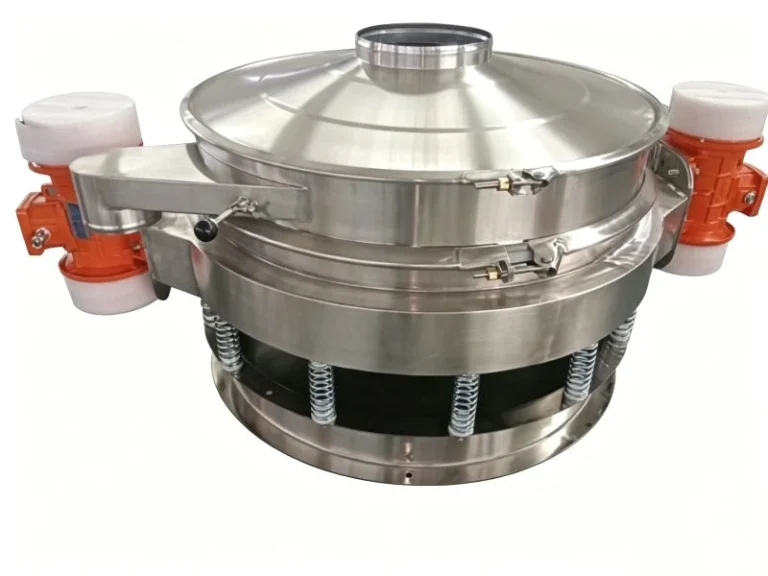
Metallpulver-Siebung: Wie man Maschenweite, Siebtyp und Schutzsystem auswählt
Die Auswahl eines Metallpulver-Siebsystems erfordert mehr als nur die Abstimmung eines Pulvers auf eine Maschenweite. Die richtige Lösung hängt von der Ziel-Partikelgrößenverteilung, der Fließfähigkeit des Pulvers, der erforderlichen Kapazität, den Kontaminationsgrenzen und Risiken wie Oxidation, statischer Elektrizität oder brennbarem Staub ab. Herkömmliche Vibrationssiebe sind im Allgemeinen für frei fließende Pulver und grobere Trennung geeignet, während Ultraschallsysteme für feine, kohäsive oder elektrostatische Pulver effektiver sind. Reaktive Pulver können auch eine versiegelte Konstruktion, Inertgasschutz, Erdung und explosionsgeschützte Komponenten erfordern.
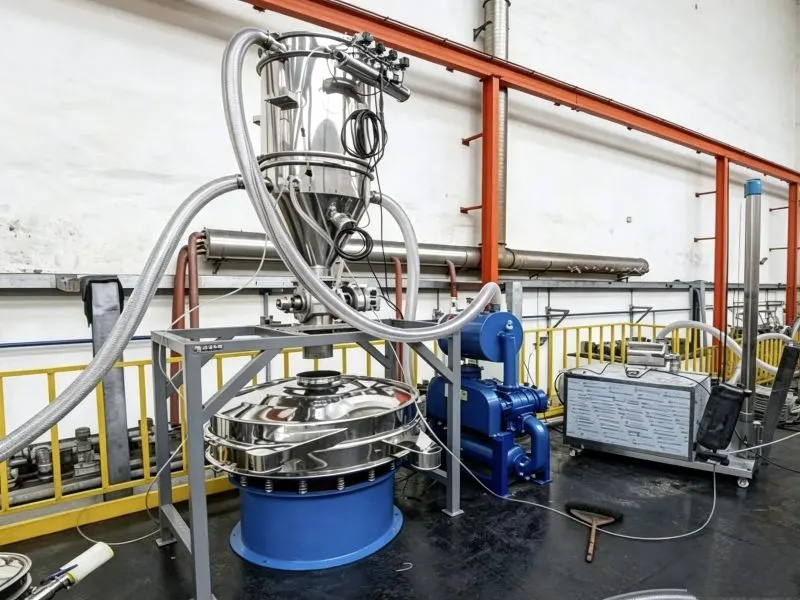
Was ist Metallpulversieben?
Metallpulversieben wird verwendet, um die Partikelgröße zu kontrollieren und das Pulver sauber und konsistent zu halten. Es entfernt Fremdmaterial und übergroße Partikel, zerbricht weiche Klumpen und trennt das Pulver in den erforderlichen Größenbereich. Es kann auch wiederverwendbares Pulver zurückgewinnen und nachfolgende Prozesse wie Pressen, Sintern, thermisches Spritzen und additive Fertigung schützen.
Klassifizierung, Sicherheitssiebung und Pulverrückgewinnung
Metallpulversieben dient im Allgemeinen drei Zwecken:
- Klassifizierung: Trennt das Pulver in verschiedene Partikelgrößenbereiche, um die Produktionsanforderungen zu erfüllen.
- Sicherheitssiebung: Entfernt Fremdmaterial, große Partikel und unerwünschte Agglomerate vor dem nächsten Prozess.
- Pulverrückgewinnung: Gewinnt nutzbares Pulver zurück, das nach dem 3D-Druck oder anderen Produktionsprozessen übrig bleibt, und hilft, Materialverschwendung zu reduzieren.
Die erforderliche Maschenweite und das Siebverfahren hängen von den Pulvereigenschaften, der Zielpartikelgröße, der Produktionskapazität und den Sicherheitsanforderungen ab.
Welche Informationen werden vor der Auswahl eines Siebsystems benötigt?
Vor der Auswahl eines Metallpulver-Siebsystems müssen Sie sowohl die Pulvereigenschaften als auch die Produktionsanforderungen verstehen. Diese Faktoren bestimmen die richtige Maschenweite, den Siebtyp, die Maschinenkapazität und das Schutzsystem. Die Auswahl von Geräten nur anhand des Metallnamens oder der Zielmaschenweite kann zu geringer Kapazität, Siebverstopfung oder Sicherheitsproblemen führen.
Metallpulver-Eigenschaften
Verschiedene Metallpulver verhalten sich beim Sieben unterschiedlich. Wichtige Eigenschaften sind:
- Schüttdichte: Beeinflusst die Siebbeladung, den Materialfluss und die erforderliche Maschinengröße.
- Fließfähigkeit: Frei fließende Pulver lassen sich leichter sieben, während schlecht fließende Pulver auf der Sieboberfläche bleiben können.
- Partikelform: Kugelförmige, unregelmäßige und flockige Partikel passieren das Sieb unterschiedlich.
- Statische Elektrizität: Feine Pulver können am Sieb haften bleiben und die Kapazität verringern.
- Agglomeration: Weiche Klumpen können das Sieb verstopfen oder die Partikelgrößengenauigkeit beeinträchtigen.
- Oxidationsrisiko: Aluminium-, Magnesium-, Titan- und andere reaktive Pulver können versiegelte Geräte oder Inertgasschutz erfordern.
- Materialwert: Hochwertige Legierungs- oder Edelmetallpulver können ein geschlossenes System erfordern, um Materialverlust und Kontamination zu reduzieren.
Partikelgröße und Produktionsanforderungen
Der erforderliche Partikelgrößenbereich und das Produktionsziel müssen ebenfalls bestätigt werden. Wichtige Informationen sind:
- Aktuelle Partikelgrößenverteilung, einschließlich D10, D50 und D90
- Erforderlicher Trennschnitt in Mikrometern
- Akzeptable Anteile an über- und untergroßen Partikeln
- Erforderliche Kapazität pro Stunde
- Anzahl der Partikelgrößenfraktionen
- Batch- oder kontinuierlicher Betrieb
- Sauberkeits- und Kreuzkontaminationsgrenzen
Diese Informationen bilden die Grundlage für die Auswahl der Maschenweite, der Siebausrüstung und des Schutzsystems.
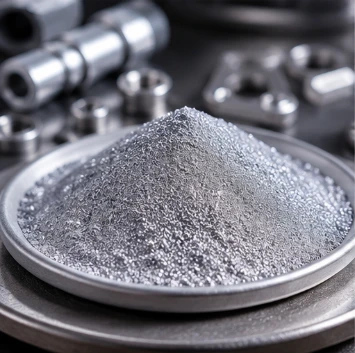
Wie wählt man die richtige Maschenweite?
Die richtige Maschenweite hängt von der Zielpartikelgröße, der Pulververteilung und der erforderlichen Kapazität ab. Entscheiden Sie zunächst, welche Partikel durch das Sieb gelangen sollen und welche Partikel entfernt werden sollen. Wählen Sie dann die Sieböffnung in Mikrometern. Für feine Metallpulver ist die Mikrometergröße normalerweise genauer als die Maschenweite.
Metallpulver können durch ihre Partikelgröße beschrieben werden:
- Konventionelles Pulver: 50–1.000 μm
- Feines Pulver: 10–50 μm
- Sehr feines Pulver: 0.5–10 μm
- Ultrafine powder: Below 0.5 μm
- Nano powder: 0.1–100 nm
These ranges are general references and may vary between industries.
Mesh Size vs Micron Size
Mesh number shows how many openings are present in one inch of screen. A higher mesh number normally means a smaller opening. Micron size shows the actual opening or particle size more directly.
The same mesh number may have slightly different opening sizes because of wire diameter and screen standards. For this reason, fine metal powders should be specified in microns whenever possible.
Common Mesh-to-Micron Reference
| Mesh | Microns (μm) | Mesh | Microns (μm) |
|---|---|---|---|
| 20 mesh | 830 | 200 Mesh | 75 |
| 40 Mesh | 380 | 325 Mesh | 45 |
| 60 Mesh | 250 | 400 Mesh | 38 |
| 80 Maschen | 180 | 500 Mesh | 25 |
| 100 Mesh | 150 | 800 mesh | 18 |
| 140 mesh | 106 | 1,000 mesh | 13 |
The values are for general reference. Always confirm the actual screen opening before ordering.
Choose Mesh Based on Particle Size Distribution
Mesh size can be selected in three steps:
- Define the target particle size. Confirm the largest acceptable particle and the required powder range.
- Choose a starting mesh. A coarse mesh can remove large impurities, while a fine mesh can control smaller particles.
- Check the particle-size distribution. Use D10, D50 and D90 data when the powder size must be controlled more accurately.
Mesh size only defines the screen opening. It cannot fully describe the particle-size distribution. For example, metal powder used in additive manufacturing may have a specified range such as 15–53 μm. In this case, the complete particle-size distribution should be considered instead of converting the whole range into one mesh number.
Why Finer Mesh Is Not Always Better
A finer mesh does not always produce a better result. If the opening is too small, several problems may occur:
- Fine particles can block the screen.
- Screening capacity can fall.
- More usable powder may remain above the screen.
- The screen may require frequent cleaning.
- Very fine woven mesh may have a low open area.
For screening above 325–400 mesh, it is usually clearer to specify the required opening in microns. Fine, electrostatic or easily agglomerated metal powders may also require an ultrasonic vibrating sieve to reduce screen blockage and maintain a stable screening rate.
How to Choose the Right Screen Type
The right screen type depends on the powder size, flowability, required capacity and production process. Rotary vibrating screens are suitable for general screening, while ultrasonic vibrating sieves are better for fine powders that easily block the mesh. Linear and inline screens are used for higher capacities or continuous production lines.You can also compare different types of vibrating sieving machines before selecting a model for your process.
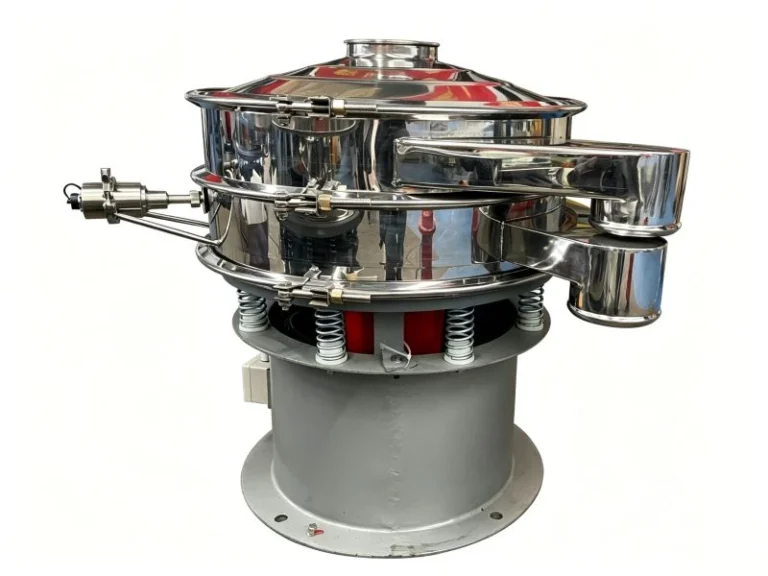
Rotations-Vibrationssieb
A rotary vibrating screen is suitable for free-flowing metal powders and general particle classification. It has a compact design and can separate the powder into one or more particle size ranges.
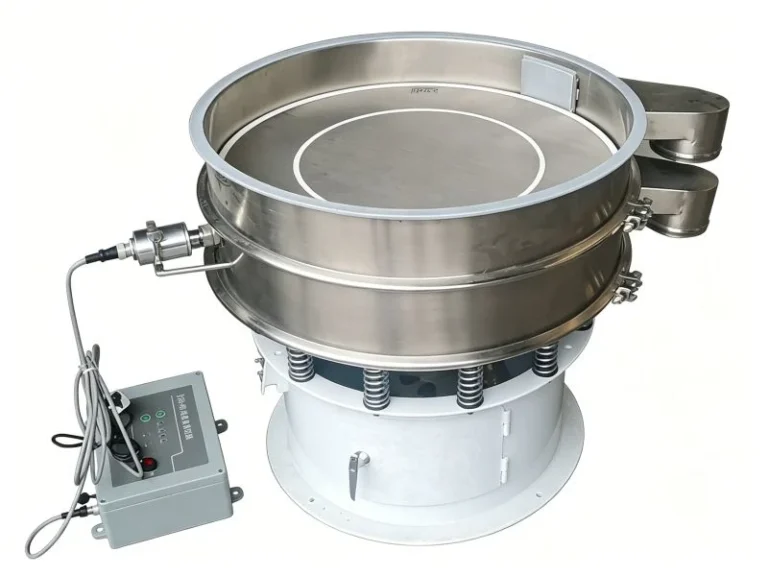
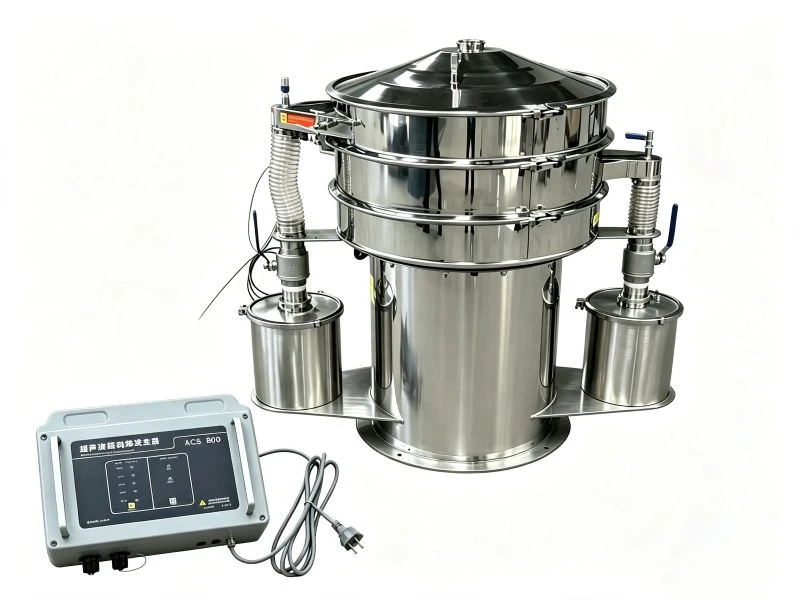
Ultraschall-Vibrationssieb
Ein Ultraschall-Vibrationssieb is suitable for fine, electrostatic or easily agglomerated powders. The ultrasonic system reduces mesh blockage and improves screening efficiency.
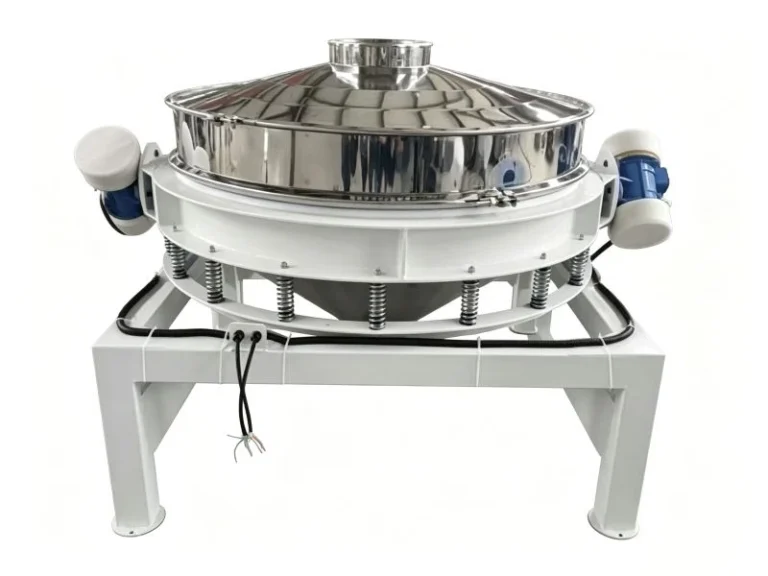
Linear and Inline Vibrating Screens
A linear vibrating screen is suitable for high-capacity screening of coarse powders and particles. An inline vibrating screen is mainly used for safety screening in continuous production lines.
Single-Deck vs Multi-Deck Screen
A single-deck screen separates the powder into two particle sizes. A multi-deck screen can produce three or more particle size ranges in one process.
How to Choose a Protection System
The protection system should be selected according to the powder’s oxidation risk, dust characteristics, corrosion and safety requirements. A suitable system can reduce powder leakage, contamination, material loss and operating risks.
Sealed and Dust-Tight Design
Fine metal powders can easily escape into the working area. A fully enclosed screen with sealed inlets, outlets and covers helps control dust and prevents outside material from entering the product.
Inert Gas Protection
Aluminum, magnesium, titanium and some alloy powders may react with oxygen. For these materials, a sealed screening system can be filled with nitrogen or argon to reduce contact with air.
Explosion Protection and Static Control
Combustible metal powders may require explosion-protected motors and electrical parts. The machine, pipelines and connected equipment should also be properly grounded to reduce static buildup.
Contact Material and Contamination Control
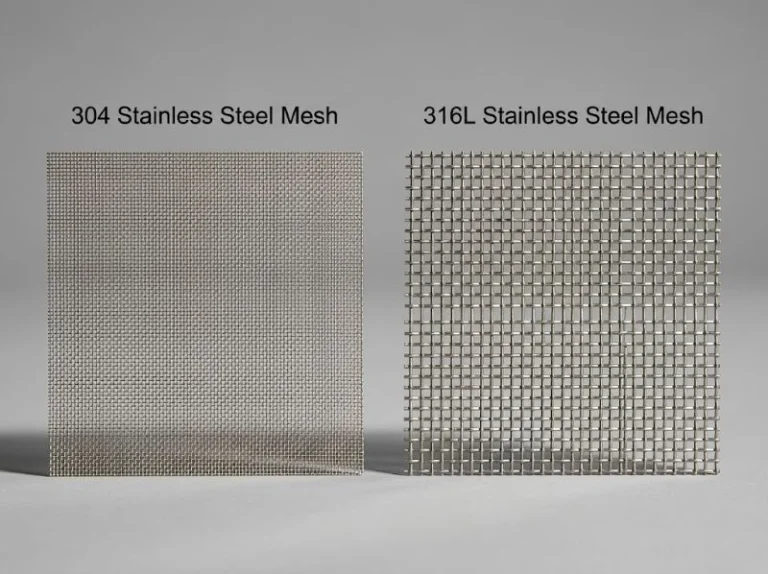
Product-contact parts are commonly made of 304 or 316L stainless steel for corrosion resistance and easy cleaning. The screen should also be checked regularly for wear or damage to prevent particle mixing and product contamination.
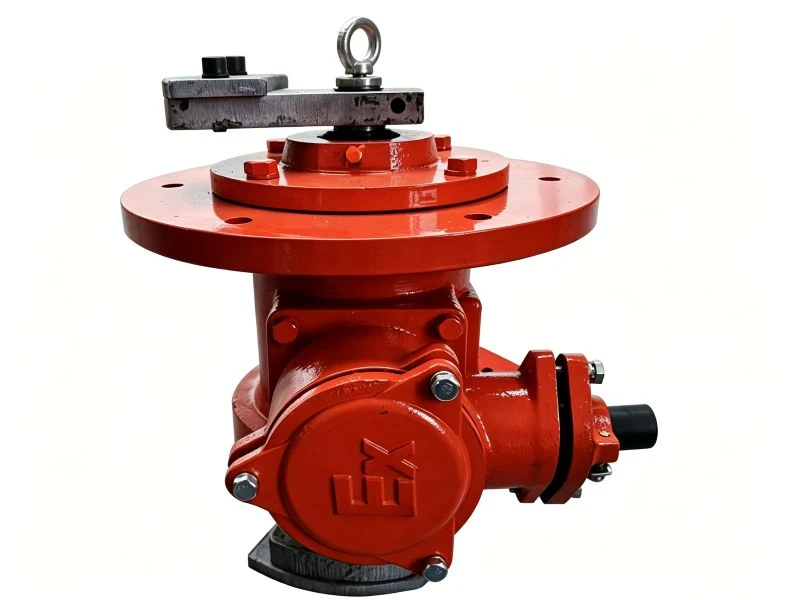
Recommended Solutions for Common Metal Powders
| Powder or application | Main challenge | Recommended screen | Protection system |
|---|---|---|---|
| Iron and stainless steel powder | High density and screen wear | Rotary or linear vibrating screen | Dust-tight design and wear-resistant screen |
| Aluminum and titanium powder | Oxidation, static and combustible dust | Enclosed ultrasonic vibrating sieve | Inert gas, grounding and explosion-protected parts |
| Fine alloy powder | Agglomeration and mesh blockage | Ultrasonic vibrating sieve | Sealed design and static control |
| Additive manufacturing powder | Fine particle range and high recovery requirement | Precision ultrasonic vibrating sieve | Closed system and contamination control |
| Battery material powder | Fine particles, static and strict purity requirements | Ultrasonic vibrating sieve | Sealed construction and clean contact parts |
The final configuration should be based on the powder’s particle-size distribution, flowability, required capacity and safety assessment.More metal powder screening solutions are available for iron, copper, nickel, alloy and other metallurgical materials.
Fazit
Choosing a metal powder sieving system starts with three key decisions: mesh size, screen type and protection system. The mesh should match the target particle size, while the screen type should suit the powder’s flowability, fineness and required capacity. For reactive or combustible powders, sealing, grounding, explosion protection or inert gas may also be required.
Because every metal powder behaves differently, the final configuration should be confirmed through material data or a screening test.
Contact us with your powder type, target particle size and required capacity. Our engineers will recommend a suitable Metallpulver-Siebmaschine for your production process.
FAQ
What mesh size is suitable for metal powder?
The correct mesh size depends on the target particle size and particle-size distribution. Coarse screening may use 20–100 mesh, while fine metal powder screening may require 200–635 mesh. For better accuracy, use the required opening size in microns.
When is an ultrasonic vibrating sieve required?
An ultrasonic vibrating sieve is recommended for fine, electrostatic or easily agglomerated metal powders. It helps prevent mesh blockage and improves the screening of powders below 75 μm.
Which screen type is best for metal powder?
A rotary vibrating screen is suitable for general metal powder sieving. An ultrasonic sieve is better for fine powders, while a linear vibrating screen is suitable for higher-capacity screening of coarser materials.
How can mesh blockage be prevented?
Mesh blockage can be reduced by controlling the feeding rate, selecting the correct mesh and using an ultrasonic de-blinding system. Powder moisture, static electricity and agglomeration should also be checked.
Does metal powder sieving require inert gas protection?
Not every metal powder requires inert gas protection. Reactive powders such as aluminum, magnesium and titanium may need a sealed system with nitrogen or argon to reduce contact with oxygen.
Is an explosion-proof metal powder sieving machine required?
Explosion protection may be required when processing combustible metal powder. The system may include explosion-protected electrical parts, dust-tight construction and proper grounding. The final design should follow the powder safety data and local regulations.