¿Por qué usar cribas vibratorias ultrasónicas para materiales de cátodo y ánodo de baterías?
Ultrasonic vibrating screens are used for battery cathode and anode materials because these powders are often fine, lightweight, prone to agglomeration, and difficult to screen without mesh clogging. Ultrasonic vibration helps keep fine particles moving across the screen surface, reduces screen blinding, and improves screening stability and particle size control.
What Makes Battery Cathode and Anode Materials Difficult to Screen?
Battery cathode and anode materials often contain fine powders that are difficult to screen with a standard vibrating screen. Materials such as LFP, NCM, lithium cobalt oxide, and graphite powder can have small particle sizes and may easily stick together or attach to the screen mesh.
These problems can reduce screening efficiency and make particle size control less stable. For this reason, battery material screening often requires a screening system designed for fine and difficult-to-screen powders.
High Adsorption/Tendency to Agglomerate
Battery cathode and anode materials—particularly nano- or sub-micron-scale powders—possess high surface energy. Consequently, they are highly prone to agglomeration and adhering to screens or equipment walls due to electrostatic forces and van der Waals forces.
Lightweight and Fluffy
These materials have low density and poor flowability; they tend to “float” on conventional vibrating screens, preventing effective passage through the mesh.
Extremely High Purity Requirements
The cleanliness of battery materials directly impacts battery performance and safety; the presence of any metallic impurities or large agglomerates can be critical.
Prone to Static Electricity
In dry screening environments, friction between powder particles generates strong static electricity, exacerbating adhesion and mesh blinding.

How Does an Ultrasonic Vibrating Screen Work?
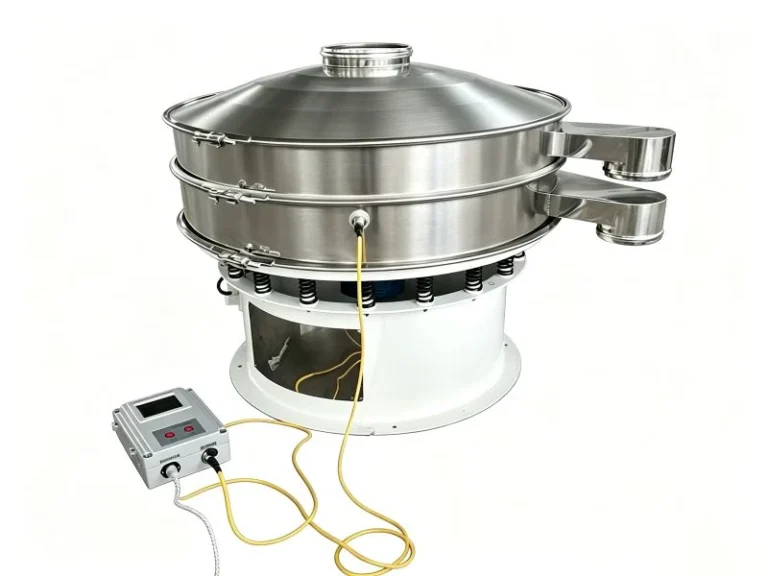
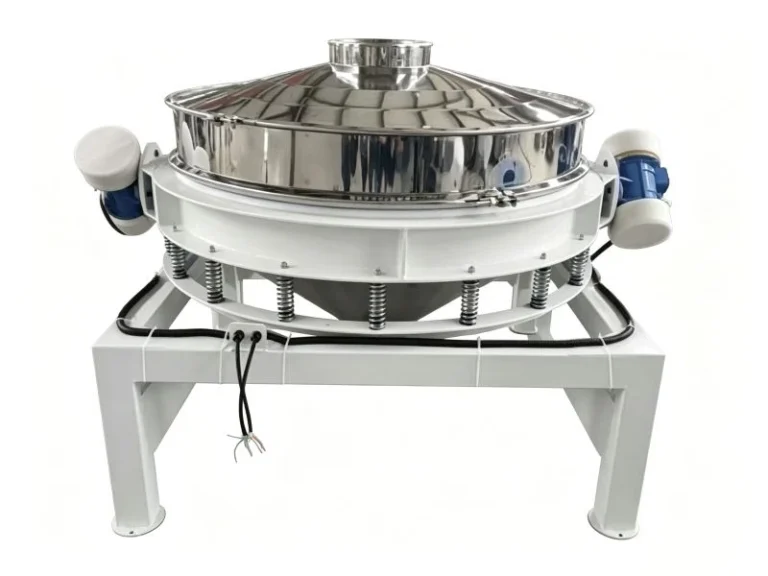
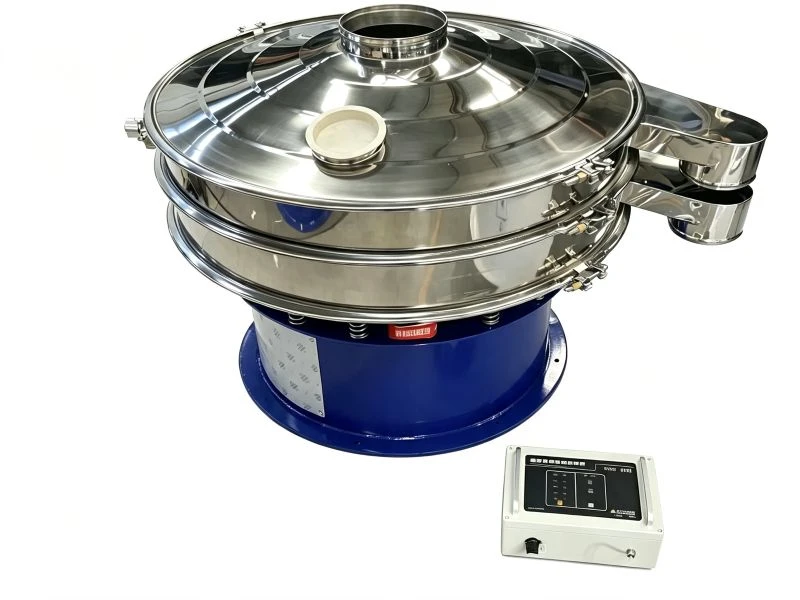
Building upon the foundation of a traditional vibrating screen, it incorporates an ultrasonic power supply and a transducer. This system converts standard electrical energy into high-frequency (typically 36 kHz or 38 kHz) mechanical vibrations and transmits them directly to the screen surface via an ultrasonic resonator, causing the screen mesh to generate high-frequency, low-amplitude ultrasonic vibrations.
The working process can be summarized as:
Ultrasonic vibration → less particle adhesion → fewer blocked mesh openings → better material passage → more stable screening
As a result, the screen can maintain more effective open area during operation. This helps improve screening stability and reduce problems caused by fine powder clogging and screen blinding.

Benefits of Ultrasonic Vibrating Screens for Battery Materials
1. Effective Anti-Blinding Performance for Higher Screening Efficiency
Advantage:
High-frequency ultrasonic vibration can effectively break the surface tension of battery cathode and anode powders, disperse fine powder agglomerates, and reduce the electrostatic attraction between the powder and the screen mesh. This allows even difficult-to-screen micron-level powders, including 500-mesh and finer battery materials, to pass through the screen smoothly.
Comparison:
When screening battery cathode and anode materials with a traditional vibrating screen, the mesh may become seriously blocked within minutes or even tens of seconds. Frequent shutdowns and screen cleaning are required, resulting in very low screening efficiency. An separador vibratorio ultrasónico for battery materials can operate continuously for longer periods and improve screening efficiency by several times.
2. High-Precision Screening for Consistent Product Quality
Advantage:
Because the screen mesh stays clean during operation, the openings are less likely to be blocked or covered by fine powder. This helps maintain consistent screening accuracy. Materials can pass through the mesh under the same screening conditions, making it easier to control particle size distribution, including D50 and D97. It also helps remove large particles, impurities, and agglomerates from the raw material.
Comparison:
When a vibrating screen becomes blocked, the effective screening area is reduced. Some qualified fine powder cannot pass through the mesh, causing more qualified fine powder to remain in the oversize material. At the same time, some large particles may be forced through the mesh and break, making the screening accuracy difficult to maintain.
3. Protect Material Properties and Reduce Secondary Agglomeration
Advantage:
Ultrasonic vibration is a low-amplitude vibration in the vertical direction. Its main function is to clean the screen mesh rather than subject the material to strong impact and friction, as with high-intensity mechanical vibration. This gentler screening process for battery cathode and anode powders helps reduce the risk of secondary particle breakage or excessive compaction. It also helps maintain the original particle shape and material properties.
Comparison:
Some high-intensity screening methods may break particles and create additional fine powder, which can change the original properties of the battery material.
4. Improve the Working Environment and Reduce Labor
Advantage: The screening process is carried out in a closed system. Combined with the effective anti-blinding performance of ultrasonic screening, this can greatly reduce dust release during battery powder screening. Operators do not need to stop the machine frequently to clean the screen mesh. This supports continuous and automated production, reduces manual work, and meets clean production requirements.
5. Extend Screen Mesh Service Life
Advantage: Screen blinding is one of the main causes of screen mesh damage. When material becomes trapped in the mesh openings, it increases the tension on the screen. Under continuous mechanical vibration, this can cause fatigue and screen breakage.
The sistema ultrasónico helps address the problem of mesh clogging at its source. By reducing screen clogging during fine battery material screening, it can significantly extend the service life of expensive fine-mesh screens.
Ultrasonic Vibrating Screen vs. Traditional Vibrating Screen for Battery Powders
| Feature | Traditional Vibrating Screen | Tamizador vibratorio ultrasónico |
| Anti-Clogging Performance | Poor; frequent mesh clogging | Excellent; virtually clog-free |
| Screening Efficiency | Low; requires frequent cleaning | High; supports continuous operation |
| Screening Accuracy | Unstable; decreases as the mesh clogs | High and stable |
| Material Protection | May cause secondary breakage | Gentle screening helps protect particle shape |
| Suitable Particle Size | Relatively coarse, typically <300 mesh | Ultra-fine powders, can handle 500 mesh and finer |
Ultrasonic Screening for Battery Cathode Materials
Battery cathode powders are often fine and prone to agglomeration, static adhesion, and screen clogging. An tamiz vibratorio ultrasónico helps fine particles pass through the mesh, reduces blockage, and keeps particle size separation more stable.
LFP and NCM/NMC Powders
Fine LFP and NCM/NMC powders can easily block fine mesh during screening. Ultrasonic vibration helps keep the mesh openings clear and improves screening stability.
LCO and LMO Powders
For LCO and LMO powders, fine particles and agglomerates can affect screening accuracy. Ultrasonic screening helps reduce powder buildup and supports more consistent particle size separation.
Ultrasonic Screening for Battery Anode Materials
Battery anode powders are often fine and lightweight, which can cause static adhesion, agglomeration, and screen clogging during screening. An ultrasonic sieving machine helps fine particles pass through the mesh and keeps screening more stable.
Graphite Powder Screening
Natural and synthetic graphite can easily stick to fine mesh because of their small particle size and static properties. An ultrasonic screen for graphite powder helps reduce mesh clogging and improves fine powder screening.
Graphite-Based Anode Powders
Graphite anode powders require stable particle size control. Ultrasonic vibration helps separate fine particles and reduce agglomeration, making it suitable for graphite anode powder screening.

When Should You Choose an Ultrasonic Vibrating Screen for Battery Materials?
Mesh size:
Installation is recommended for 200–600 mesh (particle size ≤100 μm) and mandatory for sizes ≤50 μm.For more details on fine mesh selection, see our 200–500 mesh powder screening guide.
Moisture content:
Ultrafine powders with >3% moisture content tend to form a water film that causes clogging on the screen surface; ultrasonic technology effectively resolves this issue.
Viscosity:
Installation is strongly recommended for materials characterized by high static electricity, high specific gravity, or strong adsorption properties; otherwise, the screen surface will quickly become clogged.
For ultrafine powders finer than 200 mesh, ultrasonic rotary vibrating screens offer 10%–70% higher screening precision and 1–10 times greater throughput compared to standard vibrating screens.
Videos relacionados
How to Choose an Ultrasonic Vibrating Screen for Battery Materials?
Choosing the right criba vibratoria ultrasónica mainly depends on material type, particle size, mesh size, capacity, and purity requirements. The right configuration helps maintain stable screening performance and reduce mesh clogging.
- Material type: LFP, NCM, LCO, graphite, and other battery powders have different screening properties.
- Particle and mesh size: Fine powders and high-mesh screens have a higher risk of screen blinding, making ultrasonic screening more useful.
- Capacidad: Select the screen size and configuration according to the required production capacity.
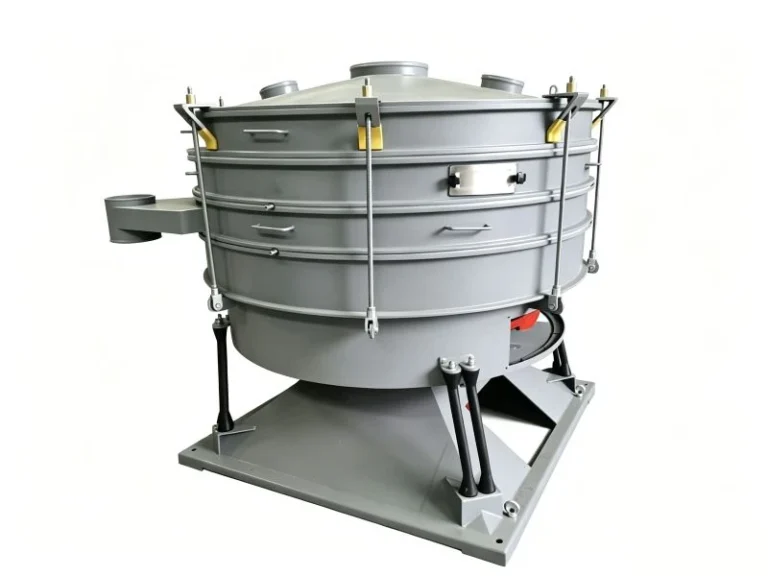
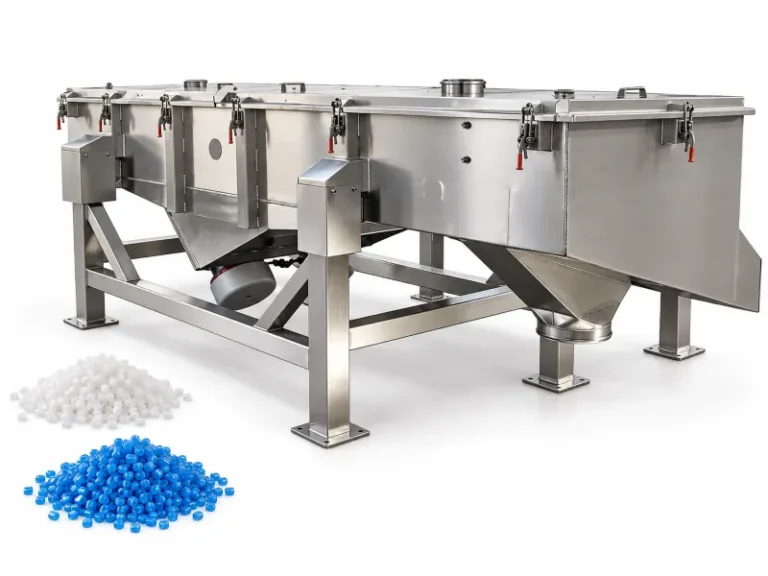
- Screening layers: Choose one or multiple layers based on the required particle size separation.
- Purity and dust control: For high-purity battery materials, consider material-contact parts, sealing, and dust collection.
Conclusión
Ultrasonic vibrating screens provide a practical solution for fine battery cathode and anode material screening. They help reduce screen clogging, improve screening stability, and maintain consistent particle size separation for materials such as LFP, NCM, and graphite powder.
If you are facing problems with fine powder, mesh clogging, agglomeration, or unstable screening efficiency, contact us with your material type, particle size, mesh size, and required capacity. Our team can recommend a suitable ultrasonic vibrating screen for your battery material screening process.