Tamis vibrant linéaire pour légumes déshydratés
A linear vibrating screen for dehydrated vegetables removes fines, separates impurities that differ in size from the product, and grades dried pieces before packaging. Equipment built for wet service can also drain surface water from washed vegetables.
The first question is where the machine will sit in the process. Dried flakes need screening conditions that limit breakage. Washed vegetables need a deck that drains freely, collects water, and can be cleaned thoroughly. These jobs may use the same linear motion, but they need different configurations.

Dry Screening or Wet Draining?
Before choosing a linear vibrating screen for dehydrated vegetables, confirm the condition of the material entering the machine.
| Facteur de sélection | Dehydrated vegetable screening | Washed vegetable draining |
|---|---|---|
| État du matériau | Dried flakes, pieces, or granules | Wet whole or cut vegetables |
| Objectif principal | Fines removal and size grading | Removal of excess surface water |
| Screen selection | Aperture matched to product specifications | Openings that drain water while retaining the product |
| Structural requirements | Separate outlets, dust containment, accessible screens | Water collection, drainage, and cleaning access |
| Points à vérifier lors des essais | Separation quality and breakage | Residual surface water and product damage |
Vibratory draining removes free surface water. It does not replace thermal drying. Fresh vegetables still need the appropriate drying process to become shelf-stable dehydrated products.
How the Screen Works
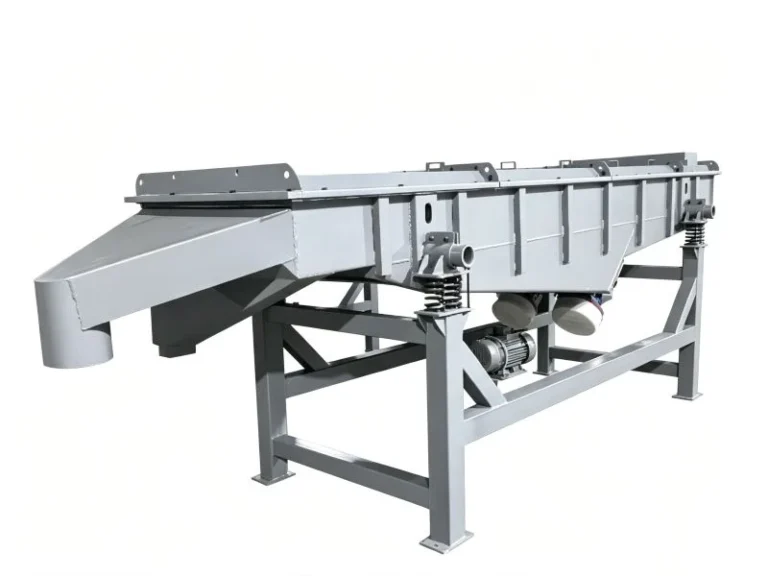
A linear vibrating screen for dehydrated vegetables typically uses two vibration motors rotating synchronously in opposite directions. Their excitation forces combine to move the screen body along a linear path.
Vibration and gravity move the material toward the discharge end. Particles smaller than the openings pass through; larger pieces remain on the deck and travel to a separate outlet.
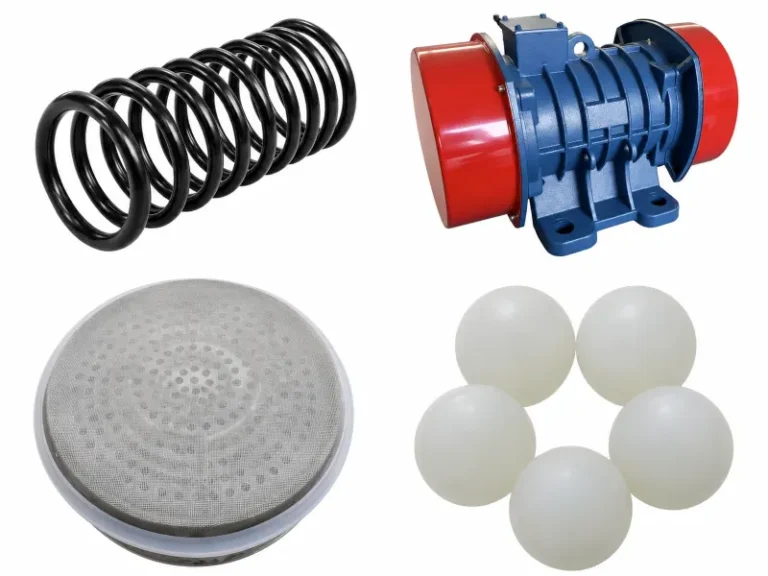
The machine consists mainly of:
- Screen box and frame: Support the deck and material.
- Screen mesh or perforated plate: Control the separation size.
- Vibration motors: Generate the excitation force.
- Isolation springs or rubber elements: Reduce vibration transmitted to the supporting structure.
- Base and support frame: Hold the machine at the required installation height.
Wet applications also need water collection and drainage. Check these details before using a dry screening machine for washed vegetables.
de Yuanjing linear vibrating screen range offers configurable screen dimensions, decks, and material options.
Where It Fits in a Vegetable Processing Line
Removing Fines After Drying
Dried vegetables can break during drying, transfer, and storage. Screening before packaging separates some of these fragments from the required product.
A linear vibrating screen for dehydrated vegetables needs to retain acceptable pieces while allowing unwanted fines to pass through. Irregular flakes deserve particular attention: the same piece may pass or remain on the deck depending on how it meets the opening.
During a trial with dried vegetable slices, inspect the undersize stream as well as the finished product. If too many acceptable slices pass through, review the aperture and operating settings.
Calibrage avant l’emballage
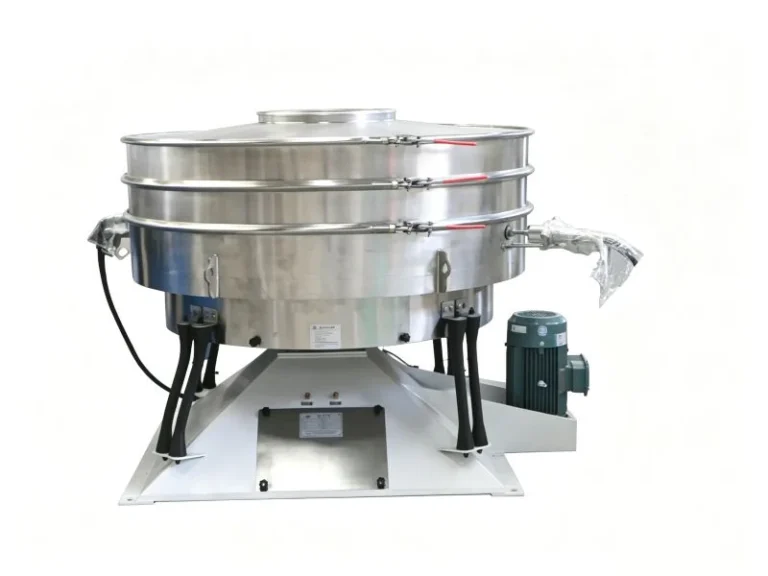
A multi-deck screen separates material into several size fractions, each leaving through its own outlet. This can suit processors who pack different vegetable grades separately.
For simple fines removal, one deck may be enough. Add decks only where the product specification calls for further separation, and leave enough access to inspect, clean, and replace each screen.
Draining After Washing
A wet-duty vibrating screen can remove some of the water carried over from washing while moving vegetables toward the next process.
Watch for standing water, blocked openings, and material collecting in one area. The deck must drain without losing an unacceptable amount of product through the openings.
Connecting Fresh-Cut and Frozen Vegetable Lines
Vibratory draining equipment may be used between washing and later processing in fresh-cut vegetable plants, frozen vegetable lines, pickled vegetable production, and central kitchens.
The next process determines how much surface water is acceptable. Delicate foods such as mushrooms and strawberries also need material trials to establish suitable handling conditions.
Technical Parameters to Check
Select a linear vibrating screen for dehydrated vegetables around the material, required separation, and production rate.
The ranges below are preliminary references. They do not describe one machine, and they are not guaranteed performance figures for vegetables.
| Paramètre | Preliminary reference range | Points à confirmer |
|---|---|---|
| Screen width | 400–2,000 mm | Feed distribution and installation space |
| Screen length | 1,500–6,000 mm | Time needed for screening or draining |
| Nombre d'étages | 1–5 | Required product fractions |
| Vibration frequency | 700–1,000 cycles/min | Compatibility with the material and machine design |
| Amplitude des vibrations | 4–8 mm | How amplitude is measured and whether it damages the product |
| Capacité de traitement | 0.5–20 t/h | Material, aperture, feeding conditions, and acceptance criteria |
A small screen cannot be assumed to reach the upper end of the capacity range. Likewise, a throughput figure for dense granules says little about how the machine will handle lightweight vegetable flakes.
Preliminary ranges for draining equipment also include 1–10 t/h throughput, 1.5–7.5 kW power, and 1–6 m² screen area. Check these against the proposed design. For power, ask whether the figure refers to one motor or the total installed power.
de Yuanjing guide de sélection du tamis vibrant linéaire covers the relationship between material properties, throughput, screen specifications, and operating conditions.

Choosing the Configuration
Describe the Material
When requesting a linear vibrating screen for dehydrated vegetables, include:
- Whether the material is dry or wet.
- Typical piece dimensions and shape.
- Moisture content, if available.
- Bulk density.
- Whether it breaks, sticks, or accumulates easily.
- Required hourly throughput.
- Acceptable product sizes and allowable fines.
Weight alone can be misleading. Lightweight leaves occupy more space than compact granules at the same mass flow rate. The resulting bed depth affects how much material reaches the screen openings.
Choose the Aperture Around the Product
For fines removal, establish the boundary between acceptable pieces and unwanted fragments. For grading, define each size fraction. For draining, check both water passage and product retention.
Where possible, specify the opening dimensions and shape rather than giving only a mesh number. Test stainless steel woven mesh or perforated plates with representative material.
Screening relies on size differences. Impurities close to the product’s size may remain in the finished fraction.
Match Materials to Cleaning Conditions
A linear vibrating screen for dehydrated vegetables may use 304 stainless steel for product-contact parts. Consider 316 stainless steel where the chemical environment requires greater corrosion resistance.
Check salt exposure, cleaning chemicals, temperature, and contact time before making that choice. Construction details and access for cleaning matter too.
For wet service, confirm drainage paths and the protection of motors and electrical components. An IP rating by itself does not establish that the complete machine can withstand every washdown procedure.
Check the Connections Before Ordering
Confirm inlet height, outlet directions, collection points, and maintenance space while the layout is still being planned.
A dry grading machine may discharge into several containers or downstream conveyors. A wet draining machine also needs a route for collected water. Review these connections alongside the washing equipment and the next conveyor or sorting table.
What to Look for During a Trial
Run representative material through the linear vibrating screen for dehydrated vegetables before committing to full production.
Begin within the manufacturer’s permitted operating range. Check how the material moves, what passes through, and whether the machine produces additional breakage.
More vibration is not always helpful. Excessive movement can increase impacts; too little can leave material accumulating on the deck. Adjust the settings against the results you can see and measure.
| Trial check | Dry vegetable screening | Wet vegetable draining |
|---|---|---|
| Feed distribution | Even loading across the screen | No concentrated clumps or surges |
| Material movement | Steady travel without excessive bouncing | Steady travel without product damage |
| Undersize stream | Limited loss of acceptable pieces | Limited product loss through the deck |
| Screen condition | No persistent blinding or accumulation | No persistent blockage or standing water |
| Discharge quality | Required grading and acceptable breakage | Acceptable surface moisture and damage |
Record the feed rate, aperture, operating settings, and results. This gives operators a usable starting point for the next batch.
For further adjustment guidance, see improving linear vibrating screen efficiency, which covers feed distribution, mesh condition, and vibration settings.
A Related Dried-Food Example
de Yuanjing dried coconut particle screening case describes a project with a required capacity of 1,200 kg/h, a bulk density of 400 kg/m³, four screening decks, et SUS304 stainless steel construction.
The case shows the level of material and grading information needed at the selection stage. Coconut particles behave differently from dehydrated vegetables, so its specifications should not be carried over to another product without testing.
Nettoyage et maintenance
A linear vibrating screen for dehydrated vegetables needs regular checks of its screen, fasteners, and isolation components.
Before Starting
Inspect the screen for damage and loss of tension. Check fasteners, springs or rubber isolation elements, and the inlet and outlets. On wet-duty equipment, inspect the water collection tray and drainage route as well.
Stop and isolate the equipment before cleaning, adjustment, or maintenance.
After Processing
Remove vegetable fragments from the deck, frame, and outlets. Use cleaning and sanitizing procedures compatible with the equipment materials and the plant’s food hygiene requirements.
If a dry screening machine has been wet-cleaned, let it reach the required dry condition before restarting production.
During Scheduled Maintenance
Inspect isolation components for deterioration and screens and seals for wear.
Follow the motor manufacturer’s bearing lubrication instructions. The correct interval depends on the bearing arrangement and operating conditions; a monthly schedule will not suit every motor.
Replace screens and seals according to their condition and effect on operation.
Troubleshooting
| Problème | What to inspect | What to do |
|---|---|---|
| Poor separation | Blocked or damaged mesh, excessive feed | Clean or replace the mesh and stabilize feeding |
| More vegetable breakage | Vibration settings, transfer drops, collisions | Review handling conditions and repeat the trial |
| Poor surface-water removal | Thick material bed, blocked openings, restricted drainage | Improve distribution and clear drainage paths |
| Abnormal noise | Loose parts, bearings, component contact | Stop and inspect before restarting |
| Abnormal vibration | Motors, power supply, isolation components | Have qualified personnel inspect the equipment |
| Material moving to one side | Installation, feed position, screen condition | Check installation and correct uneven feeding |
Frequently Asked Questions
Can a linear vibrating screen for dehydrated vegetables handle wet vegetables?
It can if the machine is built for wet service. Confirm the deck, drainage system, cleaning access, and electrical protection before changing applications.
How do I reduce breakage during screening?
Test the actual product, keep feeding even, and adjust vibration within the equipment’s permitted range. Check the drops at the inlet and outlets too; damage may occur during transfer rather than on the deck.
Do more decks improve screening?
Only when additional size fractions are needed. Each extra deck adds cleaning and maintenance work.
What determines actual capacity?
Piece size, shape, bulk density, moisture, aperture, bed depth, and feeding conditions all affect throughput. Measure capacity while the machine meets the agreed separation and product-quality requirements.
Can vibratory draining guarantee a fixed water-removal percentage?
Only against defined test conditions. Agree on the incoming material condition, processing time, and residual-water measurement method before assessing performance.
Discuss Your Vegetable Screening Requirements
To specify a linear vibrating screen for dehydrated vegetables, prepare material photos or samples, the dry or wet condition, target throughput, required grades, and installation dimensions.
For washed vegetables, include the cleaning method, drainage requirements, and acceptable product damage.
Contact Yuanjing Machinery for a customized screening proposal using these details.