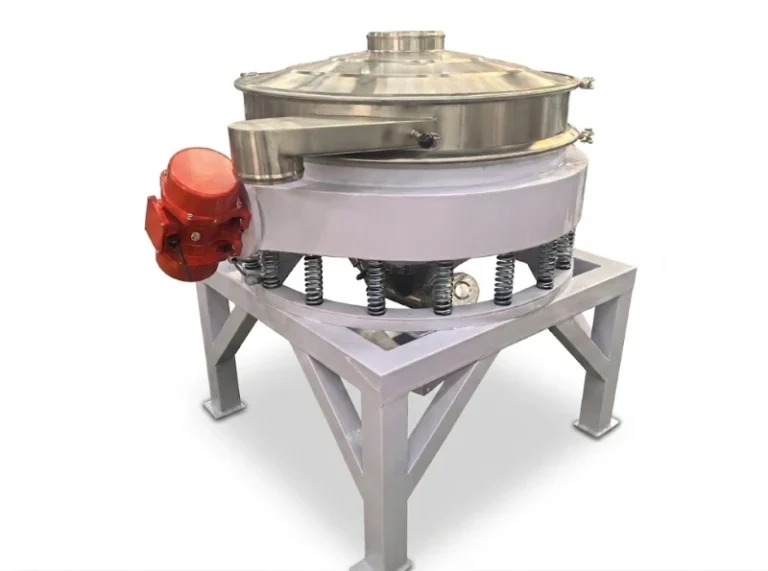
설탕 분말 스크리닝 기계: 올바른 산업용 체를 선택하는 방법
A sugar powder screening machine can remove oversized lumps, separate fine particles from coarse sugar, or classify granulated sugar into different size fractions. The right equipment depends on the screening purpose, mesh opening, required throughput and separation accuracy.
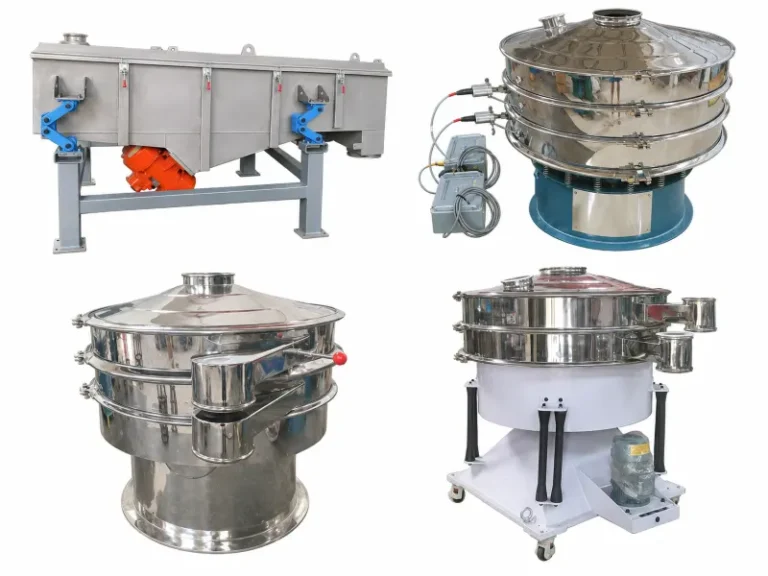
Common options include rotary vibratory sifters, inline sifters, linear vibrating screens and tumbler screens. For powdered sugar and icing sugar, clumping and mesh blinding are important considerations. For granulated sugar and crystalline fructose, continuous throughput and particle size classification may be the main priorities.
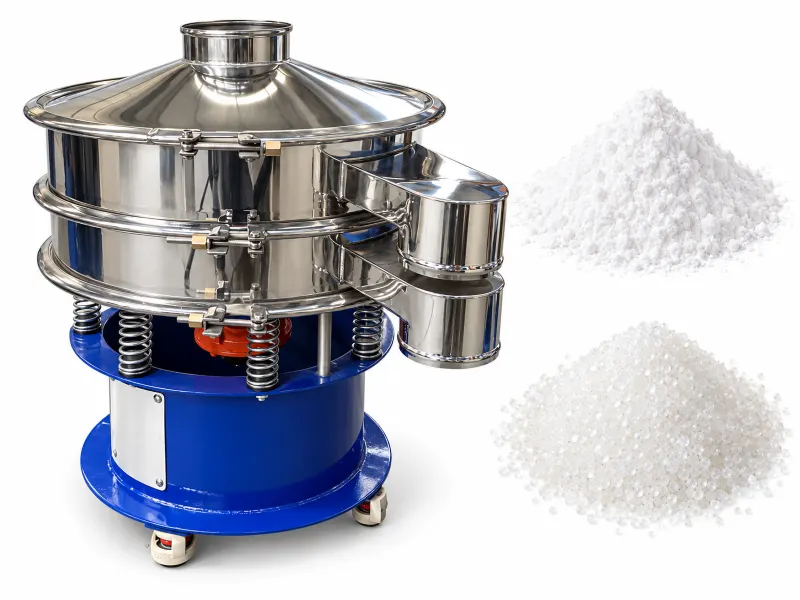
1. Why Screen Powdered and Granulated Sugar?
Remove Lumps and Oversized Foreign Material
Sugar may form lumps during drying, storage and handling. Screening before mixing or packaging helps retain oversized agglomerates and screen-retained foreign material before they enter the next process.
This is usually a check-screening application: most acceptable material passes through the mesh, while a smaller oversize fraction is collected separately. The main goals are stable throughput and minimal loss of usable sugar through the reject outlet.
A screen separates material by size and shape. It cannot reliably remove every contaminant, particularly material small or narrow enough to pass through the openings.
Classify Granulated Sugar by Particle Size
Different applications may require different sugar crystal sizes. Multiple screen decks create several separation cuts, allowing each size fraction to discharge through its own outlet.
For granulated sugar screening, total throughput is only part of the requirement. The particle size distribution at each outlet also needs to meet the intended product specification.
Particle size classification should not be confused with assigning a sugar quality grade, which may involve requirements beyond particle size.
Separate Fines from Coarse Sugar
An industrial sugar sifter can also remove fine powder mixed with coarse sugar particles or crystals. In this application, the material retained on the screen may be the main product, while the fines passing through are collected separately.
Specify which fraction you want to retain when requesting a machine. This determines the mesh opening, outlet arrangement and discharge requirements.
2. Which Sugar Powder Screening Machine Should You Choose?
Rotary Vibratory Sifter: General Screening and Size Classification
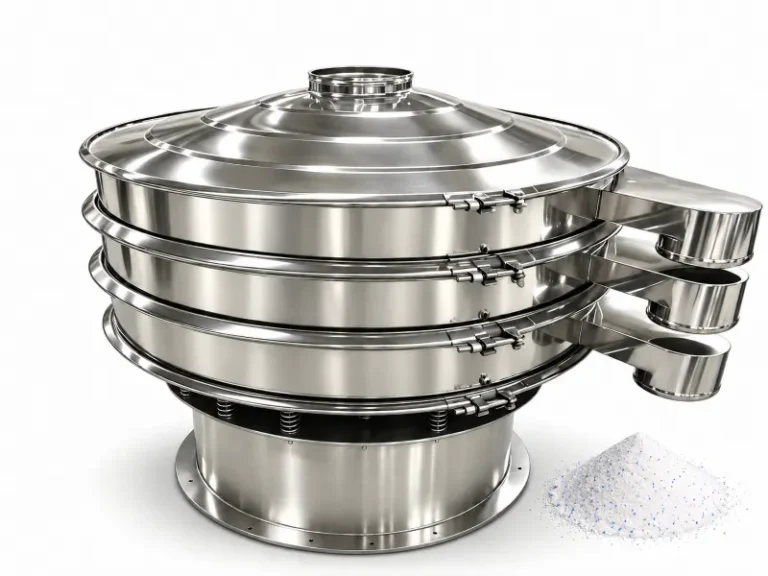
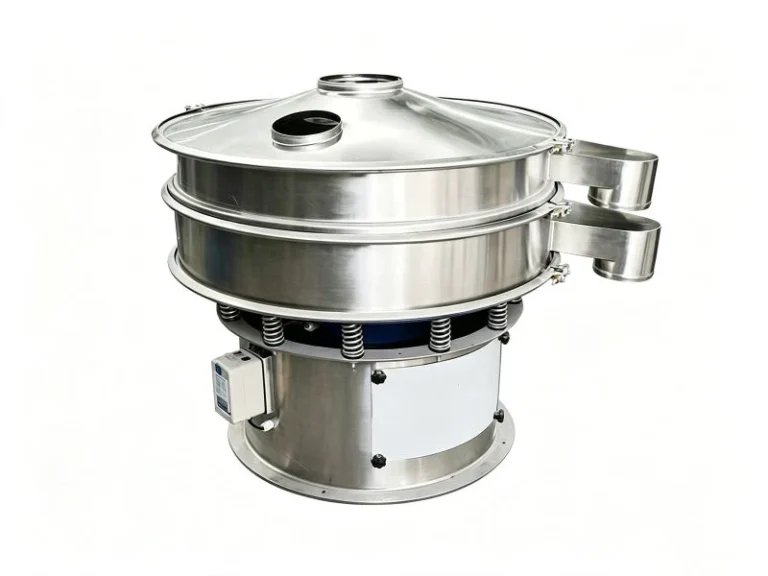
A 회전 진동 스크린 moves material across the mesh through vibration. Smaller particles pass through the openings, while larger particles travel across the screen and discharge separately.
It can be used for sugar check screening, coarse and fine powder separation, and multi-fraction grading with multiple screen decks. It is also an option for batch production where screen specifications change between products.
Key selection factors include mesh opening, deck count, mesh-cleaning method and the separation required at each outlet.
Inline Sifter: Check Screening Before Mixing or Packaging
하나의 인라인 진동 체 discharges screened material through a bottom outlet, making it suitable for installation between hoppers, mixers and packaging equipment.
For free-flowing sugar powder containing a small proportion of oversized lumps, an inline sifter can provide check screening within the production line. If the process requires several closely controlled size fractions, compare rotary or tumbler screening arrangements instead.
Before installation, confirm the available height, bottom discharge clearance and method for removing retained oversize material.
Linear Vibrating Screen: Continuous Sugar Crystal Processing
A 선형 진동 체 moves material forward along the screen while separating particles. It can be considered for continuous screening, fines removal and grading of free-flowing granulated sugar, crystalline fructose or glucose granules.
Screen width, length and feed distribution are important selection factors. Even feeding helps use the available screen area and prevents excessive material buildup in one section.
For fine sugar powder prone to sticking or agglomeration, verify mesh passage and cleaning performance before selecting a linear screen solely for its throughput.
Tumbler Screen: Multi-Fraction Sugar Grading
A tumbler sieve uses a tumbling motion to distribute and move material across the screen. It is an option for sugar grading applications that require several particle size fractions.
For granulated sugar that needs to be separated into multiple products in one pass, a multi-deck tumbler screen is worth comparing. Mesh openings, deck loading, residence time and mesh-cleaning arrangements all affect the result.
The finest or most heavily loaded deck may limit overall throughput, so machine diameter alone is not enough to determine capacity.
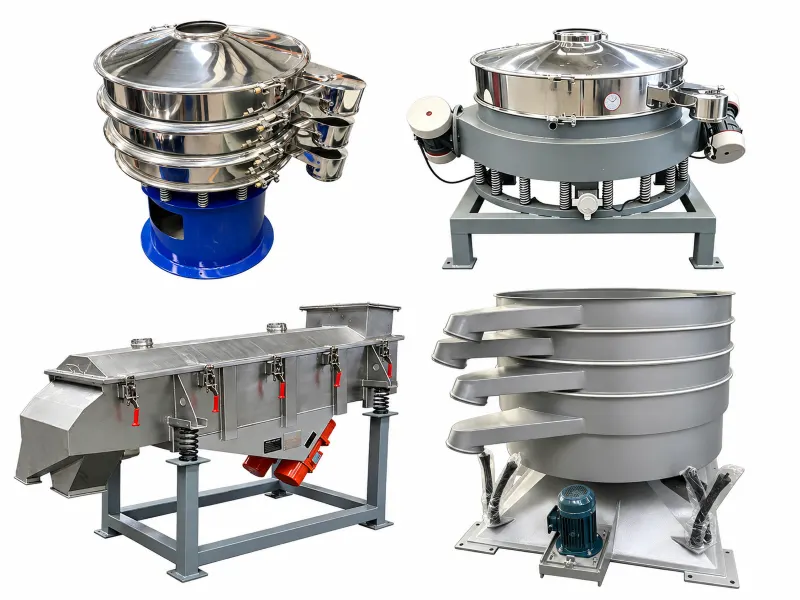
Comparison of Sugar Sifter Types
| 기계 유형 | 주요 응용 분야 | Key Selection Factors |
|---|---|---|
| Rotary vibratory sifter | Sugar powder screening, coarse/fine separation and multi-fraction grading | Mesh opening, deck count and mesh cleaning |
| Inline sifter | Check screening before mixing or packaging | Throughput, installation space and oversize removal |
| 선형 진동 스크린 | Continuous sugar crystal screening, fines removal and grading | Screen dimensions and uniform feeding |
| 텀블러 스크린 | Multi-fraction classification of granulated sugar | Deck loading, mesh openings and grading performance |
Ultrasonic mesh deblinding can be added to compatible equipment when fine sugar powder repeatedly blinds the screen. Its value should be assessed against the actual material and screening requirement.
3. Sugar Screening Application Examples
South Korean Customer: A 1-Meter Stainless Steel Rotary Sifter
We supplied a stainless steel rotary vibratory sifter with a diameter of 1 meter to a customer in South Korea for sugar screening and classification. The project involved requirements for 6, 10, 16 and 50 mesh screens.
Rotary sifters can be used for finished sugar screening, coarse and fine sugar powder classification, or removing fines from a coarser product. Each task requires a suitable screen and outlet configuration.
The mesh specifications above relate to this project; they are not a general recommendation for every powdered sugar application.
Granulated Sugar: A 1.5-Meter Four-Deck Tumbler Screen
A reported granulated sugar application used a 1.5-meter-diameter, four-deck tumbler screen at approximately 4–5 tonnes per hour. The arrangement produced five particle size fractions, with reported screening accuracy above 95% for each fraction based on test-sieve checks.
Four screen decks provide four separation cuts, dividing the feed into five size fractions.
These figures describe that application. Other projects require confirmation against their feed particle size distribution, mesh openings and test method.
Crystalline Fructose: Continuous Screening with a Linear Screen
Another reported application used a ZTSF-1530 linear vibrating screen to process crystalline fructose at 8 tonnes per hour. The reported product acceptance rate increased from 92% to 99.7%.
The application illustrates the use of linear screening for continuous processing of crystalline sugar. Product acceptance rate and screening accuracy are different measures, so this percentage should not be directly compared with the tumbler-screen result above.
관련 동영상
4. How Do You Select Mesh Size, Capacity and Machine Configuration?
Match the Screen Opening to the Required Separation
Start by defining which particles should pass through the screen and which should remain above it.
For lump removal, acceptable powdered sugar needs to pass through while oversized material is retained. For fines removal from coarse sugar, both the retained product and the separated fines should be checked. Multi-fraction grading requires a target particle size range for every outlet.
When requesting a quotation, provide the aperture size in microns or millimeters alongside the mesh count and applicable screen specification. Mesh count alone may not fully define the required opening.
Confirm Capacity with the Actual Sugar
Particle size, agglomerate content, mesh opening and feeding conditions all affect sugar sifter capacity. Throughput achieved with granulated sugar cannot be assumed for fine icing sugar, and a coarse-screen capacity does not establish performance with a finer mesh.
Intermittent discharge from upstream equipment can also create a temporary overload, even when the average hourly feed rate appears acceptable. A buffer hopper or controlled feeder may be needed.
For integrated powder handling, see our vacuum conveyor and vibro sifter system guide for considerations when coordinating conveying and screening.
Where throughput is critical or the powder is difficult to screen, test the actual material and check acceptable product output, reject losses and sustained operation.
Select a Mesh-Cleaning Method for Fine Sugar Powder
If throughput falls during icing sugar screening, first check for excessive feeding, material buildup, moisture-related clumping and screen condition.
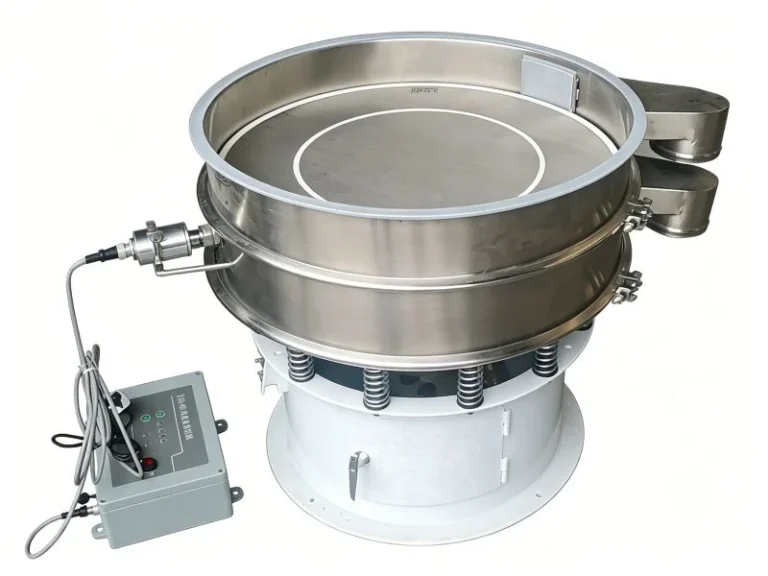
When conventional cleaning cannot maintain stable screening, an 초음파 체가름 기계 may help reduce fine powder adhesion and mesh blinding. Ultrasonic assistance does not replace hard-lump treatment or control of incoming material conditions.
For further troubleshooting, see our guide to industrial screen clogging causes and prevention.
Consider Food-Contact Materials and Cleaning Access
Depending on the plant’s requirements, sugar screening equipment may use 304 or 316L stainless steel. Screens, seals and other product-contact components should also be suitable for the intended use and cleaning procedure.
Check whether operators can remove the screen, clean the outlets and inspect seals easily. Multi-deck machines need sufficient space for screen changes and maintenance.
Stainless steel construction and an enclosed housing alone do not establish compliance with every food hygiene or GMP requirement. When comparing equipment costs, include screen replacement, cleaning downtime and routine maintenance as well as the purchase price.
Need a sugar powder screening machine for your production line?
저희를 살펴보세요 industrial sugar screening equipment and send us your material, mesh opening and required throughput. We can help select the machine type, screen arrangement and mesh-cleaning configuration for your application.