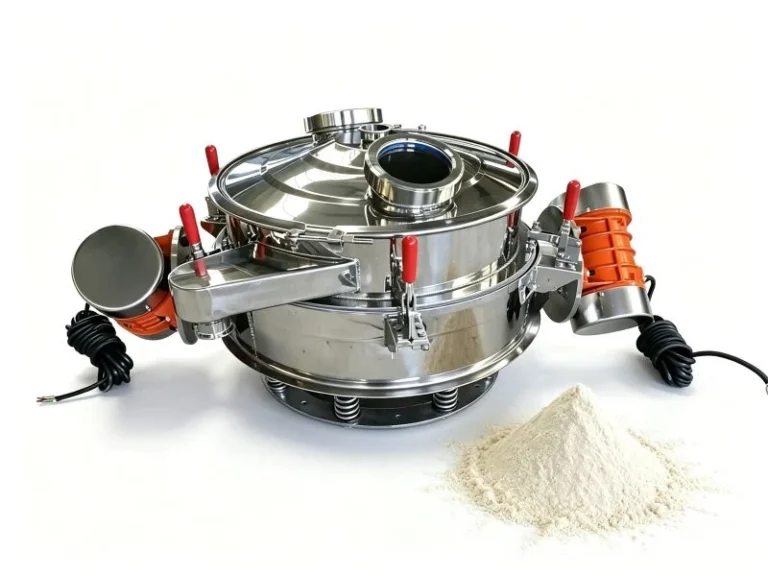
Przesiewanie papryki w proszku: usuwanie grubych cząstek po mieleniu
Paprika powder sieving removes oversized particles and incompletely ground skin fragments from milled powder. Finer powder passes through the screen and moves to the next processing stage; retained material is collected for inspection. Some of it may need regrinding, while lumps formed from fine powder require different handling. The screen opening should match the finished-product specification, with sample trials used to check performance at the required throughput.

Why Does Paprika Powder Contain Coarse Particles After Grinding?
Material left on the screen is not always a sign of insufficient grinding. It may contain coarse particles, skin fragments, or fine powder that has clumped together. Looking at this retained material helps identify where the process needs attention.
Uneven Grinding and Remaining Skin Fragments
Grinding does not reduce every particle to the same size. Some skin fragments remain above the target size and are caught during sieving. These may be suitable for another pass through the grinder, depending on their condition.
Coarse Particles vs. Powder Agglomerates
True coarse particles usually remain firm under gentle pressure. Loose agglomerates often break back into fine powder. This is a useful first check, though tightly compacted lumps need closer inspection before deciding how to handle them.
How Oversize Material Affects Finished Powder Consistency
Visible flakes and gritty particles can make batches look or feel different. Removing material above the agreed size limit helps maintain paprika powder consistency and meet the buyer’s fineness specification.
| Material on the Screen | Co sprawdzić | What to Do |
|---|---|---|
| Coarse particles or skin fragments | Remain intact under gentle pressure | Inspect for possible regrinding |
| Loose powder agglomerates | Break into finer powder under gentle pressure | Check moisture, storage, and feeding conditions |
| Unidentified material | Looks different from the normal product | Isolate and investigate before reprocessing |
How Does Paprika Powder Sieving Remove Oversize Material?
The screen divides ground paprika into two streams. Powder small enough to pass through the openings leaves through the undersize outlet. Retained material travels to a separate discharge for inspection. Even feeding is important: too much powder on the screen can send usable fines out with the coarse material.
Positioning the Sieve After Grinding
Place the sieve downstream of the grinder, with its exact position determined by the mixing and packaging sequence. Keep the feed steady and spread it across the screen. Sudden surges and deep material buildup reduce the powder’s opportunity to pass through the mesh.
Separating Acceptable Powder from Screen Retentions
A maszyna do przesiewania proszku chili can be assessed for this paprika powder screening step using the required screen opening and throughput.
Particle shape matters as well as size. A thin skin fragment may pass through an opening if it approaches at a suitable angle. Contaminants smaller than the aperture can also pass, so sieving cannot remove every piece of foreign material.
Inspecting Oversize Material Before Regrinding
Do not send everything from the oversize outlet straight back to the grinder. Clean, incompletely ground particles may be suitable for regrinding. If the retained material consists mainly of lumps, investigate why the powder is clumping. Keep unidentified material out of the return stream until it has been checked.
How to Choose the Right Screen Opening for Paprika Powder
There is no single paprika powder mesh size that suits every product. Begin with the buyer’s fineness requirement, confirm the actual screen aperture, and run a representative sample at the intended processing rate.
Start with the Finished Product Specification
Confirm the specified sieve opening, percentage passing, and test method. Removing occasional coarse particles is a different task from producing several defined size grades.
A finer screen is not automatically a better choice. It may reduce throughput and retain powder that would otherwise meet the product specification.
Specify Aperture Size Alongside Mesh Count
State the screen opening in microns (µm) or millimetres, together with the mesh count and screen specification. Mesh count alone is not enough: wire diameter affects both the aperture and the available open area. Check these details with the screen supplier before ordering.
Validate Throughput, Oversize Content, and Product Recovery
Use paprika powder that represents normal production conditions. During the trial, record the feed rate, the proportion retained, and the amount of passing powder recovered. Check the screened product against the agreed fineness requirement.
Also examine the oversize stream for usable fines and watch for buildup on the mesh. A short run on a clean screen may look satisfactory even when performance falls during longer operation.
| Informacje do przekazania | Dlaczego są potrzebne |
|---|---|
| Finished-product fineness and required percentage passing | Select candidate screen openings |
| Feed particle size and oversize proportion | Assess the separation duty and screen load |
| Moisture, temperature, and clumping behaviour | Evaluate powder flow and the tendency to blind the mesh |
| Required hourly throughput | Set equipment sizing and trial targets |
| One finished grade or several size fractions | Determine the required screening decks |

Which Sieving Machine Fits Your Paprika Powder Process?
For ground paprika, a rotary vibratory sifter is a practical option for coarse particle removal and grading. A linear vibrating screen is also worth considering for dried pepper pieces and coarser fractions. The choice depends on the material, target fineness, and production rate. Nominal machine capacity alone does not show how either machine will perform with a particular powder.
Rotary Vibratory Sifters for Ground Paprika Powder
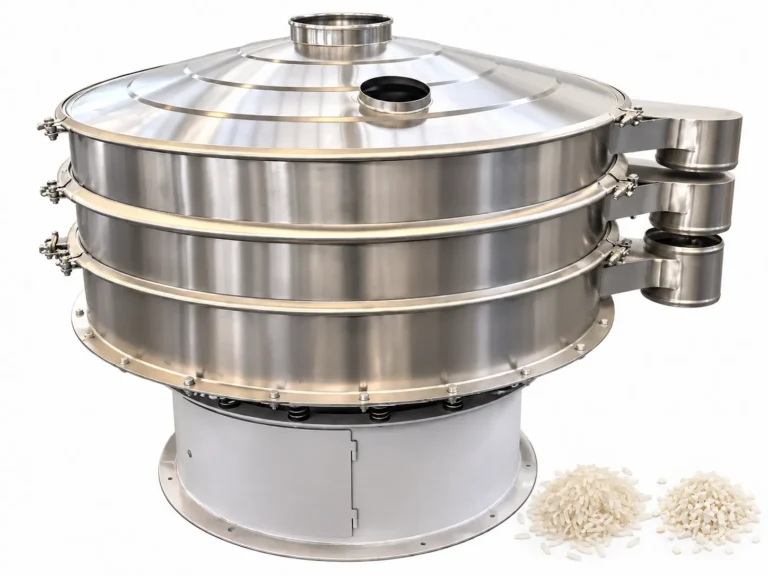
A rotary vibratory sifter separates fine paprika powder from coarse particles and incompletely ground skin fragments. Passing powder and retained material discharge through separate outlets, allowing continuous operation.
Screen opening and deck count depend on the finished grades required. The maszyna do przesiewania proszku chili page provides a starting point for reviewing this arrangement.
Linear Vibrating Screens for Coarser Pepper Materials
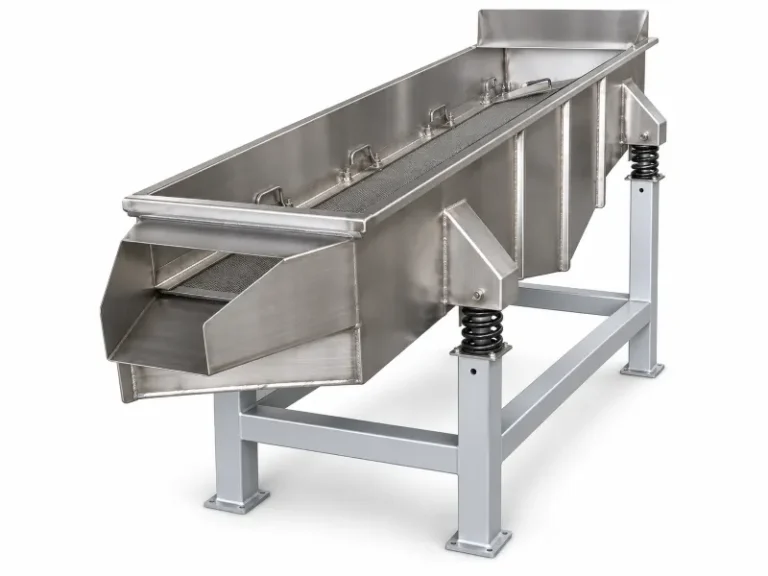
Linear vibrating screens move material forward along the screen surface. They can be used to grade dried peppers, crushed pieces, and coarse powder, with screen dimensions and outlets arranged around the required fractions.
Seeds, stems, and product particles of similar size may not separate completely. If the machine is intended for finely ground paprika, the trial should establish how readily the powder passes and whether it builds up on the screen.
If you are considering a linear screen for dried pepper pieces or coarse powder, our spice linear vibrating screen selection guide explains what to check before specifying the machine.
When to Evaluate Ultrasonic Assistance for Mesh Blinding
Before adding ultrasonic assistance, check the feed, mesh condition, and powder moisture or clumping. If fine powder continues to adhere to the screen, ultrasonic assistance may help keep the apertures open.
Compare an jest lepszym wyborem, gdy drobny proszek jest trudny do przesiewania za pomocą konwencjonalnego przesiewacza wibracyjnego. with conventional screening using the same material and target opening. The trial should show whether the additional assistance is useful for that application.
Single-Deck Removal vs. Multi-Deck Classification
One deck is generally enough to separate a finished powder from oversize material. Use multiple decks when several defined size fractions are needed.
Decide what each outlet must produce before specifying the deck arrangement. Extra decks add separation stages, but they also add surfaces that need cleaning.
Cleaning Access, Screen Inspection, and Line Integration
Check how easily operators can remove residual powder, inspect the mesh, and change screens. Product-contact materials, seals, and cleaning procedures must suit the plant’s hygiene requirements. Stainless steel construction alone does not establish hygienic performance.
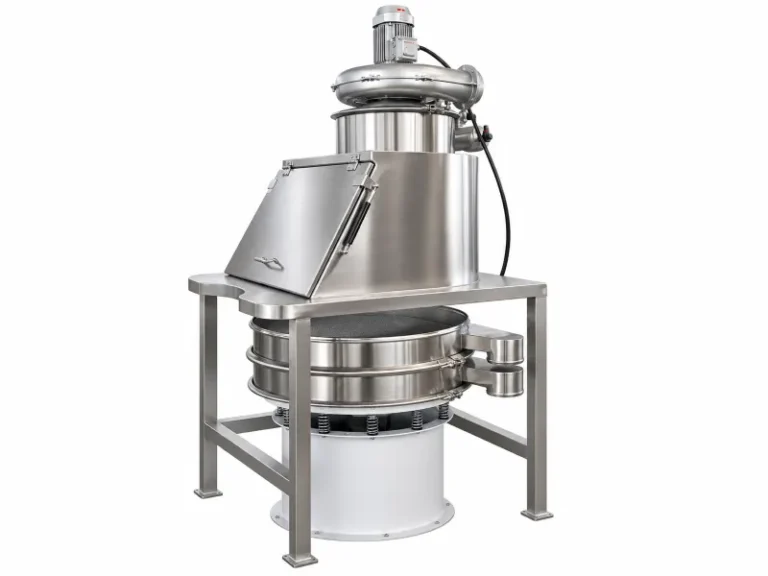
An enclosure can help contain dust. Inlet height and outlet orientation also need to fit the surrounding equipment. Finally, confirm that the selected screen can maintain the required throughput with the actual paprika powder.
| Operating Requirement | Configuration to Consider | What to Verify |
|---|---|---|
| Remove coarse particles after grinding | Single-deck rotary vibratory sifter | Finished-powder fineness and fine powder lost with oversize |
| Produce several particle-size grades | Multi-deck screening arrangement | Separation and recovery at each outlet |
| Grade dried pepper pieces or coarse fractions | Przesiewacz wibracyjny liniowy | Material movement and separation of similarly sized particles |
| Address persistent fine-powder mesh blinding | Ultrasonic-assisted screening | Improvement under comparable trial conditions |
| Integrate continuous production | Enclosed equipment with suitable connections | Stable feeding and discharge, cleaning access, and dust containment |
Wnioski
Paprika powder sieving removes coarse particles after grinding, but the screen opening and machine configuration need to match your finished-product requirements. Checking the retained material also helps avoid unnecessary regrinding and loss of usable fine powder.
Need help choosing a sieve for your paprika powder? Contact Yuanjing Machinery with your target fineness, required hourly capacity, and current screening problem. If available, include your existing mesh specification and photos of the powder and retained material so we can discuss a suitable screening setup.
Czy potrzebuję ultradźwiękowego przesiewacza wibracyjnego do drobnego proszku?
What Mesh Size Should I Use for Paprika Powder Sieving?
There is no single mesh size for all paprika powders. Start with the buyer’s required fineness and percentage passing, then confirm the actual screen opening in microns. Test a representative sample at the intended feed rate. Choosing a finer mesh than necessary can reduce throughput and retain otherwise usable powder.
Which Sieving Machine Is Suitable for Paprika Powder After Grinding?
A rotary vibratory sifter is a practical option for removing coarse particles from ground paprika. One deck usually suits a single oversize cut; multiple decks are needed for several size grades. Linear vibrating screens can also be considered, particularly for coarser pepper materials. Confirm performance with the actual powder and required screen opening.
Why Is Fine Paprika Powder Coming Out of the Oversize Outlet?
Fine powder can leave with the oversize when the screen is overloaded, blinded, or covered by a deep layer of material. Some fines may also be trapped in agglomerates. Check the retained material, feed distribution, and mesh condition before changing the screen opening.
How Can I Reduce Screen Clogging When Sieving Paprika Powder?
First check for uneven feeding, powder buildup, and moisture-related clumping. Inspect and clean the mesh, then check whether the blockage returns under steady feeding. If fine powder continues to adhere to the screen, trial ultrasonic assistance using the same aperture and material to see whether it improves passage.
Can Coarse Paprika Powder Be Returned to the Grinder?
Clean, incompletely ground particles may be returned after inspection. Do not automatically recycle everything collected at the oversize outlet. Loose powder lumps need a check for clumping causes, while unidentified material should be isolated. Examine the retained fraction before deciding what can safely return to production.
What Determines the Capacity of a Paprika Powder Sieve Machine?
Capacity depends on the screen opening, available screening area, feed particle size, oversize content, and powder condition. Clumping and mesh buildup can reduce output during a run. Confirm capacity through a representative trial that checks both sustained throughput and whether the passing powder meets the required fineness.