Przesiewanie proszku z węglika krzemu za pomocą sita ultradźwiękowego
Silicon carbide powder screening removes oversized particles and separates powder into usable size fractions. For fine SiC powders in the 200–600 mesh range, an ultrasonic vibrating sieve helps keep screen openings clear, allowing qualified particles to pass through more consistently.
Silicon carbide is hard and abrasive. Angular grains can lodge in the mesh, while fine particles may cling together or stick to the screen surface. At 200 mesh and finer, a conventional rotary vibrating screen can struggle to maintain output as these blockages accumulate.
An ultrasonic sieve adds high-frequency movement directly to the mesh to reduce this buildup.

Why Is Fine Silicon Carbide Difficult to Screen?
Friction during handling can contribute to electrostatic charging. Fine particles then collect in loose agglomerates or adhere to the mesh. Some of this powder is small enough to pass through, but it never reaches an available opening.
Particle shape adds another difficulty. Hard, angular SiC grains close to the aperture size can become wedged in the mesh. Each trapped grain reduces the area available for separation.
Operators often notice the problem gradually: output is acceptable after cleaning, then falls during the production run. Adding more feed leaves a thicker powder bed without restoring the lost capacity.
For silicon carbide powder screening, the mesh must stay open long enough to maintain the required separation and output.
How Does an Ultrasonic Sieve Work?
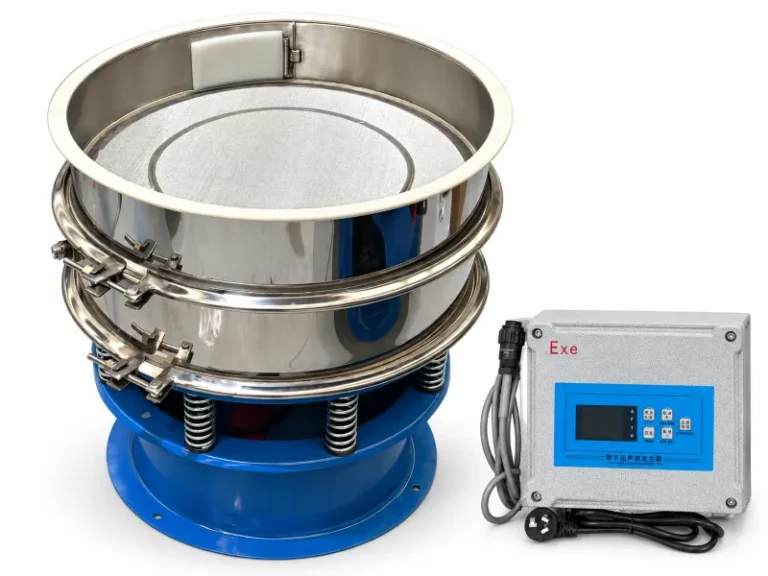
An ultrasonic sieve combines conventional three-dimensional vibration with high-frequency, low-amplitude movement at the mesh.
The system described in the supplied technical brief operates at 30–40 kHz. The vibration motor moves powder across the screen. At the same time, ultrasonic movement helps loosen adhered powder, disperse weak agglomerates, and release particles trapped in the openings.
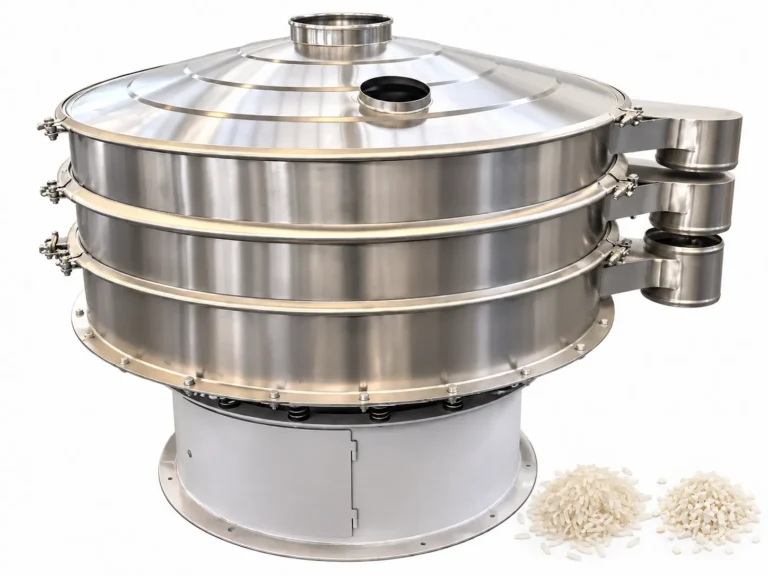
Fine particles pass through the mesh; oversized material remains above it and moves toward the oversize outlet.
This action helps separate loose powder clusters. Hard sintered lumps still need to be rejected as oversized material—the screen is not intended to grind them down.
Firma Yuanjing jest lepszym wyborem, gdy drobny proszek jest trudny do przesiewania za pomocą konwencjonalnego przesiewacza wibracyjnego. uses this combined movement for fine powders affected by adhesion, agglomeration, and mesh blockage.

Five Roles of Ultrasonic Screening in SiC Processing
1. Reducing Mesh Clogging and Cleaning Stops
In silicon carbide powder screening, loose agglomerates can be held together by electrostatic attraction and other interparticle forces, including van der Waals forces. Ultrasonic movement helps disperse these clusters so individual particles can reach the mesh.
It also helps dislodge angular grains caught in the apertures. Keeping more openings available reduces the progressive loss of screening area during operation.
Fewer blockages can mean fewer stops for manual cleaning. This may also reduce damage caused by repeatedly brushing or handling fine mesh. Screen life still depends on abrasive wear, tension, loading, and operating conditions.
2. Removing Oversized Particles and Foreign Material
After production and crushing, silicon carbide powder may contain sintered lumps or particles that have not been fully ground.
Silicon carbide powder screening retains these coarse pieces above the mesh while qualified fines pass through. This matters in grinding applications, where an unexpected large grain can scratch a workpiece. Coarse particles can also affect ceramic and semiconductor substrate processing.
Oversized foreign material, including refractory fragments and iron chips introduced during production, can be retained in the same way.
The separation is based on size. Contaminants smaller than the aperture may pass through with the usable powder. Where fine iron contamination must be controlled, a separate removal step may be needed.
3. Controlling Particle Size
The technical brief gives 200–600 mesh as a working range for fine SiC powders, including 500 mesh and finer applications.
Near-size particles are particularly troublesome. Their dimensions are close to the aperture size, so they may lodge in an opening or remain above the screen because of adhesion.
Ultrasonic movement helps keep these particles mobile at the mesh. With fewer blocked openings, fine powder can pass through more consistently while coarse particles leave through the oversize outlet.
More consistent silicon carbide powder screening supports batch control for abrasives, ceramic formulations, and raw-material preparation for processes involving nitride substrates.
Removing both oversized material and excessively fine powder requires two separation cut points. Depending on the specification, this may involve multiple screening stages or an additional classification process.
Firma Yuanjing Przewodnik po przesiewaniu proszków przez sita 200–500 mesh covers related fine-mesh applications.
4. Maintaining Output During Production
When mesh blockage limits silicon carbide powder screening, keeping the openings clear allows more qualified powder to pass through the same screening area.
The supplied technical brief describes a 1–3-fold improvement in powder passage compared with conventional screening at the same mesh size and screen area. This is an application-dependent reference. The actual improvement needs to be checked using the powder being processed.
The benefit is easier to assess over a full production run than immediately after startup. Sustained output shows whether the mesh remains available as material continues to pass across it.
The brief also gives an overall equipment throughput range of 0.1–20 t/h, depending on mesh size and powder characteristics. This range covers different screening duties and equipment configurations. It does not establish the capacity of one ultrasonic sieve operating at 600 mesh.
A representative material trial should confirm output at the intended aperture.
5. Containing Dust and Limiting Contamination
An enclosed machine helps contain fine SiC dust and reduces contamination from the surrounding workshop.
If moisture causes the powder to agglomerate again after handling, the feed and process air also need suitable control. A closed cover alone does not remove moisture.
The technical brief identifies stal nierdzewna 316L i polyurethane lining as material-contact options. These can be considered where wear from hard SiC particles could introduce unwanted contamination.
Selection depends on product purity requirements, abrasion, temperature, and compatibility with the powder. Contact surfaces and lining condition should be checked during maintenance.
Where Are SiC Powder Sieves Used?
Photovoltaic Wafer Cutting Abrasives
The supplied document describes silicon carbide micropowder used as an abrasive in photovoltaic silicon wafer cutting.
In slurry-based wire-sawing processes that use SiC abrasive, screening controls powder size and removes coarse grains before use. The required aperture should follow the actual cutting process, since other wafer-cutting methods use different consumables.
Refractory Materials
Silicon carbide micropowder can serve as a filler or reinforcing component in refractory formulations.
Screening removes oversized particles and coarse contamination before mixing. This gives the next processing stage a more consistent powder feed and helps limit variation associated with unsuitable particle sizes.
Sintered Ceramics
Silicon carbide powder screening removes coarse particles before blending and forming ceramic materials.
Uneven particle size and coarse contamination can affect local packing and subsequent processing. Screening is one step in controlling powder-related defects or cracking; the aperture must match the formulation and its tolerance for oversized material.
Aerospace Coating Materials
Where SiC is used as a filler or reinforcement in aerospace coating formulations, screening removes coarse particles before blending.
The separation size depends on the formulation, coating method, and acceptable particle-size range. These requirements need to be established before selecting the mesh.
Laboratory and Research Batches
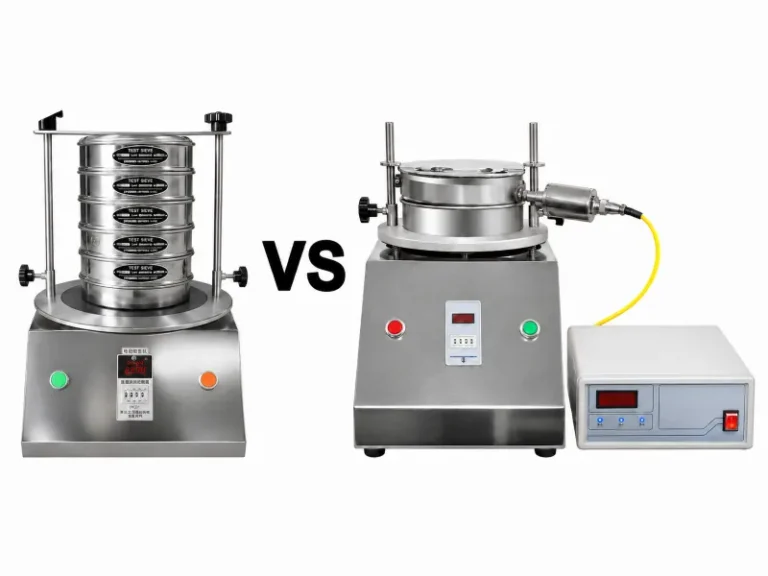
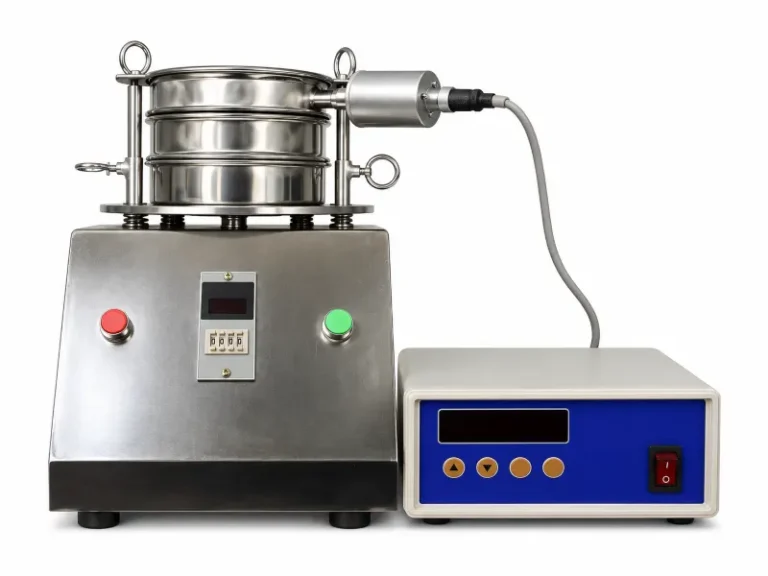
Small sieving machines can prepare powder fractions for material development and performance testing.
Researchers can compare formulations using samples prepared under more consistent particle-size conditions. The sieve prepares those fractions; the relevant testing instruments provide the performance measurements.
How to Choose a Suitable SiC Sieving Machine
The supplied document identifies airflow sieves and ultrasonic vibrating sieves as options for difficult SiC powders.
For silicon carbide powder screening, start with the required separation, then test how the powder behaves on the proposed equipment.
| Czynnik wyboru | Information to confirm |
|---|---|
| Cel przesiewania | Oversize removal, size grading, or removal of both coarse and excessively fine fractions |
| Separation size | Mesh count, actual aperture, and applicable mesh standard |
| Powder properties | Particle-size distribution, bulk density, moisture, flowability, agglomeration, and abrasiveness |
| Required capacity | Feed rate and acceptable product recovery at the target aperture |
| Product cleanliness | Permitted contamination and suitable contact materials or lining |
| Production connections | Feeding method, inlet and outlet arrangement, and dust-control requirements |
Two powders screened at the same nominal mesh can behave differently. Particle shape, moisture, and the proportion of near-size grains all affect the result.
A useful trial checks sustained throughput, separation quality, usable powder recovery, and mesh condition. A high initial feed rate tells only part of the story.
Yuanjing offers customization of screen size, mesh, decks, construction materials, and inlet and outlet arrangements. Its przewodnik wyboru przesiewacza wibracyjnego explains how these choices relate to powder properties and production requirements.
Czy potrzebuję ultradźwiękowego przesiewacza wibracyjnego do drobnego proszku?
Can an ultrasonic sieve screen 500-mesh SiC powder?
Yes. The technical brief includes 500 mesh and finer applications. Actual output depends on the powder, aperture, screen area, feeding conditions, and required separation quality. A representative sample should be used to confirm performance.
Does screening remove all impurities?
Screening retains particles that are too large to pass through the selected aperture, including oversized foreign material. Contaminants that pass through the same openings as the qualified powder may require another removal method.
Can ultrasonic vibration eliminate clogging completely?
It helps reduce adhesion, agglomeration, and particle wedging. Its effectiveness depends on the powder and operating conditions, so mesh condition and sustained output still need to be monitored.
What capacity can a silicon carbide powder screening machine achieve?
The supplied technical brief gives a broad range of 0.1–20 t/h across different screening duties and configurations. Capacity for a particular machine must be established at the required aperture using the actual powder.
Can one screen remove both coarse particles and excessively fine powder?
A single screen opening provides one separation cut point. Producing a defined particle-size band requires two cut points, using a suitable screening arrangement or an additional classification stage.
Discuss Your SiC Screening Requirements
Send Yuanjing your target mesh or aperture, required output, powder characteristics, and cleanliness requirements. A representative sample can help establish the suitable screen size and configuration.
Available equipment configurations are listed on the ultradźwiękowy przesiewacz wibracyjny page.