Internal vs External Ultrasonic Vibrating Screen: Differences and How to Choose
The main difference between an internal and an external ultrasonic vibrating screen is where the transducer sits. An internal transducer is mounted inside the machine, commonly beneath the mesh or near the center of the screen frame. An external transducer sits outside the screening chamber, with a mechanical connection that carries vibration to the screen assembly.
That changes how you reach the transducer, how much powder it encounters, and what maintenance involves. Internal designs usually cost less upfront. External designs generally provide easier access for inspection and replacement.
Screening accuracy, output, and service life need a closer look. None can be determined from transducer position alone.

Internal vs External Ultrasonic Vibrating Screen: Quick Comparison
| Karşılaştırma | Internal Transducer Design | External Transducer Design |
|---|---|---|
| Transducer position | Inside the screening chamber, commonly beneath the mesh | Outside the screening chamber |
| Exposure to material | May encounter falling powder or dust | Usually outside the product flow |
| Maintenance access | Often requires opening the screen frame and lifting the screen assembly | Usually accessible from outside |
| Cleaning | Check around the transducer, beneath the screen assembly, and at connections | Check external connections and seals; internal screening parts still need cleaning |
| Initial cost | Usually lower for comparable configurations | Usually higher because of additional mounting, connection, and sealing parts |
| Main buying considerations | Budget, material properties, and internal maintenance access | Service access, product changeovers, and reduced exposure to powder |
| Screening performance | Depends on the complete system and operating conditions | Depends on the complete system and operating conditions |
The dismantling sequence varies by model. Use the equipment drawing and operating instructions to confirm what must be removed.
What Does “Internal” or “External” Mean?
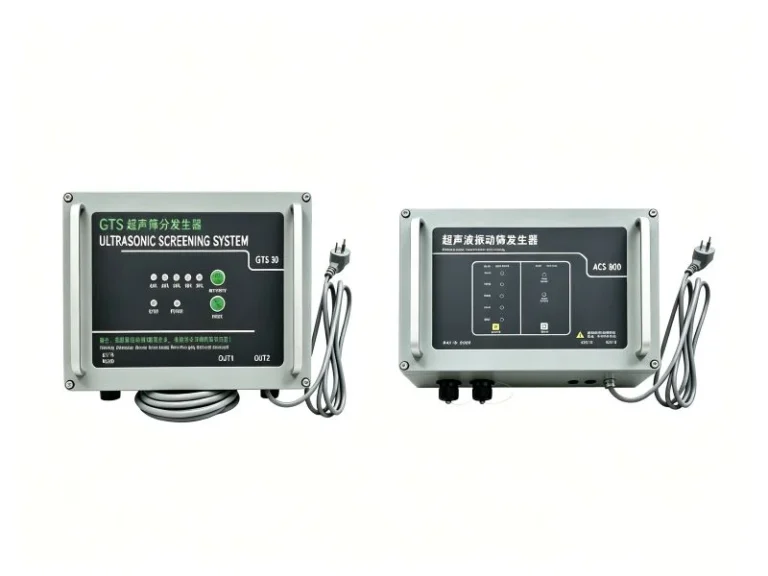
On an ultrasonic vibrating screen, “internal” and “external” refer to the transducer, not the generator control box.
The generator supplies a high-frequency electrical signal. The transducer converts it into mechanical vibration, which passes through a matched resonant structure to the mesh. This helps reduce powder buildup and blocked openings.
For the component breakdown, see how an ultrasonic screening system works.
Internal transducer
The transducer is mounted within the screening chamber, often beneath the mesh or near the center of the screen assembly. Reaching it may require opening the machine and lifting or removing the screen assembly.
External transducer
The transducer connects to the screen assembly through a rod, waveguide, or another matched structure. Although it sits outside the chamber, it still needs a mechanical connection. The vibration does not cross an open air gap to reach the mesh.

Which Design Is Easier to Clean and Maintain?
An external transducer is usually easier to inspect or replace because you can reach it from outside the machine.
With an internal ultrasonic vibrating screen, access often starts with removing the surrounding screen frame and lifting the screen assembly. Some designs require further dismantling; others do not require the mesh itself to be removed.
External mounting makes checking connections and replacing the transducer more convenient. It does not eliminate internal cleaning. Powder can remain on the mesh, resonant ring, seals, and outlets regardless of where the transducer sits.
Before buying an ultrasonic vibrating screen, ask the supplier to walk through the maintenance procedure:
- Which parts come off before the transducer can be reached?
- How is the underside of the screen assembly cleaned?
- Does replacing the transducer require removing the mesh?
- How are the connections and seals checked after reassembly?
For a line that changes products frequently, include the chamber and discharge areas when assessing cleaning time. Easy transducer access covers only part of the job.
If blocked mesh is forcing frequent stops, investigate the ince toz elek körlüğünün nedenleri. Moisture, static, powder buildup, and feeding conditions can all contribute. Moving the transducer will not necessarily correct them.
Which Design Suits Your Powder?
Routine dry powders
An internal ultrasonic vibrating screen may be a reasonable starting point for dry, non-corrosive powders when product changes are infrequent and purchase cost matters.
Check the transducer protection and the space available for maintenance. A lower purchase price is less useful if routine cleaning requires dismantling that your operators cannot easily carry out.
Frequent product changeovers
External mounting can simplify transducer servicing, but the main cleaning work may still be inside the machine.
Ask to see how the mesh, screen frame, seals, and discharge areas are cleaned between products. Include reassembly and inspection when comparing changeover procedures.
Food powders and high-purity materials
Keeping the transducer outside the product flow may be useful for an ultrasonic vibrating screen handling food powders or high-purity materials. The remaining product-contact parts still need attention.
Check their materials, the places where powder can collect, and whether operators can inspect those areas after cleaning. Also identify wear parts that could affect product quality.
An external transducer alone does not establish compliance with a hygiene or purity requirement.
Corrosive powders
External mounting reduces direct exposure of the transducer to corrosive material. The mesh, frame, resonant parts, and seals may still be exposed, so their compatibility needs a separate check.
An internal design also needs a more specific assessment than simply labeling the powder “corrosive” or “conductive.” The supplier should review the actual material, exposure, protective design, and operating conditions.
Fine and high-mesh powders
For an ultrasonic vibrating screen handling fine powder, start with the required aperture and how the material behaves on the mesh.
In 200–500 mesh toz eleme, adhesion, static, feed rate, and screen tension can affect performance. Mesh count alone does not tell you whether an internal or external transducer will work better.
Does an External Transducer Last Longer?
External mounting can reduce exposure to powder. It does not establish a fixed increase in service life.
On an internal ultrasonic vibrating screen, inspect the areas where falling powder or buildup reaches the transducer and its connections. Dust may enter a component if its seals or protective parts fail. This is a maintenance risk, not an inevitable fault of internal mounting.
An external transducer still needs secure mounting, effective seals, and sensible cable routing. Cables rubbing against nearby parts or loose connections can cause problems outside the chamber too.
During inspection, look for:
- Loose mechanical connections.
- Powder buildup around components.
- Damaged seals or cables.
- Unusual temperature rise.
- Unstable operation or warning signals.
Ask for maintenance records from similar applications if service life is a deciding factor. The installation position cannot tell you how many months or years a transducer will last.
Does an Internal Design Screen More Accurately?
An internal design does not automatically produce a finer separation or greater output.
Some internal arrangements have a shorter vibration path. That feature alone is not enough to predict the performance of an ultrasonic vibrating screen. The transducer, resonant structure, generator, and mesh must work together. External systems also depend on a correctly matched connection and screen assembly.
Check the operating conditions before comparing designs. Mesh tension, feed rate, powder distribution, and ultrasonic settings can change the result. The guide to ultrasonic vibrating screen setup and adjustment covers these points.
To compare an internal and an external ultrasonic vibrating screen, use the same material batch and mesh specification. Record more than the feed rate:
| Test Item | What to Record |
|---|---|
| Throughput | Material processed per hour while meeting the product specification |
| Ayrım kalitesi | Whether the oversize and undersize fractions meet the target |
| Mesh blockage | Buildup or blockage during continuous operation |
| Output stability | Whether throughput changes during the run |
| Cleaning requirements | Cleaning frequency, dismantling steps, and time taken |
| Operating condition | Transducer temperature, connection stability, and alarms |
A higher throughput only helps if the separated material still meets the required specification.
How Do the Costs Compare?
An internal ultrasonic vibrating screen usually costs less upfront when the other specifications are comparable. External mounting can add supports, connections, and sealing parts to the quotation.
First check that both quotations cover the same screen diameter, mesh specification, product-contact materials, and ultrasonic configuration. Then compare the items you will pay for during use:
- Replacement transducer and screen assembly.
- Cleaning and inspection labor.
- Mesh replacement.
- Maintenance downtime.
- Compatible spare parts and their availability.
Easier access may justify a higher purchase price on a line where maintenance stops are costly. On a machine used less often, the calculation may be different. Use your cleaning schedule and maintenance requirements to assess the difference.
How to Choose an Ultrasonic Vibrating Screen
An internal design is worth considering when the material suits its protection, internal access is acceptable, and initial cost is a priority.
An external arrangement deserves a closer look when transducer access is difficult, servicing is frequent, or you want to reduce direct powder exposure.
Before placing an order, confirm:
- Malzeme: Name the powder and describe its moisture, adhesion, corrosion, or purity requirements.
- Screening target: Specify the aperture, required product quality, and hourly capacity.
- Cleaning schedule: State how often the machine is cleaned and how often the product changes.
- Maintenance access: Confirm which parts must be removed to inspect or replace the transducer.
- Test evidence: Ask what results are available for the proposed configuration and your material.
Get a Configuration for Your Material
When requesting an ultrasonic vibrating screen quotation, send the material name, target aperture, required hourly capacity, and cleaning frequency.
Include moisture, adhesion, corrosion, or purity requirements. If you already use a screening machine, describe where blockage occurs and what maintenance involves.
View Yuan Jing’s ultrasonic vibrating screen configurations and submit those details through the product page. Ask the supplier to confirm the transducer position, product-contact materials, maintenance procedure, and relevant test conditions.
SSS
Is the generator built into an internal ultrasonic vibrating screen?
“Internal” describes the transducer position in this comparison. It does not specify where the generator control box is installed. A layout drawing should show both.
Does an external transducer mean the machine can be cleaned without opening it?
No. The transducer is usually easier to reach, but cleaning the mesh, screen assembly, and chamber may still require opening the machine.
Do fine powders require an internal transducer?
No. Both arrangements need a matched ultrasonic system and screen assembly. Use screening quality, throughput, and blockage behavior to assess the configuration for your powder.
Can an internal transducer be moved outside the machine?
It is not necessarily a simple relocation. The connection, resonant structure, seals, and generator compatibility need review. Ask the equipment supplier to assess the conversion before changing the assembly.
Why does an external ultrasonic vibrating screen usually cost more?
External mounting may require extra supports, a vibration-transmitting connection, and sealing parts. Compare quotations with the same screen size, materials, mesh, and ultrasonic configuration. The higher price may be worthwhile if it reduces maintenance work, but that depends on how the machine is used.
Which transducer design should I choose for corrosive powder?
An external design can reduce direct exposure of the transducer, making it worth evaluating for corrosive powders. It does not make the entire machine corrosion-resistant. The supplier still needs to check the mesh, frame, resonant parts, and seals against the specific material and operating conditions.