Sàng bột thủy tinh: Lựa chọn máy sàng cho các cấp độ mịn 200 mesh, 325 mesh và mịn hơn
For glass powder screening, the required mesh size is only part of equipment selection. A powder that flows freely through a clean screen may start sticking after a period of operation. Static, moisture, and agglomeration can change the result considerably.
Đối với 10–200 mesh glass powder, a linear vibrating screen is an option for initial classification and higher throughput. A rotary vibrating screen is often suitable for routine impurity removal at 200 mesh or coarser, particularly with low-static powder and small to medium production requirements.
At 325 mesh and finer, an ultrasonic vibrating sieve is usually the first option to assess. A tumbler screen is another choice when the process calls for precise classification into several particle-size fractions.
These ranges overlap. The useful question is whether a machine can maintain the required separation and output with the actual powder.

Why Screen Glass Powder?
Glass powder is used in construction, electronics, chemicals, aerospace, and other industries. Its particle size commonly ranges from a few microns to several hundred microns.
After grinding, the powder may still contain coarse particles or agglomerates that do not meet the next process’s requirements. Screening separates these particles and can divide the material into different product grades.
The main tasks are:
- Removing oversized particles left after grinding;
- Retaining foreign material larger than the screen openings;
- Producing different particle-size fractions;
- Reducing coarse particles and agglomerates entering coating, filler, and mixing processes.
Common specifications include 200 mesh, 300 mesh, and 400 mesh. As the openings become smaller, adhesion and blockage tend to become more troublesome. The cleaning system matters more at these finer grades.
Glass Powder Screening Equipment Comparison
| Thiết bị | Typical Mesh Range and Conditions | Main Uses | Cần kiểm tra gì |
|---|---|---|---|
| Sàng rung tuyến tính | Approximately 10–200 mesh conventional glass powder | Initial screening, coarse classification, higher-throughput processing | Capacity, enclosure, deck count, and static adhesion |
| máy sàng rung tròn | Generally 200 mesh or coarser, with low static and limited agglomeration | Impurity removal and routine classification | Screen diameter, bouncing-ball cleaning, deck count, and moisture |
| Sàng rung siêu âm | Above 200 mesh, particularly 325 mesh and finer | Fine powder screening where adhesion or blockage restricts output | Ultrasonic configuration, sustained throughput, and cleanliness |
| Tumbler screening machine | Approximately 10–635 mesh, depending on the powder and cleaning system | Precise classification into multiple fractions | Screening motion, mesh cleaning, wear, and dust containment |
These are selection references. The usable range depends on the powder, machine configuration, and required separation quality.
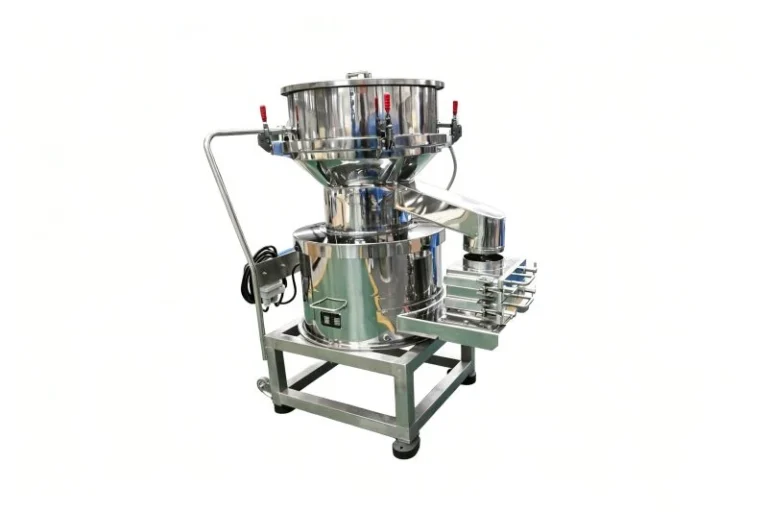
Linear Vibrating Screen for Conventional Glass Powder
A linear vibrating screen for glass powder suits conventional material in the 10–200 mesh range, especially initial screening and classification of coarser powder.
An appropriately configured machine can process several tonnes per hour. The actual capacity depends on the screen aperture, dimensions, and feeding conditions.
Installation After the Ball Mill
In a glass powder production line, the linear screen is commonly installed after the ball mill.
Ground material enters the screen and moves forward under vibration. Qualified particles pass through the mesh to the next process. Oversized particles continue across the screen surface and leave through the oversize outlet.
Where several product grades are needed, a multi-deck screen can make more than one separation in the same machine.
Configuration Details
Một enclosed screen helps contain dust and reduce material loss. This is useful with glass powder, which can escape around open screening and transfer points.
Các mesh and deck count should follow the required product grades. For finer powder, check whether the material continues to pass through the screen during an extended run.
Static also needs attention. In dry conditions, glass powder may adhere to the mesh. An ionizing air device can be considered where this affects screening.
See Yuanjing’s sàng rung tuyến tính for equipment options.
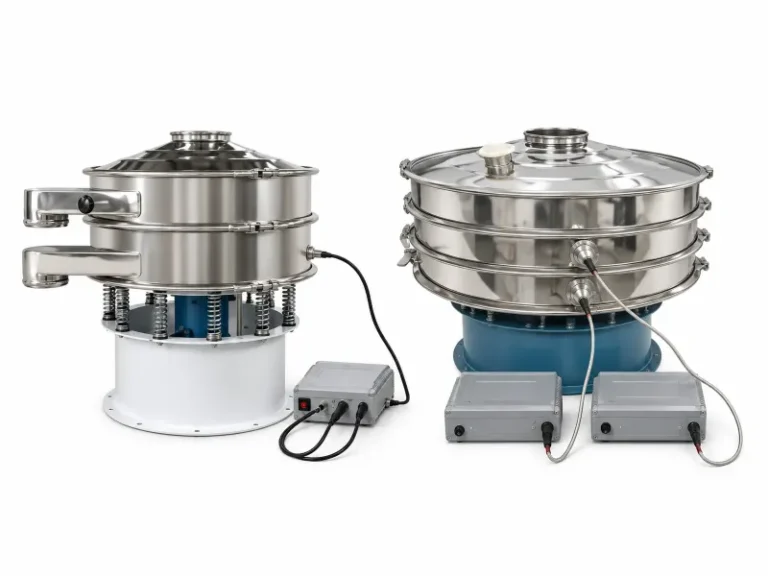
Ultrasonic Vibrating Sieve for 325-Mesh and Finer Glass Powder
For 325-mesh glass powder and finer grades, maintaining clear screen openings is often the main difficulty.
Fine powder can adhere to the mesh or form agglomerates. Particles close to the aperture size may lodge in the openings. As blockage builds, less screen area remains available and output falls.
An ultrasonic system adds high-frequency, low-amplitude movement to the mesh. This helps loosen adhered powder, disperse loose agglomerates, and reduce particle wedging.
Glass Powder Mesh Sizes
Ultrasonic screening can be used for:
- 200 lưới glass powder;
- 325 lưới fine glass powder;
- 500 lưới glass powder;
- 625 mesh ultra-fine glass powder.
A coarser powder may also need ultrasonic assistance if static adhesion or agglomeration makes conventional cleaning ineffective.
Capacity at 325 Mesh
For common 800 mm and 1,000 mm diameter ultrasonic sieves, the experience-based throughput reference for 325-mesh glass powder is approximately 100–500 kg/h.
In suitable fine glass powder applications, throughput can reach 2–5 times that of a conventional rotary vibrating screen. The result depends on the material, mesh, cleaning system, and comparison equipment. The multiplier should be used with those conditions in mind.
Construction and Applications
Glass powder ultrasonic sieves commonly use Thép không gỉ 304 and can be configured with 1–5 screen decks.
Ultrasonic mesh cleaning can reduce reliance on bouncing balls or brushes. This reduces potential contamination from those contact components.
Applications include electronic fillers, epoxy fillers, artificial stone, precision casting, and photovoltaic glass powder processing.
Available configurations are listed on Yuanjing’s sàng rung siêu âm page.

Rotary Vibrating Screen for 200-Mesh Glass Powder and Coarser Grades
A rotary vibrating screen for glass powder is suitable for routine screening at 80, 100, 120, 150, and 200 mesh, provided the material has relatively low static and no significant agglomeration.
It can handle conventional coarse glass powder, recycled crushed glass powder, glass granules, and glass sand. Typical duties are impurity removal and classification at small to medium capacities.
Common Configurations
| Mục | Application Reference |
|---|---|
| Vật liệu chế tạo | 304 stainless steel, or stainless steel for product-contact parts |
| Screen diameter | 400, 600, 800, 1,000, and 1,200 mm |
| Commonly used diameters | 600 and 800 mm |
| Tầng sàng | Commonly 1–3 decks, producing 2–4 particle-size fractions |
| Vệ sinh lưới | Rubber bouncing balls; silicone balls can be selected according to cleanliness requirements |
| Dust containment | Enclosed dust cover for dusty applications |
| Discharge outlets | Adjustable orientation, including 360° positioning where supported by the configuration |
Capacity at 200 Mesh
Một 800 mm rotary vibrating screen processing conventional 200-mesh glass powder has an experience-based throughput reference of approximately 200–600 kg/h.
Static and moisture can change this considerably. If powder builds up on the mesh or output drops during a run, check the cleaning arrangement and whether ultrasonic assistance is needed.
The 200-mesh rotary screen figure cannot be directly compared with the 325-mesh ultrasonic sieve figure above. They describe different screening duties.
For routine glass powder screening, see the rotary vibrating screen.
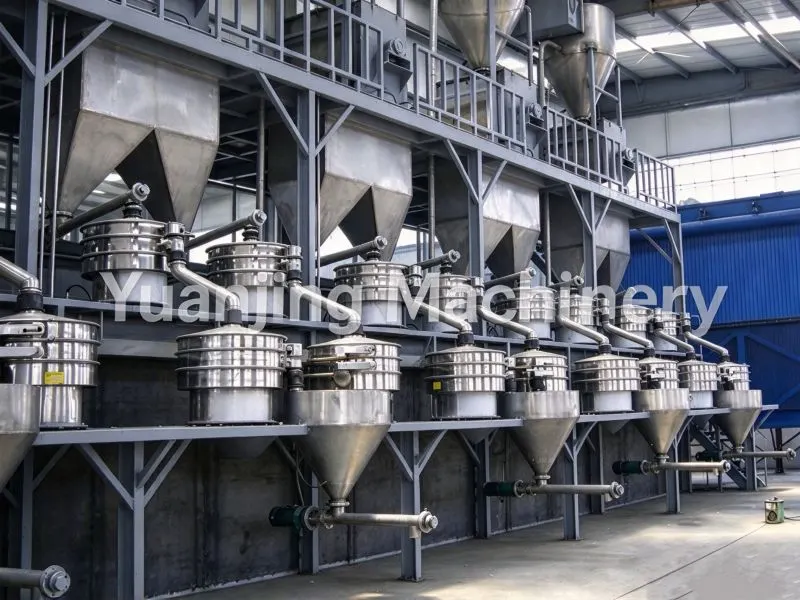
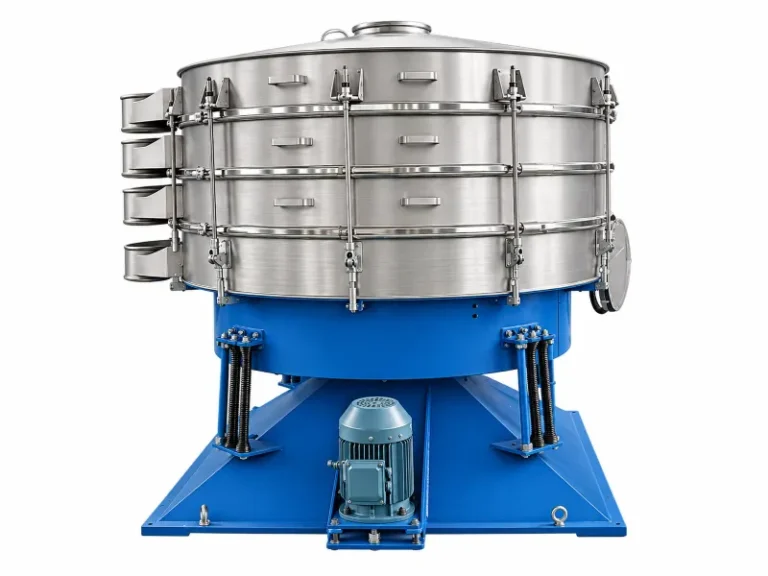
Tumbler Screen for Multi-Grade Glass Powder Classification
A tumbler screening machine for glass powder can be used where the process requires precise classification and several particle-size grades.
Its application range is approximately 10–635 lỗ, depending on the powder and mesh-cleaning system. At the finer end of that range, the required output and separation quality need to be assessed together.
Dust Containment
A dust cover or sealed construction helps contain powder during operation. A dust extraction connection can also link the screen to the workshop collection system, reducing powder escape and material loss.
Mesh Cleaning and Static
Tumbler screens can use bouncing balls or ultrasonic cleaning to help keep the openings clear.
Where static adhesion is significant, suitable static-control equipment or an appropriate antistatic mesh treatment can be assessed for the application.
For ultra-fine glass powder that struggles to pass through the mesh, an ultrasonic transducer system adds high-frequency movement to reduce adhesion. In suitable conditions, this can increase throughput by 20–30%. The improvement depends on the original blockage and the selected configuration.
Wear from Glass Powder
Glass powder is abrasive. Contact parts can use wear-resistant stainless steel or polymer composite materials where the process allows.
Mesh life also depends on particle shape, operating hours, and maintenance. Wear-resistant contact parts do not remove the need to inspect the screen.
Where Tumbler Screening Is Used
Coatings: Screening removes coarse powder and agglomerates to meet formulation requirements for transparency and sanding performance.
Refractory materials: Screening before mixing helps match the glass powder particle size to the other raw materials.
Inks, composites, and polishing materials: Classification controls particle size and removes coarse particles before downstream processing.
See the máy sàng thùng quay for multi-fraction screening options.

Glass Powder Screening Problems and Possible Adjustments
| Vấn đề | What to Assess |
|---|---|
| Fine powder sticks to the mesh and passes through slowly | Ultrasonic cleaning to reduce adhesion and blockage |
| Agglomerates or deposits form on the screen | Powder moisture and a cleaning system suited to the material |
| Near-size particles lodge in the openings | Ultrasonic assistance to reduce particle wedging |
| Static adhesion increases in dry conditions | Ionizing air or another suitable static-control method |
| Dust escapes during screening | Sealed construction and dust extraction where required |
| Contact parts wear quickly | Wear-resistant materials and regular inspection of the mesh and contact surfaces |
More than one adjustment may be needed. A 325-mesh glass powder with both static adhesion and particle wedging may require ultrasonic cleaning alongside a separate static-control measure.
Get a Glass Powder Screening Recommendation
Send Yuanjing the target mesh size, required throughput, number of product grades, and details of any sticking or clogging.
It also helps to include:
- The powder source: conventional, recycled, or ball-milled glass;
- Moisture and agglomeration conditions;
- Required product-contact materials;
- Cleanliness and dust extraction requirements.
Yuanjing Machinery supplies rotary vibrating screens, ultrasonic sieves, linear vibrating screens, and tumbler screens, with configurations adapted to the material and production line.
Send your glass powder screening requirements to Yuanjing
Câu hỏi thường gặp
Should I use a rotary sieve or an ultrasonic sieve for 200-mesh glass powder?
Start by checking the powder’s behaviour. A rotary sieve is a reasonable option for low-static material with limited agglomeration and routine classification requirements. If deposits form or throughput declines during continuous production, assess an ultrasonic configuration.
Can a conventional vibrating screen process 325-mesh glass powder?
It may work under some conditions, but stable screening becomes more difficult at 325 mesh and finer. Compare sustained output and blockage during production when assessing conventional and ultrasonic equipment.
Can one machine produce several glass powder grades?
Yes. A multi-deck screen can separate the powder into several fractions. A rotary vibrating screen with 1–3 decks, for example, can produce 2–4 fractions. Deck count depends on the required grades, feed particle-size distribution, and capacity.
Does ultrasonic screening eliminate static electricity?
No. Ultrasonic vibration helps reduce adhesion and mesh blockage, but it does not replace static elimination. Significant static may still require a separate control measure.
Why does capacity vary at the same mesh size?
Powder moisture, static, agglomeration, and particle-size distribution affect how easily material passes through the screen. Screen diameter, effective area, deck count, and feeding conditions also affect output.
Which machine suits recycled glass powder?
For coarser recycled glass powder with limited static and agglomeration, consider a rotary vibrating screen or linear vibrating screen. Finer separation or persistent mesh blockage may call for ultrasonic assistance.