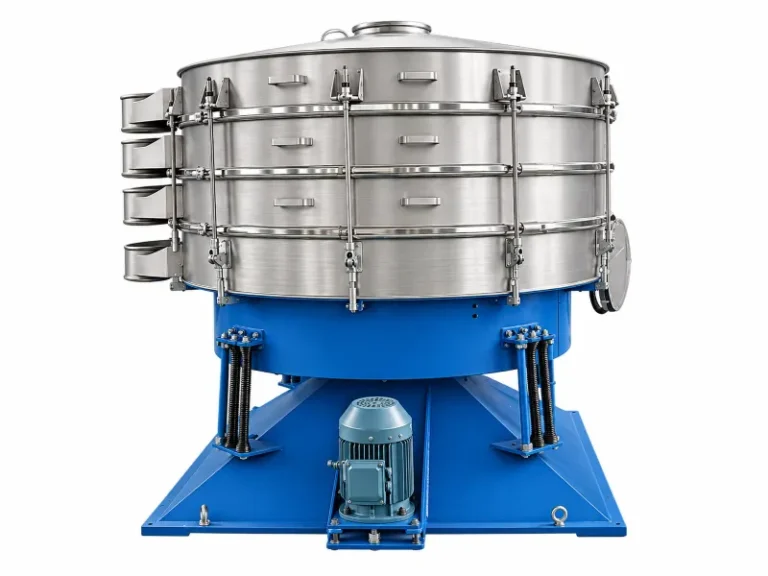
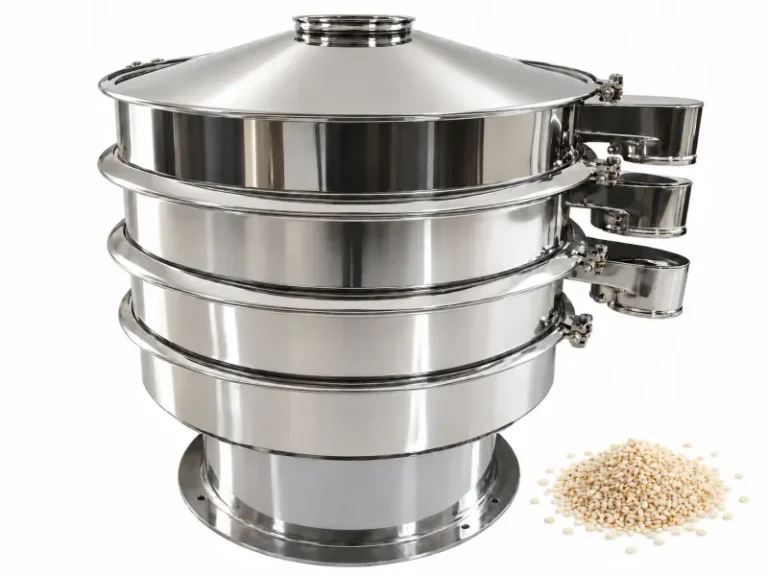
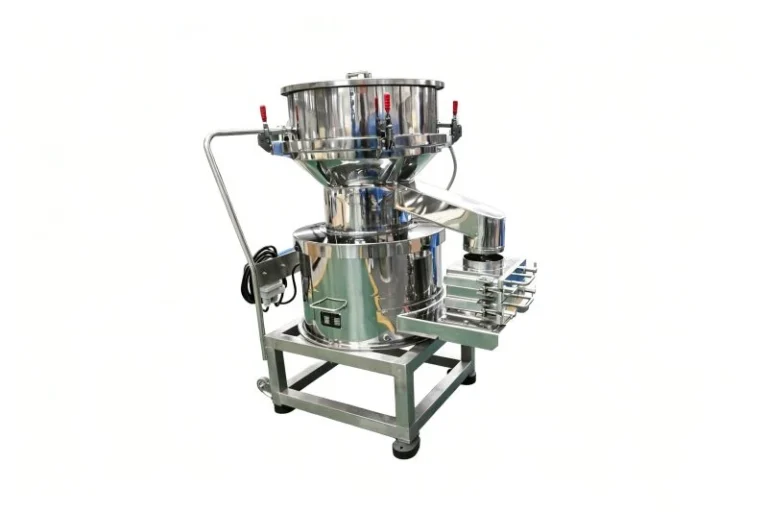
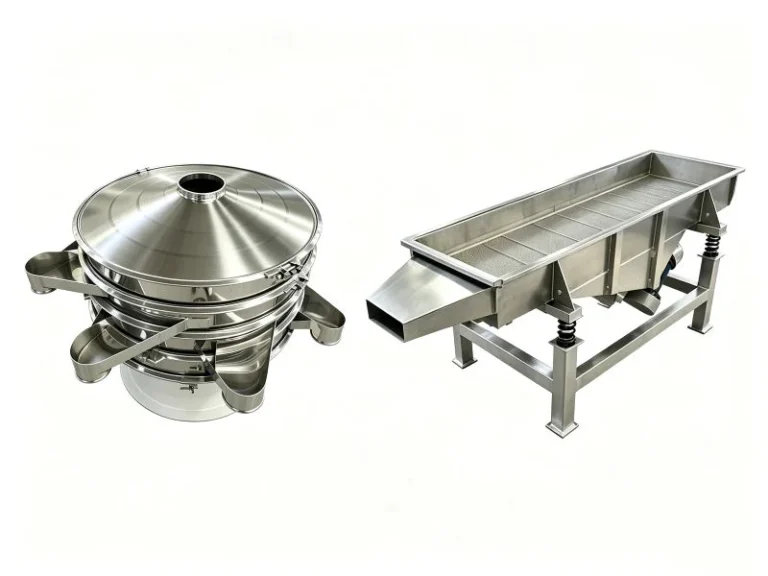
무기염용 회전식 진동 선별기: 미세 분급, 불순물 제거 및 막힘 방지
소다회, 탄산수소나트륨, 염화칼륨, 황산마그네슘은 생산 직후 입자 크기가 다음 공정에 필요한 크기와 항상 일치하는 것은 아닙니다. 건조 과정에서 덩어리가 남을 수 있습니다. 분쇄 과정에서는 미분이 발생합니다. 결정화 과정에서는 완제품에 허용되는 범위보다 입자 크기 분포가 넓어질 수 있습니다.
하나의 무기염용 회전식 진동 선별기 이러한 물질을 입자 크기에 따라 분리합니다. 작은 입자는 체망을 통과하고, 큰 입자는 체망 위에 남아 별도의 배출구로 나갑니다. 체단이 여러 개이면 한 대의 기계로 여러 입도 분획을 수집할 수 있습니다.
구성은 처리하는 염의 종류에 따라 달라집니다. 수분, 결정 형태, 미분 함량 및 투입 조건은 물질이 체망 위에서 이동하는 방식과 체망 청소 주기에 영향을 미칩니다.
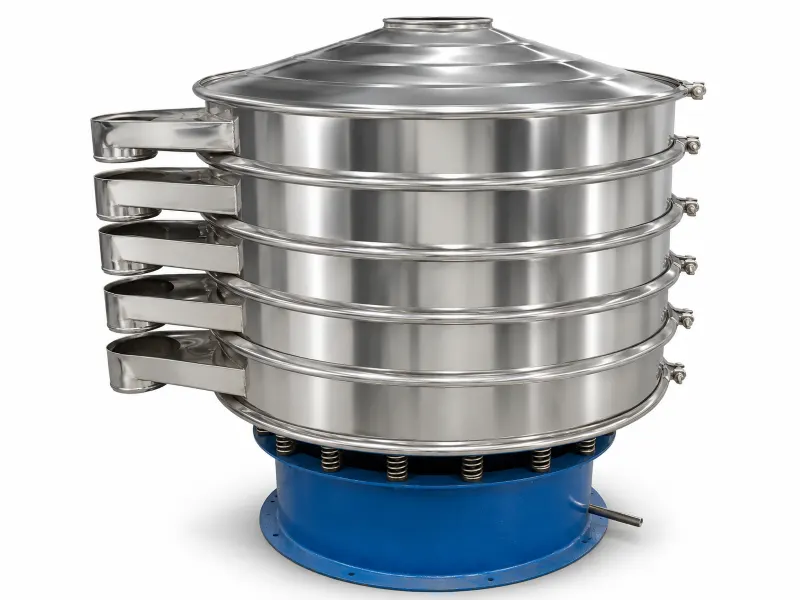
무기염 회전 진동체의 작동 원리
수직 진동 모터가 체를 구동합니다. 모터의 상단과 하단에 있는 편심 추가 수평, 수직 및 경사 방향의 움직임을 생성합니다.
물질은 투입구로 들어와 중심에서 가장자리로 퍼집니다. 이동하는 동안:
- 체망 구멍보다 작은 입자는 통과합니다.
- 크기가 큰 입자, 덩어리 및 큰 이물질은 조립자 배출구로 이동합니다.
- 필요한 경우 하부 체단에서 입도를 추가로 분리합니다.
편심 추의 상대 각도를 변경하면 물질의 이동 경로와 체류 시간이 달라집니다. 염의 종류나 체망 크기를 바꿀 때는 투입 속도와 진동 설정을 다시 확인해야 합니다.
Yuanjing의 회전 진동 스크린 제품 페이지에서 장비 구조와 선택 가능한 다단 구성을 확인할 수 있습니다.
무기염 처리 공정에서 체의 적용 위치
입도 분급
결정화, 건조, 분쇄 및 이송 과정은 각각 입도 분포를 변화시킬 수 있습니다. 체질은 필요한 입도 분획을 조립자 및 미분과 분리합니다.
적용 사례로는 건조 또는 분쇄 후 소다회 선별, 포장 전 탄산수소나트륨 선별, 염화칼륨 또는 황산마그네슘 결정의 입도 분급이 있습니다. 인산일칼륨, 인산일암모늄 및 수용성 비료 결정에도 입도 관리가 필요할 수 있습니다.
무기염 회전식 진동 스크린을 선택할 때는 회수하려는 입도 범위를 명시해야 합니다. 예를 들어 “40메시”는 선별 규격을 나타내지만, 허용되는 제품의 입도 범위를 완전히 설명하지는 않습니다.
덩어리 및 이물질 제거
포장 전에 선별을 통해 제품과 크기가 다른 일부 큰 응집물과 이물 입자를 제거할 수 있습니다.
이러한 선별로 달성할 수 있는 효과에는 한계가 있습니다. 스크린은 용해된 오염물질을 제거하거나 염과 크기가 비슷한 이물 입자를 모두 확실하게 분리할 수 없습니다. 입도 검사를 통과했다고 해서 화학적 순도가 확인되는 것은 아닙니다.
염수 및 슬러리 여과
염을 함유한 액체에는 다른 평가가 필요합니다. 염수 여과 시 적절한 스크린을 사용하면 스크린 개구부보다 큰 부유 고형물을 제거할 수 있습니다.
액체의 특성, 온도, 고형물 농도, 여과 매체 및 접액부 재질을 모두 명시해야 합니다. 건조 분말의 처리 용량 수치를 이 용도에 그대로 적용할 수는 없습니다.
각 염에 대해 확인할 사항
무기염 회전식 진동 스크린을 구성하기 전에 분리 작업과 이에 영향을 줄 수 있는 원료 조건을 파악해야 합니다.
| 원료 또는 용도 | 선별 작업 | 확인할 사항 |
|---|---|---|
| 소다회 및 탄산수소나트륨 | 분급, 큰 입자 및 덩어리 제거 | 수분, 응집 및 목표 개구부 크기 |
| 염화칼륨 및 황산마그네슘 | 결정 분급 및 이물질 제거 | 결정 형태, 입도 분포 및 접촉부 재질 |
| 인산일칼륨 및 인산일암모늄 | 원료 또는 완제품의 입도 관리 | 미분 함량, 처리량 및 필요한 입도 구간 |
| 수용성 비료 결정 및 복합비료 원료 | 큰 입자와 미분의 분리 | 수분 민감성, 제품 규격 및 스크린 데크 배열 |
| 식품용 소금 및 식품용 인산염 | 입도 분류; 분리 가능한 덩어리 및 오염물 제거 | 세척, 접촉 재질 및 교차 접촉 관리 |
| 산업용 폴리염화알루미늄 및 황산제일철 | 원료 선별 | 수분, 부식성 환경 및 세척 절차 |
| 염수 및 염을 함유한 기타 액체 | 부유 고형물 제거 | 고형물 농도, 액체 특성 및 여과공 크기 |
수분이 재료의 거동을 변화시킨다면 시험 시료에 생산 조건이 반영되어야 합니다. 건조 시료로는 같은 염이 수분을 흡수한 후 어떻게 선별되는지 알 수 없습니다.
재료 특성, 처리 용량 및 장비 크기 사이의 전반적인 관계는 Yuanjing의 다음 자료를 참조하십시오. 회전 진동 스크린 선택 가이드.
망목 크기 및 스크린 데크 선택
몇 개의 분획이 필요한가요?
스크린 데크 하나는 망상물과 망하물, 두 개의 분획을 생성합니다. 데크를 추가하면 원료를 더 많은 입도 구간으로 나눌 수 있습니다.
제공된 원자료에서는 1~5개의 스크린 데크를 설명하며, 최대 2~6개의 분획을 생성합니다. 원자료의 구성 예시는 아래에 그대로 제시되어 있습니다.
| 스크린 구성 | 분리 결과 | 용도 |
|---|---|---|
| 데크 1개: 40메시 | 망상물과 망하물 | 단순 조대물 제거 또는 단일 입도 분리 |
| 데크 2개: 20메시를 60메시 위에 배치 | 조립, 중간립 및 미립 분획 | 조대 입자와 미분을 모두 제거 |
| 데크 3개: 16, 40 및 80메시 | 4개의 입도 구간 | 다중 분획 입도 선별 |
이 예시는 분리 구성을 설명하기 위한 것입니다. 모든 염에 적용되는 사양이 아니며, 특정 분획이 식품용 또는 산업용 등급에 해당하는지 결정하지도 않습니다.
무기염용 회전 진동 스크린을 선택할 때는 메시 번호뿐 아니라 스크린 규격과 실제 개구 크기를 확인하세요.
미세 선별 수치의 의미
제공된 자료에서는 200~800메시를 언급하며, 이에 대한 대략적인 환산값으로 74~18μm를 제시하고, 500메시를 약 28μm로 제시합니다.
이 수치는 원자료의 참고값입니다. 메시 수와 개구 크기의 관계는 스크린 규격에 따라 달라집니다. 따라서 모든 염이나 장비 구성에 대해 확인된 성능 한계로 해석해서는 안 됩니다.
수분, 입자 형상, 미분 함량, 망의 구조 및 세척 방식이 결과에 영향을 미칩니다. 미세 선별 작업에서는 필요한 개구 크기에서 처리량과 분리 성능을 확인해야 합니다.
망 막힘 해결하기
망하물 배출량 감소는 흔히 문제의 첫 징후입니다. 원료가 망에 쌓이기 시작하거나, 청소를 위한 가동 중단이 잦아지거나, 규격에 맞는 미분이 망상물과 함께 배출될 수 있습니다.
무기염용 회전 진동 스크린에 청소 장치를 추가하기 전에 무엇이 개구를 막고 있는지 확인하세요. 습한 퇴적물, 달라붙은 미분, 망에 끼인 입자는 각각 다른 대응이 필요할 수 있습니다.
바운싱 볼 세척
망 아래의 볼이 작동 중에 망을 두드려 끼어 있는 입자 일부를 떨어뜨리는 데 도움을 줍니다. 기계적 세척이 원료와 스크린 구성에 적합한 경우 사용할 수 있는 방법입니다.
식용 소금에 사용하는 경우 볼과 기타 관련 접촉 부품의 적합성을 확인하십시오.
초음파 보조
초음파 보조는 미세 분말, 달라붙는 입자 또는 기존 세척 방식이 충분하지 않은 용도에 도움이 될 수 있습니다. Yuanjing의 초음파 진동 체 페이지에서는 이러한 유형의 선별에 사용되는 장비를 설명합니다.
초음파 보조는 원료를 건조하지 않으며, 수분으로 단단해진 모든 덩어리를 부술 것으로 기대해서도 안 됩니다. 무기염류용 회전식 진동 스크린에 초음파 보조가 필요한지는 원료의 상태와 시험 결과에 따라 달라집니다.
When comparing mesh-cleaning options for damp or fine salt on a tumbler screen, keep the batch and feed rate constant and record how long each setup runs before the mesh starts to blind.
공급 속도와 원료 축적
공급량이 많다고 해서 반드시 기준에 맞는 제품이 더 많이 생산되는 것은 아닙니다. 원료층이 두꺼우면 입자가 망에 도달할 기회가 줄어들 수 있습니다.
배출량이 감소하면 먼저 공급 상태를 확인하십시오. 국부적으로 원료가 쌓인 곳이 있는지 살펴본 다음, 망이 막히거나 느슨해지거나 손상되었는지 점검하십시오. 망의 구멍 크기와 데크 구성이 요구되는 배출물에 적합한지 확인하고, 유입되는 원료의 수분이 더 많아졌는지도 확인하십시오.
밀폐만으로는 수분 관리가 되지 않습니다
밀폐 구조는 분진의 확산을 막고 외부 오염을 줄이는 데 도움이 됩니다. 하지만 소금의 수분을 제거하지는 않습니다.
수분에 민감한 원료는 여전히 관리된 보관 환경, 적절한 이송 방식, 그리고 젖은 잔류물이 장비에 남지 않도록 하는 가동 중단 절차가 필요할 수 있습니다.
고습도 수치에 대한 참고 사항
제공된 자료에서는 다음 조건에서의 운전을 설명합니다 상대습도 80%. 이 자료에 따르면 세척을 위해 가동을 중단하는 간격은 2시간 for one configuration and 24 hours without cleaning for another enclosed configuration.
The salt type, moisture content, mesh opening, feed rate and cleaning system are not identified, and no supporting test records are included. These are unverified source observations, not general performance guarantees or verified Yuanjing project results.
For a useful comparison, record the operating time, cleaning frequency and separation quality under the same defined conditions.


Contact Materials, Seals and Cleaning Access
Choosing Stainless Steel
The supplied material discusses 304, 316 and 316L stainless steel contact components.
The grade should be chosen against the actual salt composition, impurities, moisture, temperature and contact duration. Cleaning chemicals matter too.
No single stainless steel grade suits every acid, alkali or salt environment. Stainless steel also does not mean zero wear or zero metal migration. Inspect the mesh, welds, seals and cleaning components as part of routine maintenance.
Checking the Connections
The frame gasket is only one part of the sealing arrangement. Dust can also escape at the feed inlet, discharge outlets or connections to other equipment.
When specifying an inorganic salt rotary vibrating screen, identify any dust-control or negative-pressure requirements and show how the machine will connect to the line.
Quick Disassembly and CIP Are Different Requirements
Quick-release clamps and removable frames make mesh changes and manual cleaning easier.
Clean-in-place capability needs separate confirmation. If CIP is required, specify the cleaning connections, drainage, coverage and material compatibility. A machine that is easy to dismantle is not automatically suitable for CIP.
Food-Grade Salt: Fines, Residue and Ingredient Distribution
Watch for Additional Fines
Throughput alone does not show whether screening is suitable for a salt crystal. Compare the particle-size distribution before and after screening, along with fines generation and recovery of the required fraction.
The supplied material reports a 1.5% increase in fines in a 40-mesh salt-screening application using a circular rotary screen.
It does not provide the calculation method, feed rate or machine settings. The number is retained as an unverified source observation, not a guaranteed result for food-grade salt screening.
Clean Between Products
Sea salt, lake salt, rock salt, iodized salt, low-sodium salt and seasoning salt can involve different formulations and handling requirements.
During a product change, clean the mesh, frame, seals and outlets to reduce carryover. Residue at a discharge connection deserves the same attention as residue on the screen.
The source also mentions nylon mesh. Before using it, confirm food-contact suitability, temperature limits, wear characteristics and whether it can deliver the required separation.
Check Where the Ingredients Go
For iodized, low-sodium and seasoning salts, examine ingredient distribution across the separated fractions. An acceptable particle-size result does not establish that additives remain evenly distributed.

Connecting the Screen to the Production Line
An inorganic salt rotary vibrating screen may sit after drying or cooling, or immediately before collection and packaging. Its location affects the available height, inlet arrangement and access for cleaning.
Confirm those details before settling on the machine size.
The supplied material mentions 360° adjustment of the discharge direction. The actual adjustment range and installation restrictions need to be checked for the selected machine.
Level sensors, automatic start and stop, PLC control and MES interfaces should be listed individually if required. They should not be assumed to come with the standard machine.
Yuanjing’s guide to custom rotary vibrating screen configurations covers options such as contact materials, deck arrangements, cleaning systems and inlet or outlet design.
| 제공할 정보 | 세부 사항 |
|---|---|
| 재질 | Exact salt name and mixed ingredients, if any |
| Physical form | Powder, crystals, granules, liquid or slurry |
| Material properties | Size distribution, moisture, bulk density, temperature and lumping |
| Separation task | Scalping, impurity removal or multi-fraction grading |
| 체망 규격 | Opening size, screen standard and required fractions |
| 처리량 | Feed rate and required acceptable-product output |
| 접촉 재질 | Food-contact or corrosion-related requirements |
| Line arrangement | Space, connections, collection method and controls |
Maintenance in Salt-Screening Service
Salt deposits, damaged mesh and worn seals should be addressed before they affect separation.
| When | Task | Reason |
|---|---|---|
| Each shift | Check mesh tension, damage and gasket condition | Reduce leakage and unintended mixing of fractions |
| Periodically | Remove deposits from frames, outlets and contact surfaces | Limit buildup and make surface inspection possible |
| During operation | Check for abnormal noise, vibration and bearing temperature | Detect operating problems |
| As specified in the motor instructions | Check lubrication and service requirements | Avoid insufficient or incorrect lubrication |
| After washing or a shutdown in damp conditions | Drain residual liquid and dry appropriately | Reduce lumping at the next start |
| Between salt types or formulations | Clean mesh, frames, seals and outlets | Reduce carryover |
The source suggests monthly checks of motor lubrication and bearing temperature. Use that as a planning reference; the equipment instructions and operating conditions should determine the final schedule.
Mesh-change times in the source vary: 3–5 minutes, 5–10 minutes and approximately 10 minutes. The conditions are not defined consistently, so none of these figures should become a universal promise.
Ask what the stated time includes. Removing and fitting a mesh is a different task from changing it, cleaning the frame and completing the inspection.
Discuss Your Salt-Screening Requirements
To configure an inorganic salt rotary vibrating screen, start with the separation you need: the fraction to keep, the material to reject and the required output.
For soda ash, sodium bicarbonate, potassium chloride, magnesium sulfate or another salt, include moisture and lumping information with the particle-size specification.
Discuss your inorganic salt screening requirements with Yuanjing. Provide the salt name, target opening size, required throughput and installation details so the proposed configuration can be assessed against your process.
자주 묻는 질문
Which materials can an inorganic salt rotary vibrating screen handle?
Applications can be evaluated for soda ash, sodium bicarbonate, potassium chloride, magnesium sulfate, monopotassium phosphate and other inorganic salts. Material condition, screen opening, throughput and contact materials determine suitability.
Are more screen decks better?
Only if the process needs more size fractions. One deck may be enough for scalping or a single size cut.
Does every difficult salt powder need ultrasonic assistance?
No. Identify the blockage first. The answer may involve bouncing-ball cleaning, feed adjustment, ultrasonic assistance or upstream treatment.
Can an enclosed screen prevent moisture absorption?
It helps contain dust and limit external contamination. Humidity control, drying and storage still need their own measures.
Can published capacity figures be used directly?
Published ranges are references. Check the expected output against the salt properties, opening size, deck arrangement and feeding method.
What should a screening trial measure?
Record the feed rate, output from each outlet, particle-size distribution, continuous operating time and cleaning frequency at the required opening size.
For food-grade applications, also check fines generation, cleaning and ingredient distribution where relevant.