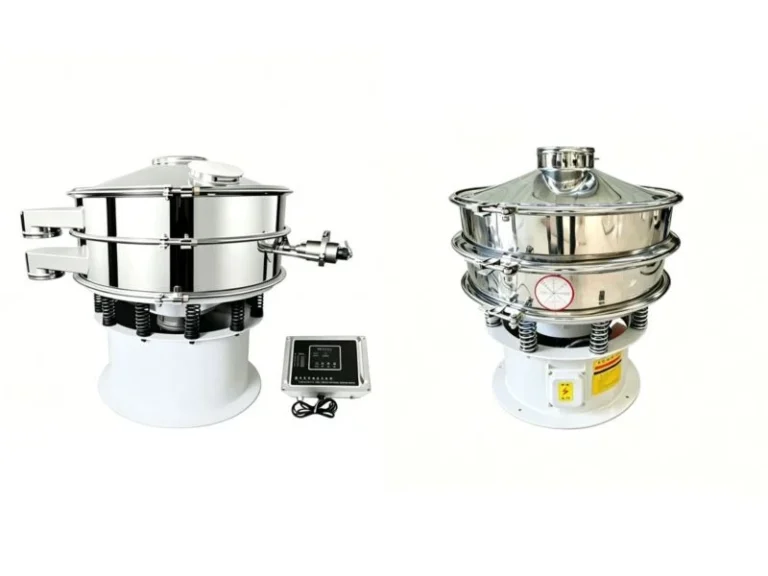
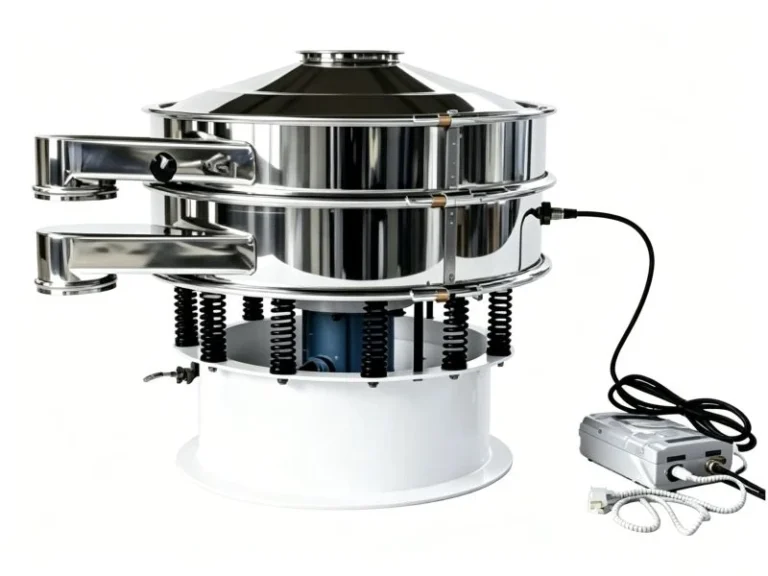
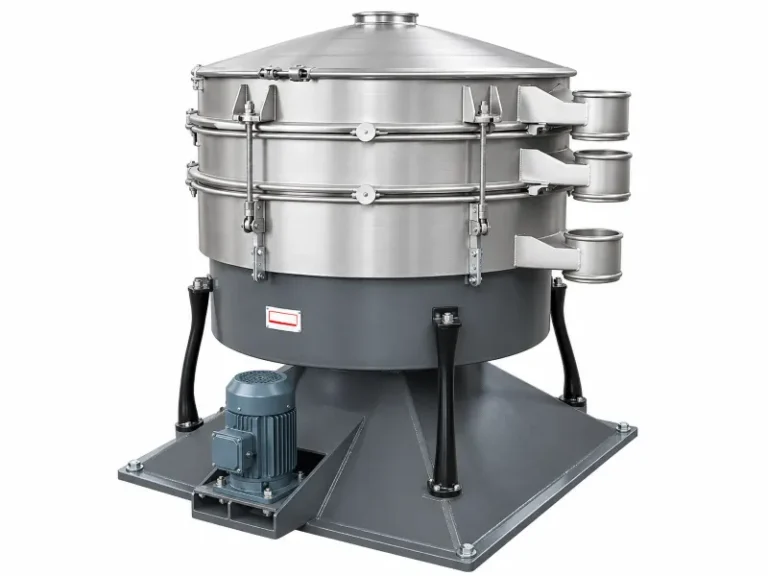
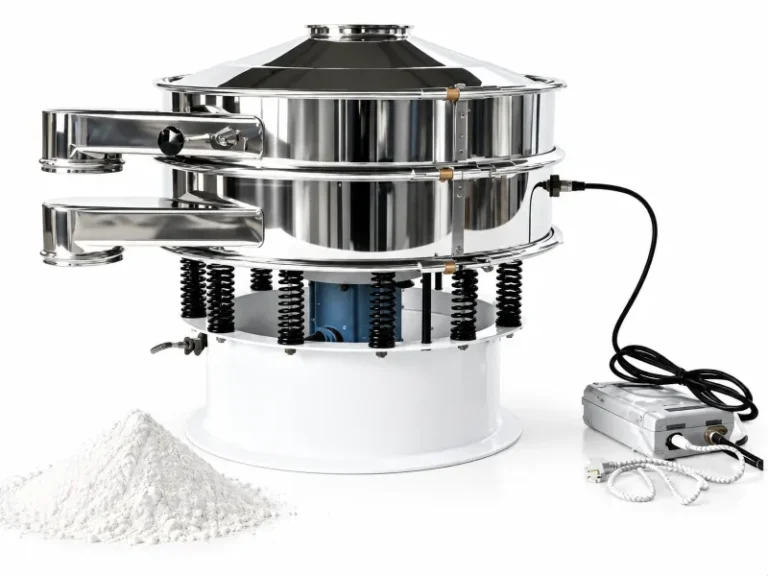
無機塩用回転振動ふるい:精密分級、不純物除去、目詰まり防止
ソーダ灰、炭酸水素ナトリウム、塩化カリウム、硫酸マグネシウムは、製造後に必ずしも次工程に必要な粒径になっているとは限りません。乾燥によって塊が残ることがあります。粉砕では微粉が発生します。結晶化によって、最終製品で許容される範囲よりも広い粒度分布になることがあります。
超音波振動ふるい 無機塩用回転振動ふるい これらの材料を粒径別に分離します。小さい粒子はふるい網を通過し、大きい粒子は網の上に残って別の排出口から排出されます。複数のふるい段を備えた機械なら、1台で複数の粒径区分を回収できます。
構成は処理する塩によって異なります。水分、結晶形状、微粉の含有量、供給条件は、材料の網面上での動きや、網の清掃頻度に影響します。
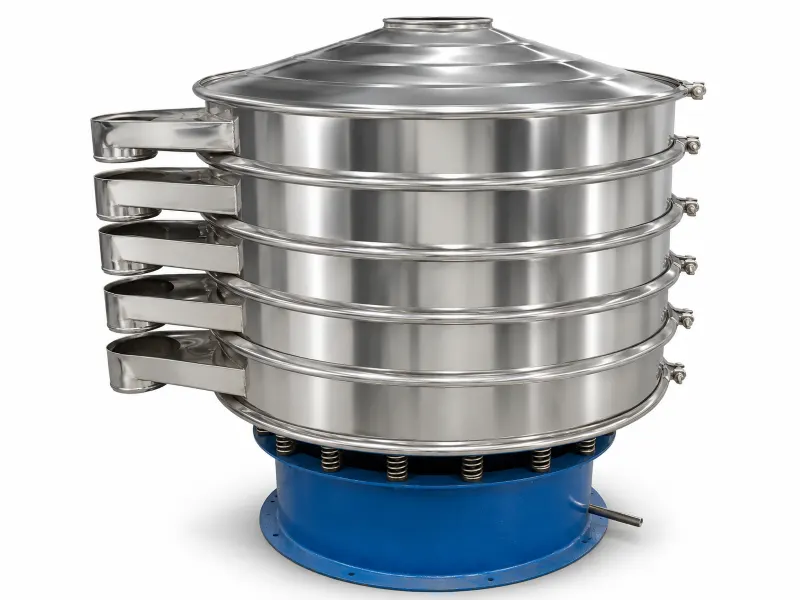
無機塩用円形振動ふるいの仕組み
縦型振動モーターがふるいを駆動します。モーターの上下端にある偏心錘が、水平、垂直、傾斜方向の動きを生み出します。
材料は投入口から入り、中心から外周に向かって広がります。移動する過程では:
- 網の目開きより小さい粒子は通過します。
- 目開きより大きい粒子、塊、大きな異物は粗粒排出口に向かって移動します。
- 必要に応じて、下段でさらに粒径を分けます。
偏心錘の相対角度を変えると、材料の移動経路と滞留時間が変わります。処理する塩の種類や網の目開きを変える際は、供給量と振動設定を再確認する必要があります。
Yuanjingの 回転振動スクリーン 製品ページでは、装置の構造と選択可能な複数段構成を紹介しています。
無機塩の処理工程におけるふるいの役割
粒度分級
結晶化、乾燥、粉砕、搬送は、それぞれ粒度分布を変化させることがあります。ふるい分けによって、必要な粒径区分を粗粒や微粉から分離します。
用途には、乾燥後または粉砕後のソーダ灰のふるい分け、包装前の炭酸水素ナトリウムのふるい分け、塩化カリウムや硫酸マグネシウムの結晶の粒度分級などがあります。リン酸二水素カリウム、リン酸二水素アンモニウム、水溶性肥料の結晶にも粒度管理が必要となる場合があります。
無機塩用回転式振動ふるいを選定する際は、回収したい粒度範囲を明示してください。例えば「40メッシュ」はふるいの規格を示しますが、許容される製品の粒度範囲を十分に表すものではありません。
塊と異物の除去
包装前のふるい分けにより、製品と大きさが異なる粗大な凝集塊や異物粒子の一部を除去できます。
ただし、その効果には限界があります。ふるいでは溶解した汚染物質を除去できず、塩と大きさが近い異物粒子をすべて確実に分離することもできません。粒度検査に合格しても、化学的な純度が保証されるわけではありません。
塩水とスラリーのろ過
塩類を含む液体には、別の評価が必要です。塩水のろ過では、適切なふるいを使用することで、目開きより大きい浮遊固形物を除去できます。
液体の性状、温度、固形物濃度、ろ材、接液部の材質をすべて明確にする必要があります。乾燥粉体の処理能力値をこの用途にそのまま適用することはできません。
塩の種類ごとの確認事項
無機塩用回転式振動ふるいの仕様を決める前に、分離の目的と、それに影響する可能性のある材料の状態を確認してください。
| 材料または用途 | ふるい分けの目的 | 確認すべきこと |
|---|---|---|
| ソーダ灰と炭酸水素ナトリウム | 粒度分級、粗粒と塊の除去 | 水分、凝集状態、目標とする目開き |
| 塩化カリウムと硫酸マグネシウム | 結晶の粒度分級と異物除去 | 結晶形状、粒度分布、接触部の材質 |
| リン酸二水素カリウムとリン酸二水素アンモニウム | 原料または製品の粒度管理 | 微粉の含有量、処理量、必要な粒度区分 |
| 水溶性肥料の結晶と配合肥料の原料 | 粗粒と微粉の分離 | 水分への感受性、製品仕様、デッキの配置 |
| 食品グレードの塩と食品用リン酸塩 | 粒度分級、分離可能な塊と異物の除去 | 清掃、接触材料、交差接触の管理 |
| 工業用ポリ塩化アルミニウムと硫酸第一鉄 | 原料のふるい分け | 水分、腐食性の環境、清掃手順 |
| 塩水およびその他の塩分を含む液体 | 浮遊固形物の除去 | 固形物濃度、液体の特性、ろ過の目開き |
水分によって材料の挙動が変化する場合、試験サンプルは生産条件を反映する必要があります。乾燥したサンプルでは、同じ塩が水分を吸収した後にどのようにふるい分けられるかを確認できません。
材料特性、処理能力、設備サイズのより広範な関係については、Yuanjingの 回転振動スクリーン選定ガイド.
Choosing Mesh Openings and Screen Decks
How Many Fractions Are Needed?
One deck produces two fractions: oversize and undersize. Additional decks divide the material into more size intervals.
The supplied source material describes 1–5 screen decks, producing up to 2–6 fractions. Its example arrangements are retained below.
| Screen Arrangement | Separation | Intended Use |
|---|---|---|
| One deck: 40 mesh | Oversize and undersize | Simple scalping or one size cut |
| Two decks: 20 mesh above 60 mesh | Coarse, intermediate and fine fractions | Removing both oversized particles and fines |
| Three decks: 16, 40 and 80 mesh | Four size intervals | Multi-fraction grading |
These examples explain the separation layout. They are not specifications for every salt, and they do not determine whether a fraction qualifies as food-grade or industrial-grade material.
For an inorganic salt rotary vibrating screen, confirm the screen standard and actual opening size—not just the mesh number.
What the Fine-Screening Figures Mean
The supplied material references 200–800 mesh, with approximate equivalents of 74–18 μm, and gives 500 mesh as approximately 28 μm.
These figures remain source references. The relationship between mesh count and opening size depends on the screen specification. They should not be read as confirmed performance limits for every salt or machine configuration.
Moisture, particle shape, fines content, mesh construction and cleaning arrangements affect the result. Fine-screening applications need throughput and separation checks at the required opening size.
Dealing with Mesh Blockage
A falling undersize output is often the first sign of trouble. Material may begin accumulating on the mesh, cleaning stops become more frequent, or acceptable fines leave with the oversize.
Before adding a cleaning device to an inorganic salt rotary vibrating screen, identify what is blocking the openings. Damp deposits, adhering fines and particles lodged in the mesh may call for different responses.
バウンシングボールによる清掃
Balls beneath the mesh strike it during operation and help dislodge some trapped particles. This is an option where mechanical cleaning suits the material and screen arrangement.
For food-use salts, check the suitability of the balls and other relevant contact components.
Ultrasonic Assistance
Ultrasonic assistance may help with fine powders, adhering particles or applications where conventional cleaning is insufficient. Yuanjing’s は、微細粉体を従来の振動ふるいでスクリーニングするのが困難な場合に、より良い選択です。 page explains the equipment used for this type of screening.
Ultrasonic assistance does not dry the material, and it should not be expected to break down every moisture-hardened lump. Whether it belongs on an inorganic salt rotary vibrating screen depends on the material condition and trial results.
いつ comparing mesh-cleaning options for damp or fine salt on a tumbler screen, keep the batch and feed rate constant and record how long each setup runs before the mesh starts to blind.
Feed Rate and Material Buildup
More feed does not necessarily mean more acceptable product. A thick bed can limit the opportunity for particles to reach the mesh.
When output falls, check the feeding pattern first. Look for local buildup, then inspect the mesh for blockage, looseness or damage. Confirm that the opening size and deck arrangement suit the required output, and check whether the incoming material has become wetter.
Enclosure Does Not Replace Moisture Control
An enclosure helps contain dust and limit external contamination. It does not dehumidify the salt.
Moisture-sensitive materials may still need controlled storage, suitable transfer arrangements and a shutdown procedure that prevents damp residue from remaining in the machine.
A Note on the High-Humidity Figures
The supplied material describes operation at 80% relative humidity. It reports cleaning stops every 2 hours for one configuration and 24 hours without cleaning for another enclosed configuration.
The salt type, moisture content, mesh opening, feed rate and cleaning system are not identified, and no supporting test records are included. These are unverified source observations, not general performance guarantees or verified Yuanjing project results.
For a useful comparison, record the operating time, cleaning frequency and separation quality under the same defined conditions.


Contact Materials, Seals and Cleaning Access
Choosing Stainless Steel
The supplied material discusses 304, 316 and 316L stainless steel contact components.
The grade should be chosen against the actual salt composition, impurities, moisture, temperature and contact duration. Cleaning chemicals matter too.
No single stainless steel grade suits every acid, alkali or salt environment. Stainless steel also does not mean zero wear or zero metal migration. Inspect the mesh, welds, seals and cleaning components as part of routine maintenance.
Checking the Connections
The frame gasket is only one part of the sealing arrangement. Dust can also escape at the feed inlet, discharge outlets or connections to other equipment.
When specifying an inorganic salt rotary vibrating screen, identify any dust-control or negative-pressure requirements and show how the machine will connect to the line.
Quick Disassembly and CIP Are Different Requirements
Quick-release clamps and removable frames make mesh changes and manual cleaning easier.
Clean-in-place capability needs separate confirmation. If CIP is required, specify the cleaning connections, drainage, coverage and material compatibility. A machine that is easy to dismantle is not automatically suitable for CIP.
Food-Grade Salt: Fines, Residue and Ingredient Distribution
Watch for Additional Fines
Throughput alone does not show whether screening is suitable for a salt crystal. Compare the particle-size distribution before and after screening, along with fines generation and recovery of the required fraction.
The supplied material reports a 1.5% increase in fines in a 40-mesh salt-screening application using a circular rotary screen.
It does not provide the calculation method, feed rate or machine settings. The number is retained as an unverified source observation, not a guaranteed result for food-grade salt screening.
Clean Between Products
Sea salt, lake salt, rock salt, iodized salt, low-sodium salt and seasoning salt can involve different formulations and handling requirements.
During a product change, clean the mesh, frame, seals and outlets to reduce carryover. Residue at a discharge connection deserves the same attention as residue on the screen.
The source also mentions nylon mesh. Before using it, confirm food-contact suitability, temperature limits, wear characteristics and whether it can deliver the required separation.
Check Where the Ingredients Go
For iodized, low-sodium and seasoning salts, examine ingredient distribution across the separated fractions. An acceptable particle-size result does not establish that additives remain evenly distributed.

Connecting the Screen to the Production Line
An inorganic salt rotary vibrating screen may sit after drying or cooling, or immediately before collection and packaging. Its location affects the available height, inlet arrangement and access for cleaning.
Confirm those details before settling on the machine size.
The supplied material mentions 360° adjustment of the discharge direction. The actual adjustment range and installation restrictions need to be checked for the selected machine.
Level sensors, automatic start and stop, PLC control and MES interfaces should be listed individually if required. They should not be assumed to come with the standard machine.
Yuanjing’s guide to custom rotary vibrating screen configurations covers options such as contact materials, deck arrangements, cleaning systems and inlet or outlet design.
| 提供すべき情報 | Details |
|---|---|
| 材質 | Exact salt name and mixed ingredients, if any |
| Physical form | Powder, crystals, granules, liquid or slurry |
| Material properties | Size distribution, moisture, bulk density, temperature and lumping |
| Separation task | Scalping, impurity removal or multi-fraction grading |
| ふるいの仕様 | Opening size, screen standard and required fractions |
| 処理能力 | Feed rate and required acceptable-product output |
| Contact materials | Food-contact or corrosion-related requirements |
| Line arrangement | Space, connections, collection method and controls |
Maintenance in Salt-Screening Service
Salt deposits, damaged mesh and worn seals should be addressed before they affect separation.
| いつ | Task | Reason |
|---|---|---|
| Each shift | Check mesh tension, damage and gasket condition | Reduce leakage and unintended mixing of fractions |
| Periodically | Remove deposits from frames, outlets and contact surfaces | Limit buildup and make surface inspection possible |
| During operation | Check for abnormal noise, vibration and bearing temperature | Detect operating problems |
| As specified in the motor instructions | Check lubrication and service requirements | Avoid insufficient or incorrect lubrication |
| After washing or a shutdown in damp conditions | Drain residual liquid and dry appropriately | Reduce lumping at the next start |
| Between salt types or formulations | Clean mesh, frames, seals and outlets | Reduce carryover |
The source suggests monthly checks of motor lubrication and bearing temperature. Use that as a planning reference; the equipment instructions and operating conditions should determine the final schedule.
Mesh-change times in the source vary: 3–5 minutes, 5–10 minutes and approximately 10 minutes. The conditions are not defined consistently, so none of these figures should become a universal promise.
Ask what the stated time includes. Removing and fitting a mesh is a different task from changing it, cleaning the frame and completing the inspection.
Discuss Your Salt-Screening Requirements
To configure an inorganic salt rotary vibrating screen, start with the separation you need: the fraction to keep, the material to reject and the required output.
For soda ash, sodium bicarbonate, potassium chloride, magnesium sulfate or another salt, include moisture and lumping information with the particle-size specification.
Discuss your inorganic salt screening requirements with Yuanjing. Provide the salt name, target opening size, required throughput and installation details so the proposed configuration can be assessed against your process.
微細粉体に超音波振動ふるいが必要ですか?
Which materials can an inorganic salt rotary vibrating screen handle?
Applications can be evaluated for soda ash, sodium bicarbonate, potassium chloride, magnesium sulfate, monopotassium phosphate and other inorganic salts. Material condition, screen opening, throughput and contact materials determine suitability.
Are more screen decks better?
Only if the process needs more size fractions. One deck may be enough for scalping or a single size cut.
Does every difficult salt powder need ultrasonic assistance?
No. Identify the blockage first. The answer may involve bouncing-ball cleaning, feed adjustment, ultrasonic assistance or upstream treatment.
Can an enclosed screen prevent moisture absorption?
It helps contain dust and limit external contamination. Humidity control, drying and storage still need their own measures.
Can published capacity figures be used directly?
Published ranges are references. Check the expected output against the salt properties, opening size, deck arrangement and feeding method.
What should a screening trial measure?
Record the feed rate, output from each outlet, particle-size distribution, continuous operating time and cleaning frequency at the required opening size.
For food-grade applications, also check fines generation, cleaning and ingredient distribution where relevant.