Inorganic Salt Rotary Vibrating Screen: Fine Grading, Impurity Removal and Anti-Clogging
Soda ash, sodium bicarbonate, potassium chloride and magnesium sulfate do not always leave production with the particle sizes needed for the next step. Drying can leave lumps. Grinding produces fines. Crystallization can yield a wider size distribution than the finished product allows.
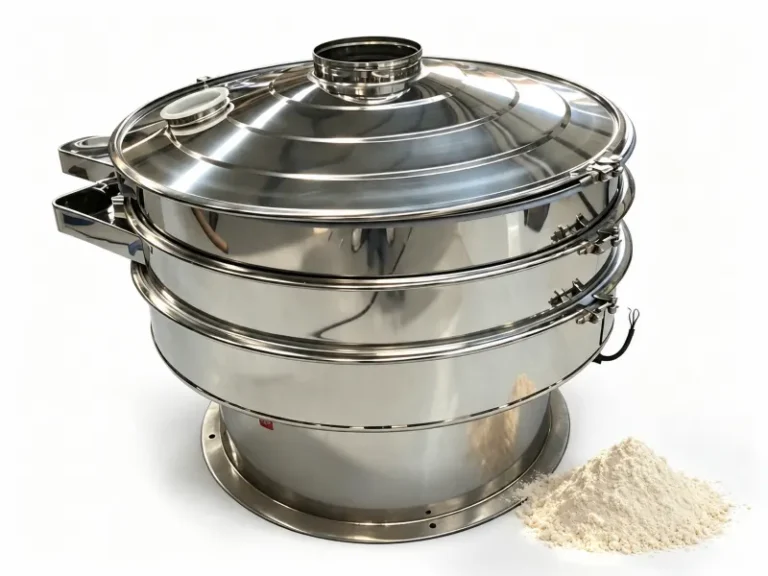
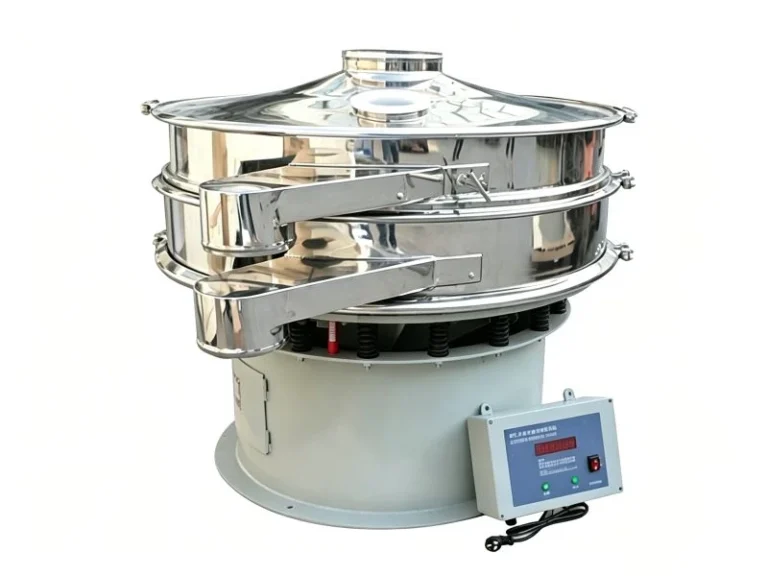
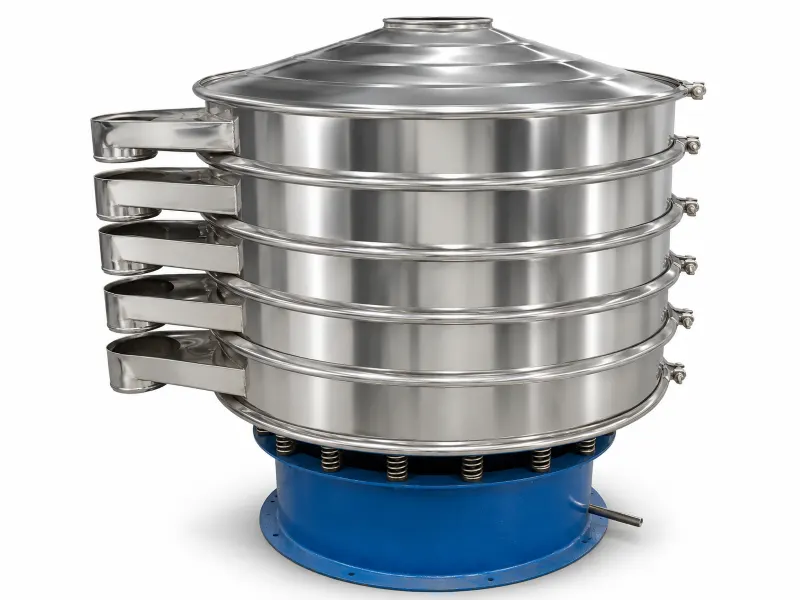
An inorganic salt rotary vibrating screen separates these materials by size. Smaller particles pass through the mesh; larger particles remain above it and leave through a separate outlet. With several screen decks, the same machine can collect multiple size fractions.
The configuration depends on the salt being processed. Moisture, crystal shape, fines content and feeding conditions affect how material moves across the mesh—and how often the mesh needs cleaning.
How an Inorganic Salt Rotary Vibrating Screen Works
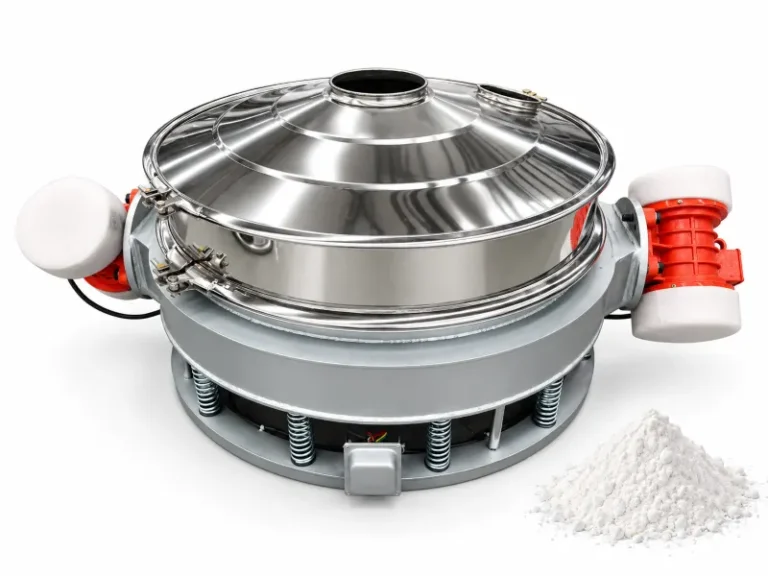
A vertical vibration motor drives the screen. Eccentric weights at the upper and lower ends of the motor generate horizontal, vertical and inclined movement.
Material enters through the feed inlet and spreads from the center toward the edge. As it travels:
- Particles smaller than the mesh openings pass through.
- Oversized particles, lumps and larger contaminants move toward the oversize outlet.
- Lower decks make further size cuts, where required.
Changing the relative angle of the eccentric weights changes the material’s path and residence time. When switching salt types or mesh sizes, the feed rate and vibration settings need another check.
Yuanjing’s rotary vibrating screen product page shows the equipment structure and available multi-deck configurations.
Where the Screen Fits in Inorganic Salt Processing
Particle Grading
Crystallization, drying, grinding and conveying can each change the particle-size distribution. Screening separates the required fraction from coarse particles and fines.
Applications include soda ash screening after drying or size reduction, sodium bicarbonate screening before packaging, and crystal grading for potassium chloride or magnesium sulfate. Monopotassium phosphate, monoammonium phosphate and water-soluble fertilizer crystals may also need particle-size control.
When selecting an inorganic salt rotary vibrating screen, state the size range you want to recover. “40 mesh,” for example, identifies a screening specification but does not fully describe the acceptable product range.
Lump and Impurity Removal
Before packaging, screening can remove some coarse agglomerates and foreign particles whose dimensions differ from those of the product.
There is a limit to what this achieves. A screen cannot remove dissolved contaminants or reliably separate every foreign particle that is similar in size to the salt. Passing the particle-size check does not establish chemical purity.
Brine and Slurry Filtration
Salt-containing liquids need a different assessment. For brine filtration, a suitable screen can remove suspended solids larger than its openings.
The liquid properties, temperature, solids concentration, filter media and wetted materials all need to be specified. Dry-powder capacity figures cannot be carried over to this application.
What to Check for Each Salt
Before configuring an inorganic salt rotary vibrating screen, identify the separation task and the material conditions that could affect it.
| Material or Application | Screening Task | What to Check |
|---|---|---|
| Soda ash and sodium bicarbonate | Grading; removal of coarse particles and lumps | Moisture, agglomeration and target opening size |
| Potassium chloride and magnesium sulfate | Crystal grading and impurity removal | Crystal shape, size distribution and contact materials |
| Monopotassium phosphate and monoammonium phosphate | Raw-material or finished-product size control | Fines content, throughput and required fractions |
| Water-soluble fertilizer crystals and compound fertilizer ingredients | Separation of coarse particles and fines | Moisture sensitivity, product specifications and deck arrangement |
| Food-grade salt and food-use phosphates | Grading; removal of separable lumps and contaminants | Cleaning, contact materials and cross-contact control |
| Industrial polyaluminum chloride and ferrous sulfate | Raw-material screening | Moisture, corrosive conditions and cleaning procedures |
| Brine and other salt-containing liquids | Removal of suspended solids | Solids concentration, liquid properties and filtration openings |
If moisture changes the material’s behavior, the test sample needs to reflect production conditions. A dry sample will not show how the same salt screens after absorbing moisture.
For the broader relationship between material properties, capacity and equipment size, see Yuanjing’s rotary vibrating screen selection guide.
Choosing Mesh Openings and Screen Decks
How Many Fractions Are Needed?
One deck produces two fractions: oversize and undersize. Additional decks divide the material into more size intervals.
The supplied source material describes 1–5 screen decks, producing up to 2–6 fractions. Its example arrangements are retained below.
| Screen Arrangement | Separation | Intended Use |
|---|---|---|
| One deck: 40 mesh | Oversize and undersize | Simple scalping or one size cut |
| Two decks: 20 mesh above 60 mesh | Coarse, intermediate and fine fractions | Removing both oversized particles and fines |
| Three decks: 16, 40 and 80 mesh | Four size intervals | Multi-fraction grading |
These examples explain the separation layout. They are not specifications for every salt, and they do not determine whether a fraction qualifies as food-grade or industrial-grade material.
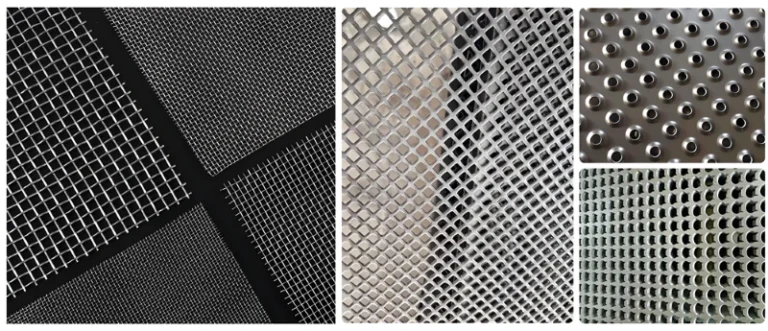
For an inorganic salt rotary vibrating screen, confirm the screen standard and actual opening size—not just the mesh number.
What the Fine-Screening Figures Mean
The supplied material references 200–800 mesh, with approximate equivalents of 74–18 μm, and gives 500 mesh as approximately 28 μm.
These figures remain source references. The relationship between mesh count and opening size depends on the screen specification. They should not be read as confirmed performance limits for every salt or machine configuration.
Moisture, particle shape, fines content, mesh construction and cleaning arrangements affect the result. Fine-screening applications need throughput and separation checks at the required opening size.
Dealing with Mesh Blockage
A falling undersize output is often the first sign of trouble. Material may begin accumulating on the mesh, cleaning stops become more frequent, or acceptable fines leave with the oversize.
Before adding a cleaning device to an inorganic salt rotary vibrating screen, identify what is blocking the openings. Damp deposits, adhering fines and particles lodged in the mesh may call for different responses.
Bouncing-Ball Cleaning
Balls beneath the mesh strike it during operation and help dislodge some trapped particles. This is an option where mechanical cleaning suits the material and screen arrangement.
For food-use salts, check the suitability of the balls and other relevant contact components.
Ultrasonic Assistance
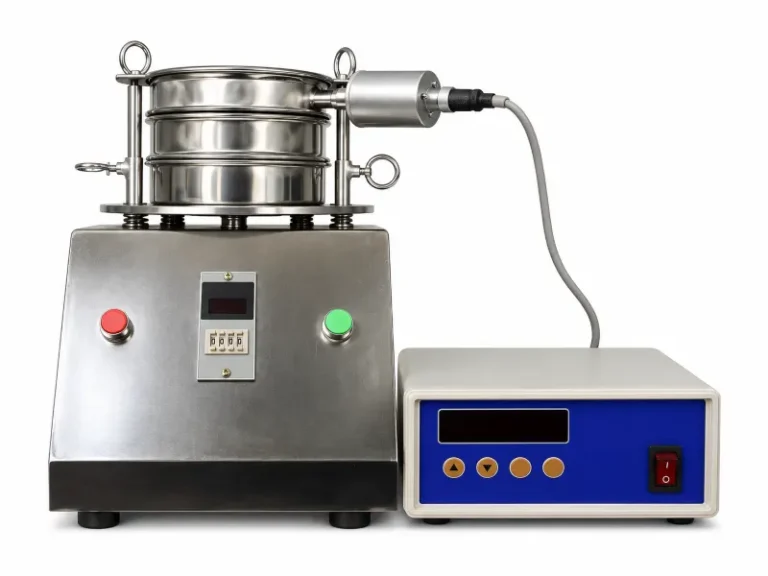
Ultrasonic assistance may help with fine powders, adhering particles or applications where conventional cleaning is insufficient. Yuanjing’s ultrasonic vibrating sieve page explains the equipment used for this type of screening.
Ultrasonic assistance does not dry the material, and it should not be expected to break down every moisture-hardened lump. Whether it belongs on an inorganic salt rotary vibrating screen depends on the material condition and trial results.
When comparing mesh-cleaning options for damp or fine salt on a tumbler screen, keep the batch and feed rate constant and record how long each setup runs before the mesh starts to blind.
Feed Rate and Material Buildup
More feed does not necessarily mean more acceptable product. A thick bed can limit the opportunity for particles to reach the mesh.
When output falls, check the feeding pattern first. Look for local buildup, then inspect the mesh for blockage, looseness or damage. Confirm that the opening size and deck arrangement suit the required output, and check whether the incoming material has become wetter.
Enclosure Does Not Replace Moisture Control
An enclosure helps contain dust and limit external contamination. It does not dehumidify the salt.
Moisture-sensitive materials may still need controlled storage, suitable transfer arrangements and a shutdown procedure that prevents damp residue from remaining in the machine.
A Note on the High-Humidity Figures
The supplied material describes operation at 80% relative humidity. It reports cleaning stops every 2 hours for one configuration and 24 hours without cleaning for another enclosed configuration.
The salt type, moisture content, mesh opening, feed rate and cleaning system are not identified, and no supporting test records are included. These are unverified source observations, not general performance guarantees or verified Yuanjing project results.
For a useful comparison, record the operating time, cleaning frequency and separation quality under the same defined conditions.


Contact Materials, Seals and Cleaning Access
Choosing Stainless Steel
The supplied material discusses 304, 316 and 316L stainless steel contact components.
The grade should be chosen against the actual salt composition, impurities, moisture, temperature and contact duration. Cleaning chemicals matter too.
No single stainless steel grade suits every acid, alkali or salt environment. Stainless steel also does not mean zero wear or zero metal migration. Inspect the mesh, welds, seals and cleaning components as part of routine maintenance.
Checking the Connections
The frame gasket is only one part of the sealing arrangement. Dust can also escape at the feed inlet, discharge outlets or connections to other equipment.
When specifying an inorganic salt rotary vibrating screen, identify any dust-control or negative-pressure requirements and show how the machine will connect to the line.
Quick Disassembly and CIP Are Different Requirements
Quick-release clamps and removable frames make mesh changes and manual cleaning easier.
Clean-in-place capability needs separate confirmation. If CIP is required, specify the cleaning connections, drainage, coverage and material compatibility. A machine that is easy to dismantle is not automatically suitable for CIP.
Food-Grade Salt: Fines, Residue and Ingredient Distribution
Watch for Additional Fines
Throughput alone does not show whether screening is suitable for a salt crystal. Compare the particle-size distribution before and after screening, along with fines generation and recovery of the required fraction.
The supplied material reports a 1.5% increase in fines in a 40-mesh salt-screening application using a circular rotary screen.
It does not provide the calculation method, feed rate or machine settings. The number is retained as an unverified source observation, not a guaranteed result for food-grade salt screening.
Clean Between Products
Sea salt, lake salt, rock salt, iodized salt, low-sodium salt and seasoning salt can involve different formulations and handling requirements.
During a product change, clean the mesh, frame, seals and outlets to reduce carryover. Residue at a discharge connection deserves the same attention as residue on the screen.
The source also mentions nylon mesh. Before using it, confirm food-contact suitability, temperature limits, wear characteristics and whether it can deliver the required separation.
Check Where the Ingredients Go
For iodized, low-sodium and seasoning salts, examine ingredient distribution across the separated fractions. An acceptable particle-size result does not establish that additives remain evenly distributed.

Connecting the Screen to the Production Line
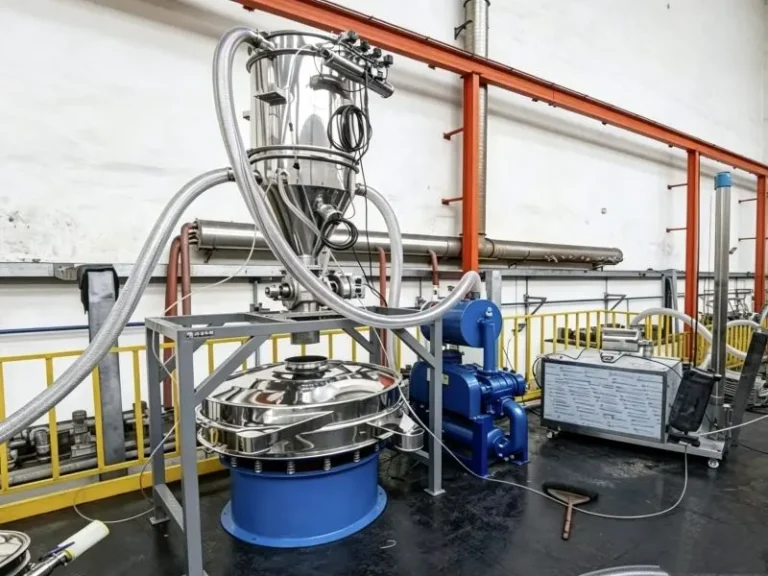
An inorganic salt rotary vibrating screen may sit after drying or cooling, or immediately before collection and packaging. Its location affects the available height, inlet arrangement and access for cleaning.
Confirm those details before settling on the machine size.
The supplied material mentions 360° adjustment of the discharge direction. The actual adjustment range and installation restrictions need to be checked for the selected machine.
Level sensors, automatic start and stop, PLC control and MES interfaces should be listed individually if required. They should not be assumed to come with the standard machine.
Yuanjing’s guide to custom rotary vibrating screen configurations covers options such as contact materials, deck arrangements, cleaning systems and inlet or outlet design.
| Information to Provide | Details |
|---|---|
| Material | Exact salt name and mixed ingredients, if any |
| Physical form | Powder, crystals, granules, liquid or slurry |
| Material properties | Size distribution, moisture, bulk density, temperature and lumping |
| Separation task | Scalping, impurity removal or multi-fraction grading |
| Screen specification | Opening size, screen standard and required fractions |
| Throughput | Feed rate and required acceptable-product output |
| Contact materials | Food-contact or corrosion-related requirements |
| Line arrangement | Space, connections, collection method and controls |
Maintenance in Salt-Screening Service
Salt deposits, damaged mesh and worn seals should be addressed before they affect separation.
| When | Task | Reason |
|---|---|---|
| Each shift | Check mesh tension, damage and gasket condition | Reduce leakage and unintended mixing of fractions |
| Periodically | Remove deposits from frames, outlets and contact surfaces | Limit buildup and make surface inspection possible |
| During operation | Check for abnormal noise, vibration and bearing temperature | Detect operating problems |
| As specified in the motor instructions | Check lubrication and service requirements | Avoid insufficient or incorrect lubrication |
| After washing or a shutdown in damp conditions | Drain residual liquid and dry appropriately | Reduce lumping at the next start |
| Between salt types or formulations | Clean mesh, frames, seals and outlets | Reduce carryover |
The source suggests monthly checks of motor lubrication and bearing temperature. Use that as a planning reference; the equipment instructions and operating conditions should determine the final schedule.
Mesh-change times in the source vary: 3–5 minutes, 5–10 minutes and approximately 10 minutes. The conditions are not defined consistently, so none of these figures should become a universal promise.
Ask what the stated time includes. Removing and fitting a mesh is a different task from changing it, cleaning the frame and completing the inspection.
Discuss Your Salt-Screening Requirements
To configure an inorganic salt rotary vibrating screen, start with the separation you need: the fraction to keep, the material to reject and the required output.
For soda ash, sodium bicarbonate, potassium chloride, magnesium sulfate or another salt, include moisture and lumping information with the particle-size specification.
Discuss your inorganic salt screening requirements with Yuanjing. Provide the salt name, target opening size, required throughput and installation details so the proposed configuration can be assessed against your process.
FAQ
Which materials can an inorganic salt rotary vibrating screen handle?
Applications can be evaluated for soda ash, sodium bicarbonate, potassium chloride, magnesium sulfate, monopotassium phosphate and other inorganic salts. Material condition, screen opening, throughput and contact materials determine suitability.
Are more screen decks better?
Only if the process needs more size fractions. One deck may be enough for scalping or a single size cut.
Does every difficult salt powder need ultrasonic assistance?
No. Identify the blockage first. The answer may involve bouncing-ball cleaning, feed adjustment, ultrasonic assistance or upstream treatment.
Can an enclosed screen prevent moisture absorption?
It helps contain dust and limit external contamination. Humidity control, drying and storage still need their own measures.
Can published capacity figures be used directly?
Published ranges are references. Check the expected output against the salt properties, opening size, deck arrangement and feeding method.
What should a screening trial measure?
Record the feed rate, output from each outlet, particle-size distribution, continuous operating time and cleaning frequency at the required opening size.
For food-grade applications, also check fines generation, cleaning and ingredient distribution where relevant.