Patlamaya Dayanıklı Vakumlu Konveyör Nasıl Seçilir: Kapsamlı Satın Alma Rehberi
Yanıcı tozların taşınması, sıradan malzeme transferine göre daha fazla özen gerektirir. Kimya tesislerinde, lityum batarya fabrikalarında ve ilaç üretiminde toz birikmesi ve statik elektrik ciddi güvenlik riskleri oluşturabilir.
Alüminyum tozu, karbon siyahı, bazı lityum batarya malzemeleri ve kimyasal pigmentler gibi malzemeler, taşınmaları sırasında yanıcı toz oluşturabilir. Bu toz bir tutuşturma kaynağıyla temas ederse patlama meydana gelebilir.
Bir Patlamaya Dayanıklı Vakumlu Konveyör tozu negatif basınç altında kapalı borular boyunca taşıyarak bu risklerin azaltılmasına yardımcı olur. Toz yayılımını sınırlar, elle taşımayı azaltır ve tehlikeli maddeler için tasarlanmış güvenlik özellikleri sunar.
Ancak “patlamaya dayanıklı” olarak etiketlenen her makine atölyenize uygun olmayabilir. Ekipman tasarımları, bileşenler ve koruma seviyeleri büyük farklılıklar gösterebilir.
Satın almadan önce, Vakumlu Konveyör Üreticisi malzemenizi ve çalışma koşullarınızı anlayıp anlamadığını kontrol edin. Doğru ekipman, yalnızca en yüksek fiyata veya en fazla güvenlik özelliğine sahip olmak yerine tozunuzun özelliklerine, tehlikeli alan gerekliliklerine ve üretim kapasitenize uygun olmalıdır.
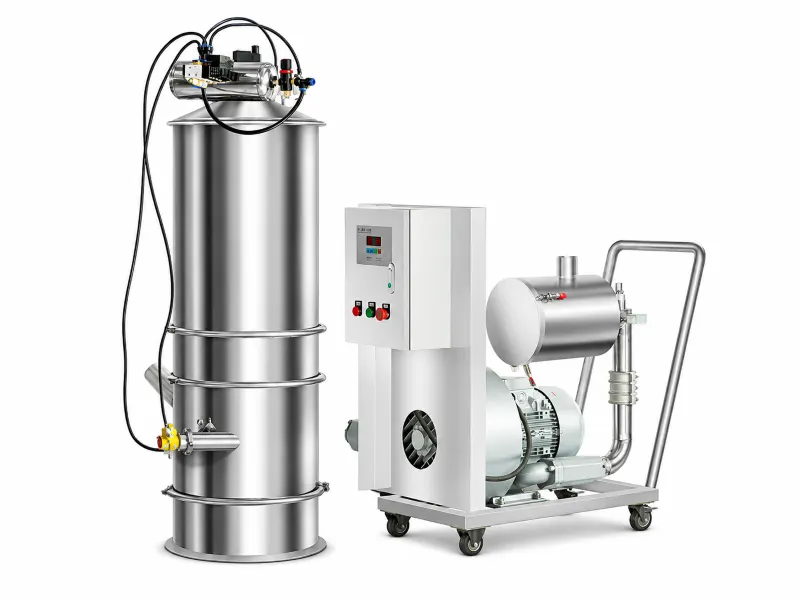
Patlamaya Dayanıklı Vakumlu Konveyör Nedir?
Patlamaya dayanıklı vakumlu konveyör, yanıcı tozların veya patlayıcı ortamların bulunabileceği uygulamalar için tasarlanmış kapalı bir toz taşıma sistemidir.
Negatif basınç oluşturmak için bir vakum pompası veya basınçlı hava kullanır. Toz, bir sonraki prosese boşaltılmadan önce kapalı bir boru hattından geçerek bir alıcı hazneye ulaşır.
Bu, atölyeye yayılan tozu ve tozun elle taşınmasını azaltır. Temel çalışma prensibi hakkında daha fazla bilgiyi şu sayfamızda bulabilirsiniz: vakum konveyör besleyici sistemi page.
Ancak, kapalı bir sistem kendiliğinden patlamaya dayanıklı değildir.
Toz borulardan geçerken sürtünme statik elektrik oluşturabilir. Elektrik yükleri birikip boşalırsa yanıcı tozu tutuşturabilir.
Standart vakumlu besleyiciler, tehlikeli alanlar için uygun motorlara, hortumlara, filtrelere veya elektrikli bileşenlere sahip olmayabilir. Patlamaya dayanıklı bir sistem, uygun elektriksel koruma, topraklama, sızdırmazlık ve diğer güvenlik önlemlerini gerektirir.
Seçim sırasında yalnızca motor değil, taşıma sisteminin tamamı dikkate alınmalıdır.
Malzeme Özelliklerini ve Patlamaya Dayanıklılık Gerekliliklerini Kontrol Edin
Patlamaya dayanıklı bir vakumlu konveyör seçmeden önce iki sorunun net bir şekilde yanıtlanması gerekir: Hangi malzemeyi taşıyorsunuz ve ekipman nerede çalışacak?
Tozunuzun Patlama Riskini Anlayın
Özel koruma gerektirebilecek yaygın malzemeler şunlardır:
- Lityum batarya malzemeleri: Bazı batarya hammaddeleri ve yanıcı metal tozları.
- Kimyasal tozlar: Karbon siyahı, bazı pigmentler, boyalar ve organik kimyasallar.
- Metal tozları: Alüminyum tozu ve diğer yanıcı metal tozları.
- Gıda ve ilaç tozları: Bazı nişastalar, şeker tozları ve organik bileşenler.
Aynı malzeme bile parçacık boyutuna, nem oranına ve bileşimine bağlı olarak farklı patlama özellikleri gösterebilir.
Tedarikçiye bir Güvenlik Bilgi Formu (SDS) ve mevcut toz patlama testi verilerini sağlayın. Önemli değerler arasında minimum patlayıcı konsantrasyon, minimum tutuşma enerjisi ve toz patlama şiddeti bulunur.
Diğer özellikler de önemlidir. Yapışkan veya nemli tozlar farklı filtre ve boru tasarımları gerektirebilirken aşındırıcı malzemeler, aşınmaya daha dayanıklı bileşenler gerektirir.
Ekipmanı Tehlikeli Alana Uygun Seçin
Atölyenizin tehlikeli alan sınıflandırması, hangi patlamadan korunma önlemlerinin gerekli olduğunu belirler.
Ekipmanın patlamadan korunma işaretini, sertifikasını ve öngörülen çalışma koşullarını kontrol edin. Projeniz ATEX uyumlu ekipman gerektiriyorsa ilgili bileşenler ve sistem tasarımı geçerli gereklilikleri karşılamalıdır.
Yanıcı tozun taşıma borularının veya alıcı haznenin içinde de tehlikeli bir ortam oluşturabileceğini unutmayın.
En yüksek koruma seviyesini seçmek her zaman gerekli değildir. Doğru çözüm, malzemeye, kurulum alanına ve risk değerlendirmesine bağlıdır. Temel güvenlik özellikleri yalnızca fiyatı düşürmek için asla kaldırılmamalıdır.
Pnömatik ve Elektrikli Patlamaya Karşı Korumalı Vakumlu Taşıyıcılar
Yaygın olarak kullanılan iki seçenek, pnömatik vakumlu taşıyıcılar ve patlamaya karşı korumalı motorlara sahip elektrikli sistemlerdir.
Her ikisi de uygun uygulamalarda kullanılabilir, ancak güç kaynakları ve çalışma gereksinimleri farklıdır.
Pnömatik Vakumlu Taşıyıcı
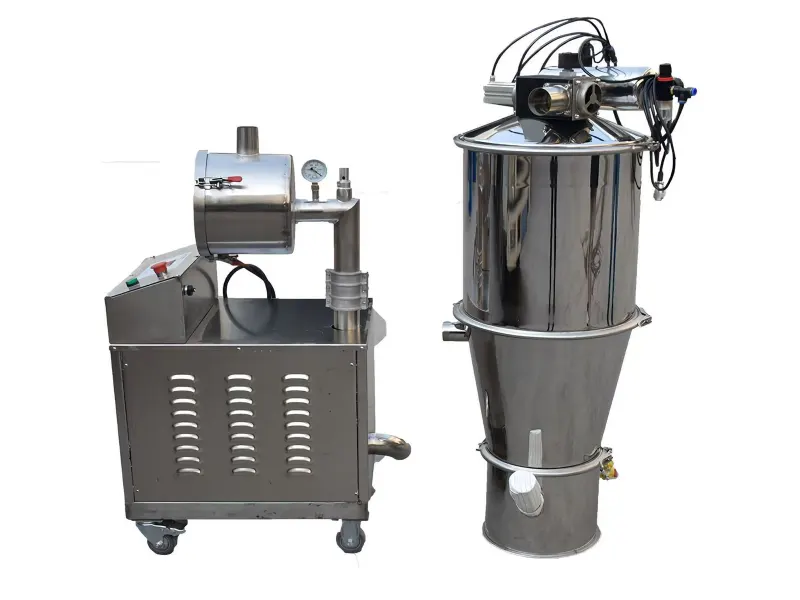
Pnömatik vakumlu taşıyıcı, emiş oluşturmak için basınçlı hava ve bir vakum jeneratörü kullanır.
Vakum jeneratöründe elektrikli tahrik motoru bulunmaz; böylece bu motor olası bir elektriksel tutuşturma kaynağı olmaktan çıkar. Bu, elektrik kullanımına ilişkin sıkı kısıtlamaların bulunduğu atölyelerde veya hâlihazırda kesintisiz basınçlı hava beslemesine sahip fabrikalarda yararlı olabilir.
Bizim pnömatik vakum besleme konveyörü sayfasında bu tür ekipmanların nasıl çalıştığı açıklanmaktadır.
Ancak pnömatik ekipmanlar patlama risklerinden tamamen arınmış değildir. Statik elektrik, toz birikimi, mekanik sürtünme ve diğer olası tutuşturma kaynakları yine de dikkate alınmalıdır.
Basınçlı hava tüketimi de işletme maliyetlerini etkiler. Kompresörünüzün gerekli taşıma kapasitesi için yeterli basınç ve hava debisi sağlayabildiğinden emin olun.
Elektrikli Patlamaya Karşı Korumalı Vakumlu Taşıyıcı
Elektrikli sistem, negatif basınç oluşturmak için motor tahrikli bir vakum pompası kullanır.
Farklı taşıma mesafeleri, kapasiteler ve çalışma süreleri için yapılandırılabilir. Daha uzun taşıma hatları veya sık çalışma için elektrikli bir sistem değerlendirilebilir.
The motor is not the only component that needs protection. Vacuum pumps, control panels, sensors, and other electrical parts installed in hazardous areas must also meet the relevant requirements.
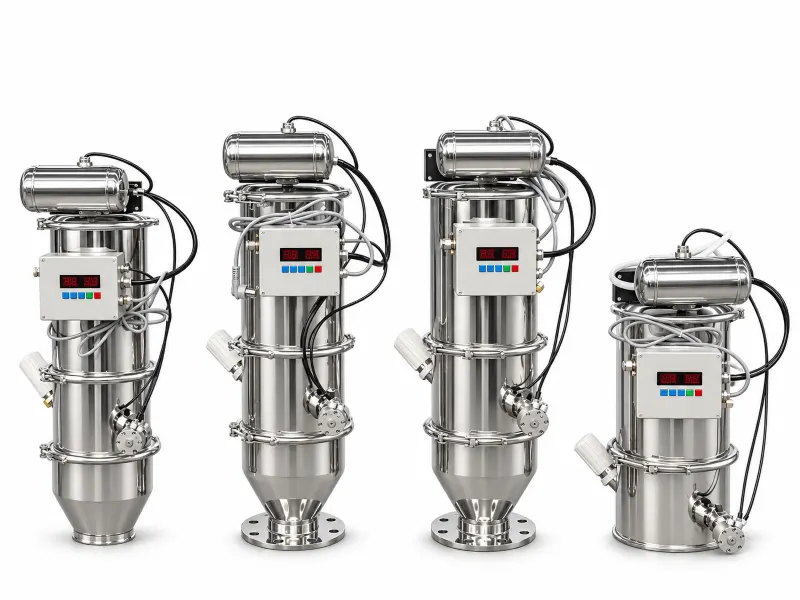
Which Type Should You Choose?
| Öğe | Pneumatic Type | Electric Type |
|---|---|---|
| Power source | Compressed air | Electric vacuum pump |
| Main feature | No drive motor in the vacuum generator | Motor-driven vacuum generation |
| Site requirements | Stable compressed air supply | Suitable electrical supply |
| Kapasite | Depends on air supply and vacuum generator | Depends on pump and system design |
| Main considerations | Air consumption, pressure, safety | Electrical protection, capacity, energy use |
Neither option is always better.
A Vakumlu Konveyör Üreticisi should consider your material, hazardous area, conveying distance, and available utilities before recommending a system.
Key Features to Check Before Buying
The performance and safety of an explosion-proof vacuum conveyor depend on more than its vacuum source. Pay attention to the following components.
Explosion-Proof Electrical Components
For an electric system, check the motor, vacuum pump, control panel, and sensors.
Ask the supplier whether these components are suitable for your hazardous area and whether the required certificates and technical documents are available.
A certified explosion-proof motor does not automatically make the entire conveyor suitable for hazardous environments.
Equipment Materials and Sealing
Material-contact parts are commonly made from 304 or 316L stainless steel.
304 stainless steel works for many general powder applications. For more corrosive materials or stricter cleanliness requirements, 316L may be a better option.
Sealing is equally important. Poorly sealed joints, discharge valves, and pipe connections may allow dust to escape.
For food, pharmaceutical, or multi-product production lines, choose equipment that is easy to open and clean to reduce material residue and cross-contamination.
Anti-Static Pipes and Hoses
Powder moving through pipelines can generate static electricity.
Use suitable conductive or anti-static pipes and flexible hoses based on the material. Metal hoppers, pipelines, and other conductive components should be properly bonded and grounded.
Pipe layout also matters. Too many bends or sudden diameter changes can increase conveying resistance, wear, and powder buildup.
Filters and Pulse-Jet Cleaning
Filters separate powder from the conveying air and help prevent material from entering the vacuum source.
For combustible powders, suitable anti-static or conductive filters may be required.
As powder builds up on the filter surface, suction can decrease and conveying cycles may become longer.
Many systems use pulse-jet filter cleaning to remove collected powder and maintain airflow. The cleaning method and gas supply must also be suitable for the material being handled.
Conveying Performance and Production Line Integration
Even a well-protected explosion-proof vacuum conveyor must deliver the required capacity without frequent blockages.
Material Properties and Conveying Capacity
Particle size, bulk density, moisture, stickiness, and flowability all affect conveying performance.
Dry, free-flowing powders are often easier to handle. Moist or sticky materials may need different suction settings, pipelines, or discharge designs.
The same conveyor can achieve different capacities when handling different powders.
For difficult materials, a conveying test before purchase can help confirm performance.
Conveying Distance and Lifting Height
When requesting a quotation, provide the horizontal conveying distance, vertical lifting height, number of bends, and required capacity in kg/h or t/h.
Longer routes and higher lifts increase resistance, so the vacuum source and pipe diameter must match the actual layout.
For batch conveying systems, remember that suction and discharge take place in separate parts of the cycle. Both affect the average hourly capacity.
Connecting with Other Equipment
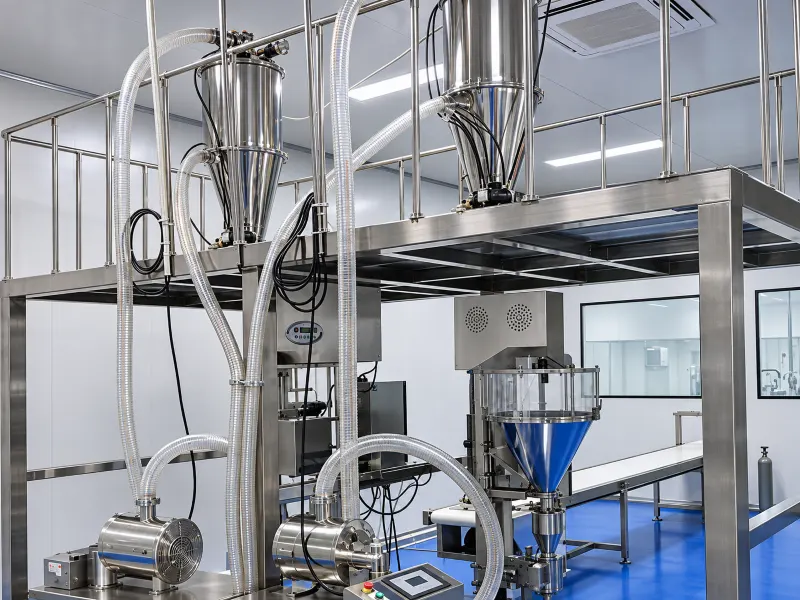
Vacuum conveyors often work with bag dump stations, bulk bag unloaders, vibrating screens, storage hoppers, and mixers.
For example, a tozsuz torba boşaltma istasyonu can feed powder into a closed conveying line, reducing manual handling and dust around the loading area.
If your process also requires screening, see our guide to connecting a vacuum conveyor and vibro sifter.
The entire production line needs to be assessed for dust hazards, not just the conveyor.
A Vakumlu Konveyör Üreticisi with system design experience can help plan the pipe route, equipment connections, and maintenance space while reducing areas where powder may collect.
How to Choose a Vacuum Conveyor Manufacturer
Explosion-proof equipment often costs more than standard powder feeders. But two machines that look similar may have very different safety components and performance.
Check Certifications
Some equipment sold as explosion-proof may only be a standard conveyor with a few modified parts.
Ask the Vakumlu Konveyör Üreticisi for the relevant certificates, technical drawings, and component list.
Check the equipment model, explosion protection marking, certification scope, and applicable conditions. Where possible, verify the documents through the issuing organization’s official records.
For projects that require safety inspection or approval, confirm the necessary documents before placing an order.
Compare Equipment Configurations
Do not compare quotations based on price alone.
Check the motor, electrical controls, stainless steel grade, filters, sealing parts, and safety features.
Once the equipment meets your safety and production requirements, compare its purchase price, energy consumption, maintenance needs, and spare parts costs.
Check After-Sales Support
Filters may become blocked, seals can wear out, and pipes may eventually need replacement.
Before buying, ask about installation guidance, commissioning, warranty, spare parts, and technical support.
Components that affect explosion protection should not be replaced with ordinary parts without a proper technical assessment.
Information Needed for Equipment Selection
To receive an accurate recommendation, provide the Vakumlu Konveyör Üreticisi with the following information:
| Bilgi | What to Provide |
|---|---|
| Malzeme | Name, particle size, bulk density, moisture, flowability, and explosion properties |
| Hazardous area | Area classification, applicable standards, and available test data |
| Conveying route | Horizontal distance, vertical lift, and number of bends |
| Kapasite | Required kg/h or t/h and operating cycle |
| Site conditions | Electrical supply, compressed air, and installation space |
| Equipment connections | Feeding point and receiving equipment |
| Special requirements | Material grade, cleaning, automation, and custom features |
These details help the engineering team choose the right vacuum source, filters, pipelines, and protection measures.
For complex factory layouts, a site review may also help before the final design is confirmed.
Sonuç
Doğru seçim Patlamaya Dayanıklı Vakumlu Konveyör starts with understanding your powder, hazardous area, and conveying requirements. The equipment should be safe, reliable, and easy to maintain.
Looking for a reliable Vakumlu Konveyör Üreticisi? Contact Yuanjing Machinery and share your material, conveying distance, required capacity, and explosion-proof requirements.
Our team can help you choose a suitable powder conveying solution for your production line.
SSS
Q1: Is a Pneumatic Vacuum Conveyor Safer Than an Electric Model?
Not always. A pneumatic vacuum generator has no electric drive motor, but static electricity, mechanical friction, and dust buildup can still create risks.
An electric system can also be suitable when correctly designed and protected. Safety depends on the complete system, not just the power source.
Q2: Can I Convert a Standard Vacuum Conveyor into an Explosion-Proof Model?
Replacing the motor alone is not enough.
Electrical components, filters, hoses, static control, and other parts may also need changes. A qualified specialist should assess the equipment and confirm the required protection before it is used in a hazardous area.
Q3: Can a Closed Vacuum Conveyor Prevent All Dust Leakage?
Closed vacuum conveying greatly reduces dust release, but zero leakage cannot be guaranteed under every condition.
Sealing, filter performance, feeding methods, and maintenance all affect dust control. For cleaner operation, the system can be combined with a dust-free feeding station and suitable dust collection equipment.
Q4: Does an Explosion-Proof Certificate Guarantee That the Machine Will Pass a Safety Inspection?
No. A certificate covers only the equipment or components within its stated scope.
The complete installation must also meet the relevant requirements for hazardous area classification, electrical protection, grounding, and other safety measures.
Q5: Can an Explosion-Proof Vacuum Conveyor Handle Aluminum Powder, Carbon Black, or Lithium Battery Materials?
A system can be designed for certain grades of these materials, but not every model is suitable.
Aluminum powder and some battery materials can present serious dust explosion risks. The supplier should review the material properties, static control requirements, conveying distance, and capacity.
Additional safety assessments or conveying tests may be needed.
Q6: How Often Should the Filter Be Replaced?
There is no fixed replacement schedule.
Filter life depends on the powder, dust load, operating hours, and cleaning performance. If suction remains weak after cleaning, inspect the filter for blockage or damage.
Use replacement filters that meet the original filtration and anti-static requirements.