Multi-Deck Sifter Configuration: How to Specify Mesh Sizes and Product Fractions
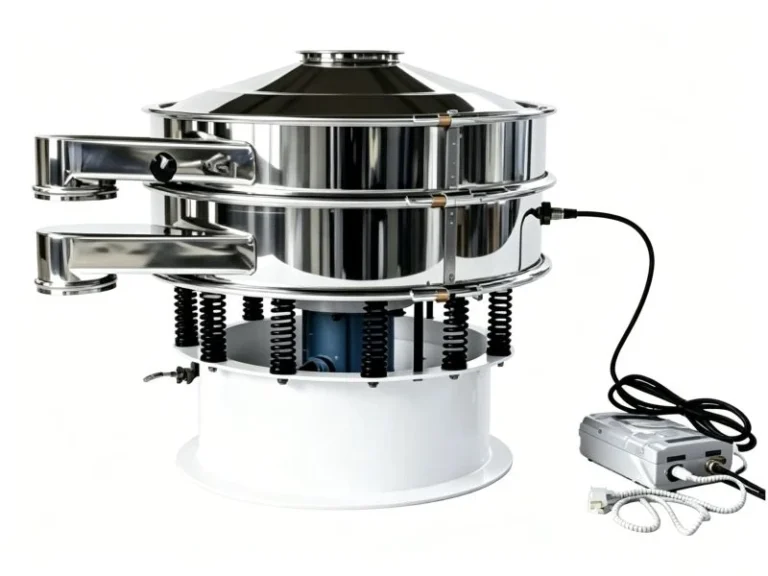
Multi-deck sifter configuration starts with the particle size ranges you need to collect and the permitted amount of oversize and fines in each product. These requirements determine the separation points, screen openings and number of decks.
In a conventional top-fed, stacked arrangement, screen openings decrease from top to bottom, with each fraction discharged through a separate outlet. Specify the openings in microns or millimeters, then test representative material to confirm throughput and particle size distribution at each outlet.
Define Product Fractions Before Choosing Screen Decks
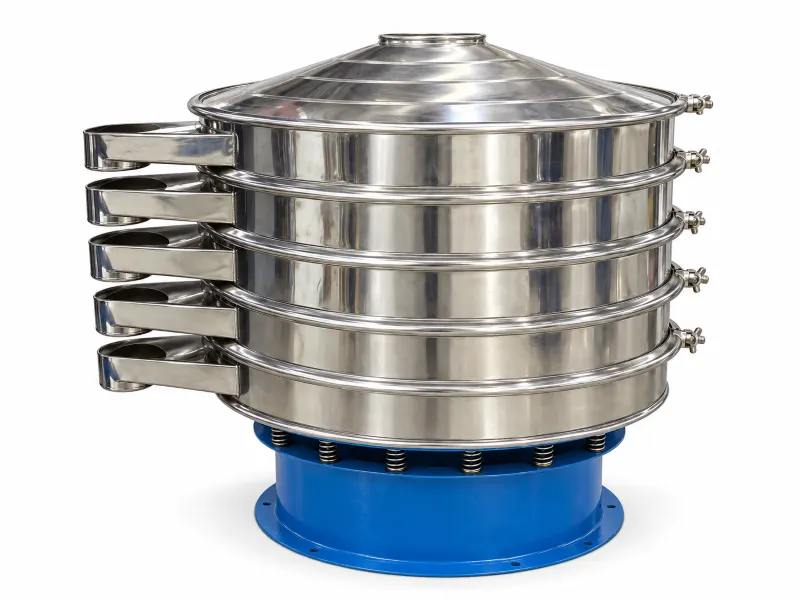
The number of screen decks depends on the size boundaries you need to separate. List each required product range, the permitted oversize and fines, and where each fraction will go.
If you are unsure whether you need several product grades or simply an oversize check, see our guide to safety screening vs particle classification.
Some applications only require an oversize check. For example, screening corn starch before packing usually focuses on removing lumps and debris rather than collecting several size grades.
Specify Product Ranges and Separation Points
Four fractions do not always require four screens. For example, feed containing no particles above 31.5 mm can be divided into nominal ranges of 0–5, 5–10, 10–20 and 20–31.5 mm using three separation points: 5, 10 and 20 mm. If particles above 31.5 mm must also be removed, a fourth separation point is needed.
This example explains how to count separation points; it does not specify a machine suitable for those particle sizes.
In a conventional stacked arrangement with separate outlets, N screening decks can produce up to N+1 fractions. Support mesh does not count as an additional screening deck.
For ground paprika, one screen can separate finished powder from oversize material. Additional decks are needed only when more size fractions are required. Our guide to sàng bột ớt paprika explains how to choose between coarse particle removal and multi-grade screening.
Rice fines removal may need only one screening cut. Collecting smaller fragments separately from fines requires another cut, provided their dimensions allow separation. See our guide to screen openings and decks for rice screening for the outlet arrangement and checks.
Set Acceptable Oversize and Fines Limits
A target range such as 100–300 μm does not automatically mean that every particle must fall within it. Specify the maximum permitted amount above 300 μm and below 100 μm, together with the test method used to measure those limits.
These acceptance criteria give the supplier a clear basis for screen selection and trial evaluation.
Distinguish Product Grades from Reject Streams
Label each outlet as a saleable grade, rework stream or reject. Four outlets may collect only two saleable products, plus oversize and fines.
Add a deck only when another separation is needed. Extra decks increase machine height and maintenance work, while achievable throughput depends on the material, screen openings and loading on each deck.
Broken tea may remain useful for another product rather than becoming waste. Our guide to separating tea leaves and fines shows how product requirements guide the choice of fractions.
Specify Mesh Openings for Each Separation Cut
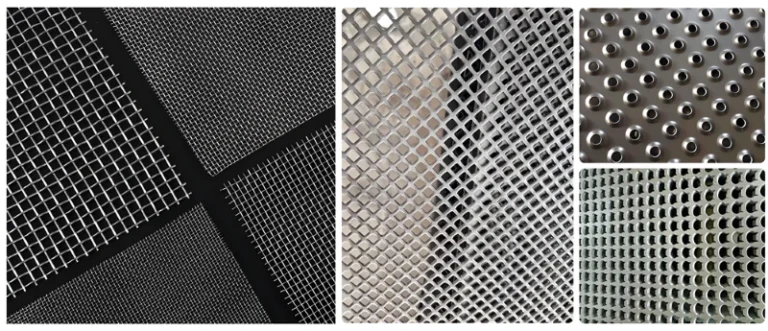
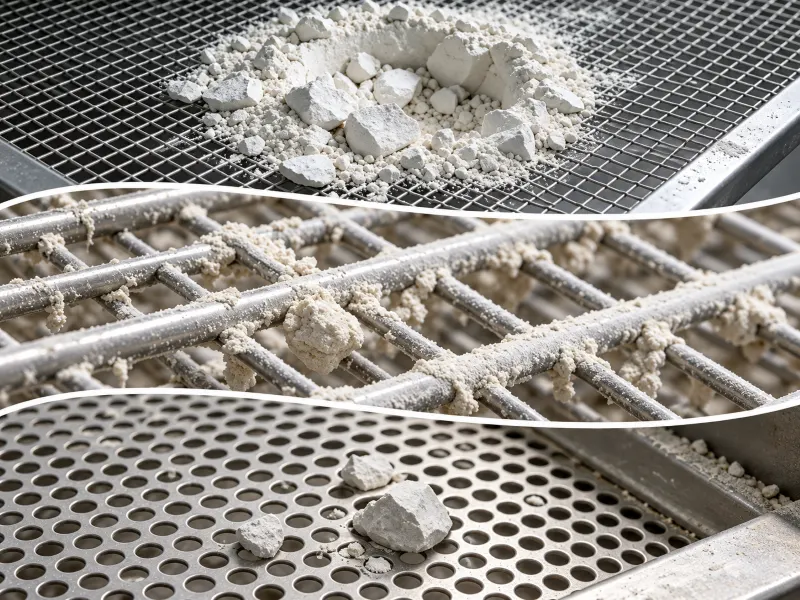
For each deck, specify the required opening in microns (μm) or millimeters (mm). Use the target product sizes to select trial openings, then check how the material passes through them. Confirm mesh count, wire diameter and aperture tolerance before ordering.
Mesh Count vs Aperture Size: What Should You Specify?
Mesh count is the number of openings per linear inch—25.4 mm. An 80-mesh screen has 80 openings along one inch, not 80 openings per square inch. Aperture is the clear opening between adjacent wires, while wire diameter is the thickness of the woven wire.
Higher mesh counts generally indicate smaller openings, but the exact aperture depends on wire diameter. For square woven mesh:
Aperture (mm) = 25.4 ÷ mesh count − wire diameter (mm)
For example, 200-mesh cloth made with 0.053 mm wire has a calculated opening of 0.074 mm, or 74 μm. This calculation describes that wire cloth; it is not a universal conversion for every 200-mesh screen.
Standard sieve designations provide another reference:
| U.S. Standard Sieve Designation | Nominal Aperture |
|---|---|
| Số 100 | 0.150 mm / 150 μm |
| Số 200 | 0.075 mm / 75 μm |
| Số 325 | 0.045 mm / 45 μm |
State the standard when using these designations. For production screens, confirm the actual aperture with the supplier.
For a closer look at how wire diameter affects the opening, see our guide to số mesh so với kích thước micron.
Match Proposed Openings to Product Size Limits
Where feed contains both oversize and fines, collecting a nominal 2–4 mm product requires two separation points. A 4 mm upper screen and a 2 mm lower screen provide a starting arrangement for testing: the target fraction passes through the upper screen and remains on the lower one.
For an application example, see how two screening cuts are used for detergent granule size control.
Material properties affect whether the proposed openings meet the specification:
- Particle size distribution: A high proportion of particles close to either opening makes separation more demanding.
- Hình dạng hạt: Flakes, needles and fibers may pass according to their orientation and smaller dimensions.
- Moisture and stickiness: Buildup can block openings. Review material conditioning and mesh cleaning before changing the aperture.
- Bulk density and flowability: These influence deck loading and throughput; they do not by themselves justify a larger or smaller opening.
- Abrasion and corrosion: These guide wire material selection and inspection requirements, since damaged or worn openings can affect the collected fractions.
A finer mesh does not automatically mean more accurate grading. Each opening must suit the required separation, and enlarging it to increase throughput may let unwanted particles enter the product.
Confirm Wire Diameter, Open Area and Aperture Tolerance
Prepare a separate specification for each deck. Open area is the percentage of the screen surface available for material passage. Aperture tolerance defines the permitted variation in opening size.
| Thông số kỹ thuật | Upper Deck | Lower Deck |
|---|---|---|
| Trial aperture | 4 mm | 2 mm |
| Separation duty | Remove oversize | Retain target product and pass fines |
| Mesh designation and standard | Confirm if used | Confirm if used |
| Wire diameter | Supplier to specify | Supplier to specify |
| Open area (%) | Supplier to specify | Supplier to specify |
| Dung sai lỗ sàng | Agree with supplier | Agree with supplier |
These openings are trial values for a nominal 2–4 mm fraction. Approve the final screens after representative material meets the agreed particle size limits and throughput.
Map the Screen Deck Arrangement to Every Product Outlet
The screen layout should show which opening each fraction passes through, where it is retained and which outlet collects it. For powder and granule grading, this connects the screen specifications to the products you need to collect.
Arrange Screen Openings from Coarse to Fine
In a conventional top-fed sifter, place the largest opening at the top and smaller openings below. Coarse material leaves through the upper outlet, while material passing through continues to the next screen.
For example, a three-deck screen arrangement can use 500 μm, 250 μm and 125 μm openings from top to bottom. Each deck retains one fraction, and material passing through all three screens reaches the bottom collection pan.
Three-Deck Configuration Example: Four Separate Fractions
The following example shows how three screen decks can produce four separate material streams.
| Screen or Collection Position | Nominal Opening | Material Collected | Outlet and Intended Use |
|---|---|---|---|
| Top deck | 500 μm | Retained on the 500 μm screen | A — Coarse material for review or rework |
| Middle deck | 250 μm | Passes through 500 μm; retained on 250 μm | B — Product A |
| Bottom deck | 125 μm | Passes through 250 μm; retained on 125 μm | C — Product B |
| Bottom collection pan | No screen | Passes through the 125 μm screen | D — Fines or by-product |
These are merely schematic representations of the screen apertures and do not constitute recommended settings for any specific material. The indicated particle size ranges represent nominal screening ranges rather than precise particle size limits. Please collect samples from all four discharge outlets for testing to verify the actual particle size distribution.
Label Outlets and Plan Collection or Rework
Mark outlets A–D on the equipment drawing and match each one to a labeled bag, bin or downstream connection. Record the material name and destination for every outlet before installation.
In this example, outlets B and C collect two product grades. Outlet A collects coarse material that must be assessed before rework, while outlet D collects fines that may be usable as a separate product. Keep these streams separate during collection and transfer.
Confirm outlet positions, connection sizes and collection space during design. Our guide to custom rotary vibrating screen options covers these installation requirements alongside material and cleaning choices.
Validate Throughput and Fraction Quality
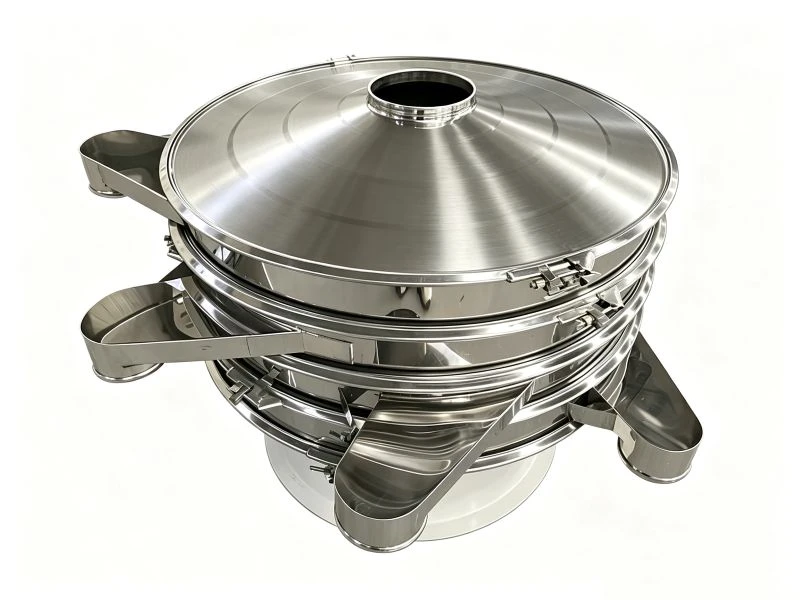
Test the multi-deck sifter configuration with representative material at the required feed rate. Check both throughput and the particle size distribution at every outlet. The machine must meet the product specifications while maintaining stable output.
Check Feed Distribution and Loading on Each Deck
Feed material evenly across the top screen. Each lower deck receives only what passes through the screen above, so its load depends on the feed’s particle size distribution.
Check for buildup on every deck during normal and peak feed conditions. Adding more screening layers does not automatically increase capacity.
Account for Near-Size Particles and Mesh Blinding
Particles close to the screen opening may need more time to pass through. Blocked openings reduce the available screening area and can send usable material to the wrong outlet.
During testing, watch for falling output or changing product quality, then review feed rate, screen area and cleaning needs. Run the trial long enough to reveal gradual buildup rather than judging performance from the first few minutes.
For further checks, see our guide to hiện tượng bít lưới sàng bột mịn.
Verify Size Compliance, Recovery and Mass Balance
Collect feed and outlet samples over the same steady operating period. Agree on acceptance limits before testing.
| Check | What to Measure | Acceptance Basis |
|---|---|---|
| Công suất | Feed and outlet mass per hour | Required production rate |
| Fraction quality | Particle size distribution at each outlet | Agreed oversize and fines limits |
| Tỷ lệ thu hồi phân đoạn mục tiêu | Target-size material reaching the correct outlet ÷ target-size material in the feed | Agreed minimum recovery |
| Mass balance | Feed mass compared with total collected mass, allowing for changes in material held inside the machine | Agreed measurement tolerance |
Outlet yield is the mass collected at an outlet divided by total feed mass. Recovery measures how much of the target-size material reaches the intended outlet. Multiply either ratio by 100 to express it as a percentage.
A high yield alone does not prove that the product meets its size specification. Check quality and recovery together to identify usable material being lost through other outlets.
Kết luận
A workable multi-deck sifter configuration connects each required product fraction to a screen opening and a separate outlet. Define the size limits first, confirm the mesh specifications, and test the arrangement at the required production rate.
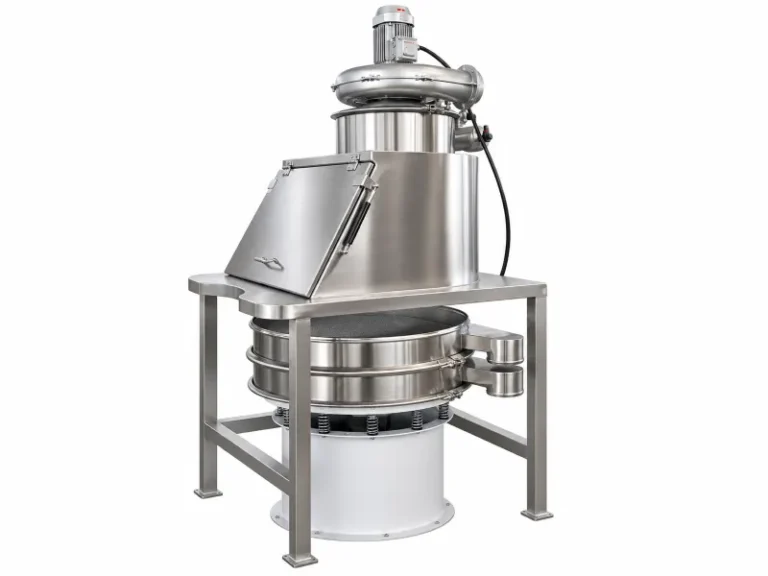
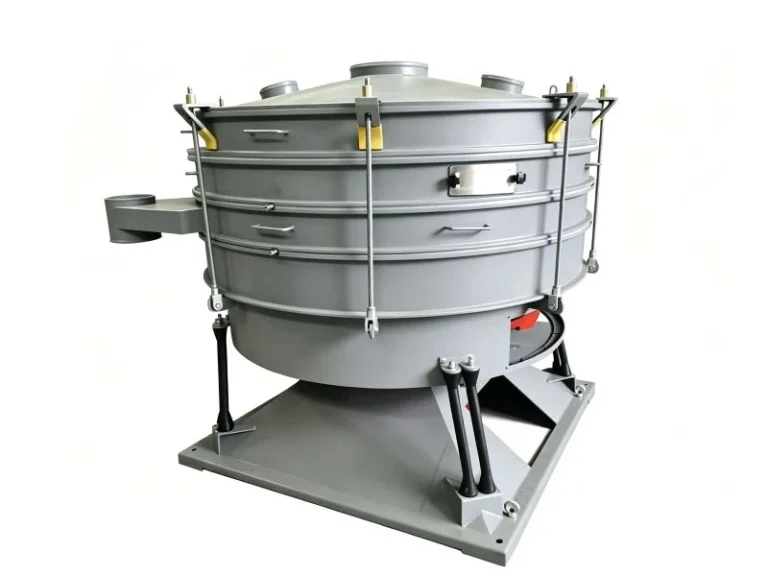
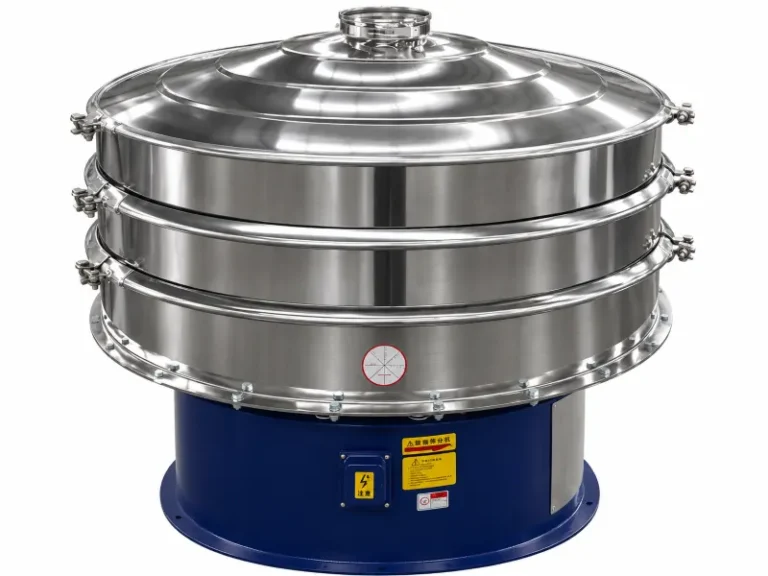
For help specifying a máy sàng rung nhiều tầng, send your material details, feed particle size distribution, target fractions and required throughput. Include the permitted oversize and fines in each product so the proposed configuration can be assessed against clear requirements.
Câu hỏi thường gặp
How Many Screen Decks Do I Need for Four Particle Size Fractions?
Three screening decks can produce four fractions in a conventional stacked sifter with separate outlets. Count every stream, including oversize and fines. If you need four saleable grades plus a separate oversize stream, four separation points may be required.
Can a Two-Deck Sifter Remove Both Oversize and Fines?
Yes. The upper screen retains oversize, while the lower screen retains the target product and allows fines to pass through. This produces three streams. Choose both openings from the product size limits and confirm the results through testing.
What Is the Difference Between 200 Mesh and 75 Microns?
“200 mesh” describes a mesh count, while 75 microns describes an opening size. A U.S. standard No. 200 test sieve has a nominal 75 μm aperture, but production cloth sold as 200 mesh can have a different opening depending on wire diameter. Specify the aperture and applicable standard when ordering.
Which Screen Goes on Top of a Multi-Deck Sifter?
For conventional top-fed, serial classification, the screen with the largest opening goes on top. Smaller openings follow below it. This removes coarse material first and allows the remaining material to reach the finer screens.
Will Adding More Screen Decks Increase Throughput?
Not necessarily. Additional decks create more separation stages, but they do not automatically increase capacity. Throughput depends on the material reaching each deck, the screen openings, available area and mesh condition. Test the complete arrangement at the required feed rate.
What Information Should I Send for a Multi-Deck Sifter Quotation?
Provide the material name, feed particle size distribution, target product ranges, permitted oversize and fines, and normal and peak feed rates. Include bulk density, moisture content, material-contact requirements and outlet connections. A representative sample helps the supplier assess the proposed screens and trial conditions.