洗剤粉末のふるい分け:塊の除去と顆粒サイズの管理方法
Detergent powder screening removes oversized lumps and separates granules to meet the required particle size specification. A single screen may be sufficient for an oversize check before packaging. Removing both coarse particles and excess fines requires two separation points to collect the desired size range. The right screen openings depend on the finished-product requirements and how the powder behaves during testing. Screening can remove lumps, but it cannot restore powder damaged by moisture or poor storage.

Why Does Detergent Powder Form Lumps?
Detergent powder can form lumps when moisture causes particles to stick together during processing or storage. The tendency to cake depends on the formulation, humidity, packaging and storage time. Identifying where lumps develop helps determine where screening is needed and which upstream conditions require attention.
Moisture Absorption by Ingredients
Some detergent ingredients absorb moisture from the air, making particle surfaces sticky and allowing neighboring particles to bind together. The response varies with the formulation, so there is no single humidity limit that applies to every washing powder.
Humid Conditions and Prolonged Storage
Poorly sealed bags and exposure to humid air can encourage caking. Longer storage gives moisture more time to enter inadequately protected powder. Check packaging seals, warehouse conditions and storage duration when lumps appear in stored material.
Agglomerates After Mixing and Handling
Lumps may already be present after mixing or develop during temporary storage before packaging. Compare samples from these stages to locate the problem. If the powder leaves the mixer in good condition but reaches the packing line with lumps, inspect the storage and transfer stages between them.
Unwanted Lumps vs Intended Granules
Larger particles are not always defects. Detergent formulations may contain deliberately formed granules or additives that should remain in the product. Set the screening limit against the finished-product specification rather than treating every large particle as waste.
How to Remove Lumps Without Losing Usable Detergent
Removing lumps starts with a clear distinction between acceptable granules and unwanted oversize. Select a screen opening that retains the unwanted material, then check the rejects to make sure usable detergent is not being discarded.
Separate Oversized Lumps from Acceptable Product
Acceptable particles pass through the screen into the product outlet. Lumps larger than the openings remain on the screen and move toward the coarse discharge. An unnecessarily small opening can retain good granules as well as lumps, increasing product loss.
If the powder already meets its size specification, an oversize check may be sufficient. When excess fines also need removing, review the difference between safety screening and particle classification before selecting the configuration.
Check Whether Lumps Need Separate Treatment
Loose agglomerates may disperse during screening, but hard lumps may require separate deagglomeration. Do not force them through the mesh simply to recover more product.
Inspect rejected lumps before deciding whether to reprocess them. Their moisture condition, composition and quality must still meet the requirements for reuse.
Position the Screen Where Lumps Occur
Compare samples after mixing, after drying and cooling where applicable, and before packaging. Place the screen where it can intercept the identified problem.
A final screen near the packing line can catch oversize formed earlier. However, recurring caking also requires attention to the processing or storage conditions that caused it.
| 原料の状態 | What to evaluate |
|---|---|
| A few oversized lumps in otherwise acceptable powder | Check screening to remove oversize |
| Both coarse particles and excess fines | Classification to collect the required size range |
| Hard lumps or visibly damp powder | Product quality and suitability for reprocessing |
| Many acceptable granules in the rejects | Screen opening, mesh blinding and feed rate |

How to Select Mesh Openings for Detergent Granule Size Control
Mesh selection starts with the required granule size range and the permitted amount of oversized particles and fines. Choose the separation points first, then confirm that the proposed screens can meet those limits with the actual washing powder.
Define the Acceptable Size Range and Off-Size Limits
Specify the upper and lower particle size limits, together with the percentage of material allowed outside that range. These requirements should come from the finished-product specification.
Analyze a representative feed sample before choosing the mesh. A powder containing occasional lumps needs a different screening arrangement from one containing substantial amounts of both coarse particles and fines.
Use Two Screening Cuts to Collect a Defined Size Range
A single screen can remove oversized lumps. When both coarse particles and fines must be separated from the product, two screen openings are needed.
For example, a nominal target range of 0.8–1.2 mm could be evaluated using a 1.2 mm upper screen and a 0.8 mm lower screen:
| ふるい分け段階 | 分離される材料 | 出口 |
|---|---|---|
| Retained on the 1.2 mm upper screen | Oversized particles and lumps | Coarse discharge |
| Passes through 1.2 mm but remains on 0.8 mm | Target size fraction | Product discharge |
| Passes through the 0.8 mm lower screen | Fine particles | Fines discharge |
This is an illustrative configuration, not a standard specification for washing powder. Particle shape, orientation and operating conditions affect passage through the openings, so the resulting fractions must be checked during testing.
For a broader explanation of the screen deck and outlet arrangement, see how each separation point determines where coarse material, product and fines are collected.
Specify Aperture Size, Not Just Mesh Count
State the required opening in millimeters or microns. If using a mesh count, also confirm the mesh standard, wire diameter and actual aperture.
Mesh count alone does not fully describe a screen. Wire diameter affects the opening and available open area, both of which influence material passage and throughput.
Check Particle Size and Composition at Every Outlet
Compare the particle size distributions of the feed, accepted product, coarse rejects and fines. This shows whether each fraction is reaching the intended outlet.
If different ingredients have different particle sizes, also check that screening has not changed the blend composition. Larger additive granules may be intentional components of the formulation. Removing them could produce powder that meets a size limit but no longer meets the intended composition.
How to Configure and Validate a Detergent Powder Screening Machine
Once the separation points are defined, match the machine to the required feed rate, material behavior and installation space. A production trial should confirm stable output, acceptable product recovery and limited granule damage.
Match the Screen Configuration to the Separation Duty
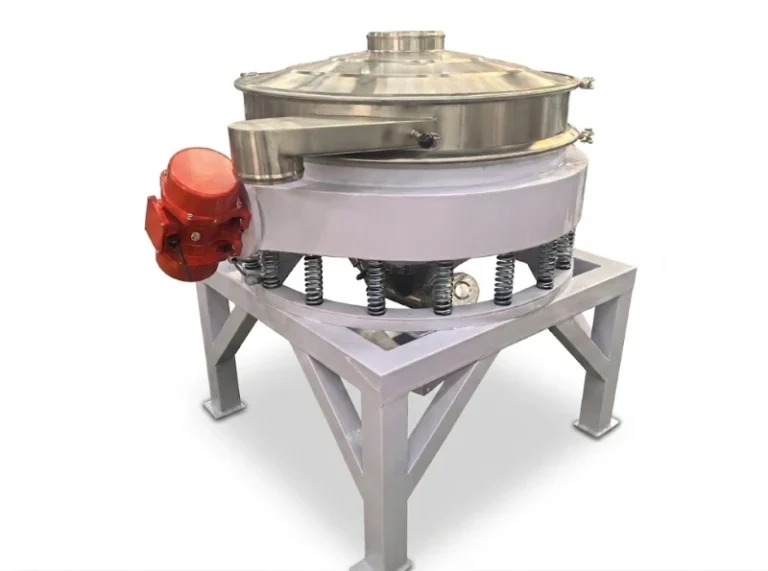
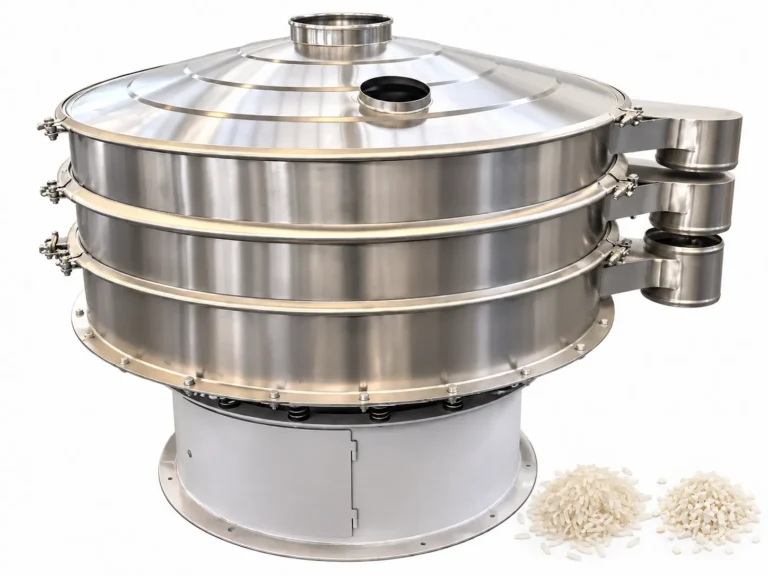
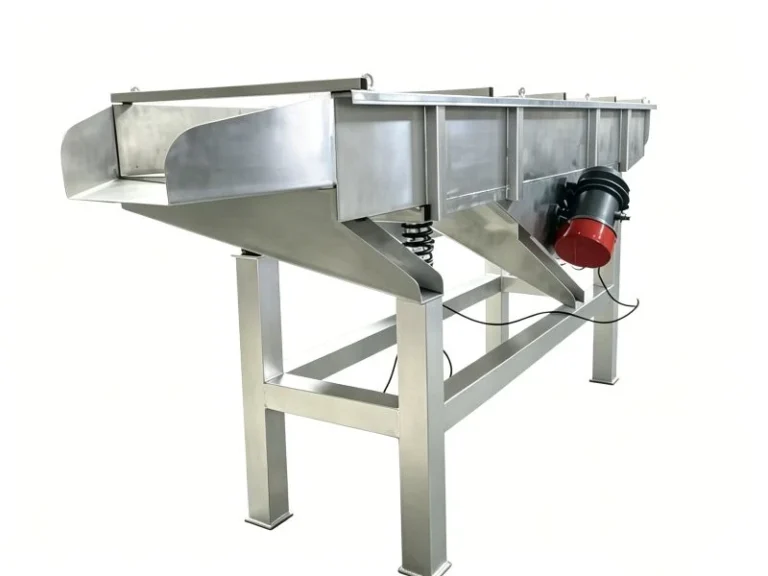
For removing occasional oversized lumps before packaging, evaluate a single-deck detergent powder screening machine. An inline screen may suit installations with a direct material flow path, while a rotary vibrating screen offers flexibility for general screening and grading.
Where both coarse particles and fines must be removed, consider a multi-deck vibratory sifter. For fragile granules, a tumbler screen may also be worth testing.
Size the screening area for normal and peak feed rates. Check that contact materials and seals suit the formulation and cleaning method, and that the machine provides enclosed connections and easy access for inspection.
Control Feeding and Check for Mesh Blinding
Feed the powder steadily and distribute it across the screen. Surges can create a thick material bed, reducing the opportunity for acceptable particles to pass through the openings.
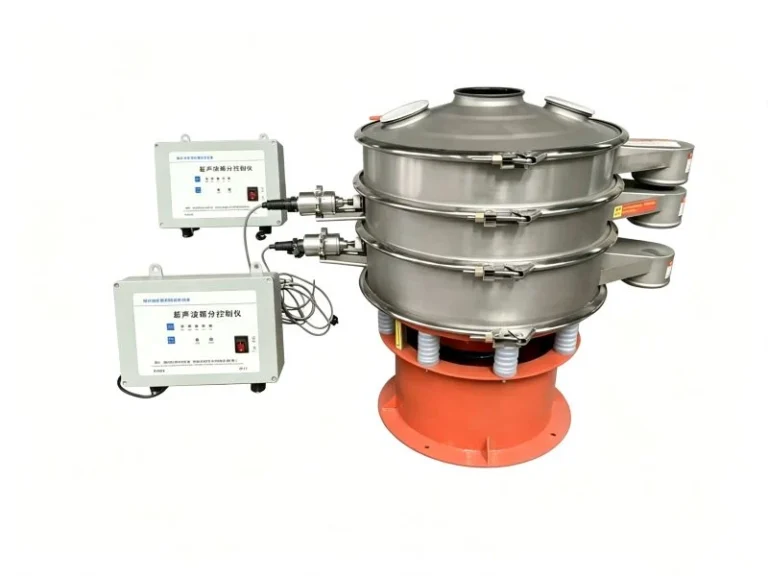
During the trial, inspect the mesh for buildup and check whether output falls as the run continues. If blockage develops, review moisture, feed loading and screen condition before choosing a cleaning system. Bouncing balls or ultrasonic cleaning may help, depending on the mesh and material. Our guide to screen blinding causes and prevention explains these checks in more detail.
Limit Granule Breakage During Screening and Transfer
Compare feed and discharge samples for newly generated fines. Take samples around transfer points as well as the screen to identify where breakage occurs.
If granules are being damaged, assess vibration settings, time on the screen and transfer drop heights. Make adjustments within the equipment supplier’s operating limits, then check that the required separation and throughput are maintained.
Validate Throughput, Size Compliance and Product Recovery
Agree on acceptance criteria before testing. Run representative material at the expected production rate for long enough to reveal buildup, blinding or changes in output.
| Test item | What to record |
|---|---|
| 処理能力 | Feed and accepted-product mass per unit of operating time |
| Size compliance | Particle size distribution at each outlet, including oversize and fines |
| Product recovery | Accepted-product mass and usable material lost in the reject streams |
| Granule condition | Changes in fines content or visible particle damage |
| 運転安定性 | Feed consistency, blocked screen area and cleaning interruptions |
Check the material balance across all outlets, including material remaining inside the machine.
Accepted-product yield (%) = Accepted-product mass ÷ Feed mass × 100
The yield target depends on how much off-size material was present in the feed. A high yield alone does not prove effective screening; the collected product must also meet its particle size and composition requirements.
If a trial misses the agreed limits, identify the cause, adjust the configuration and repeat the affected checks before approving the machine for production.
微細粉体に超音波振動ふるいが必要ですか?
What Mesh Size Is Suitable for Detergent Powder Screening?
Choose the aperture according to the particles you need to retain and remove. An oversize check before packaging may require a different opening from granule classification. Specify the opening in millimeters or microns and confirm performance with a representative washing powder sample.
Can One Screening Machine Remove Both Lumps and Fine Powder?
Yes. A machine with two suitable screen decks can discharge oversized lumps, collect the desired granules and remove fines separately. A single screen provides only one separation point and cannot isolate a middle size range when both coarse particles and fines are present.
Why Are Good Detergent Granules Appearing in the Rejects?
The opening may be too small, or acceptable granules may reach the reject outlet before passing through. Check for mesh blockage, uneven feeding and material buildup. Particles close to the aperture size can also be difficult to separate.
Where Should a Washing Powder Sieve Be Installed Before Packaging?
Position it where it can intercept lumps formed during processing or storage. Check whether downstream conveyors or holding bins cause further agglomeration or granule damage. The best location depends on where the problem occurs and how material reaches the packaging machine.
Can Screening Prevent Detergent Powder from Caking Again?
Screening removes existing oversized lumps but does not prevent new ones from forming. If washing powder cakes after screening, check moisture exposure, product temperature, packaging seals and storage conditions. Repeated caking requires attention to its cause as well as removal of affected material.
What Information Is Needed for a Detergent Powder Screening Trial?
Provide a representative sample, feed particle size distribution, target size range, moisture content, bulk density and required throughput. Describe problems such as lumps before packaging or frequent mesh blockage, and include installation space and connection requirements.
Request a Detergent Screening Evaluation
Send us your material sample details, target particle size and required capacity. We can help assess a suitable detergent powder screening machine and configuration for testing.