How to Choose a Vibrating Screen Manufacturer for Your Production Line
If a vibrating screen quote lists a capacity of 1,000 kg/h, that’s the figure I’d circle first. Is it the weight you can feed into the machine in an hour, or the weight of correctly sized product you can send to packing? If your filling line needs a tonne an hour, ask the vibrating screen manufacturer which figure it quoted, at what screen opening, and under what feed conditions.
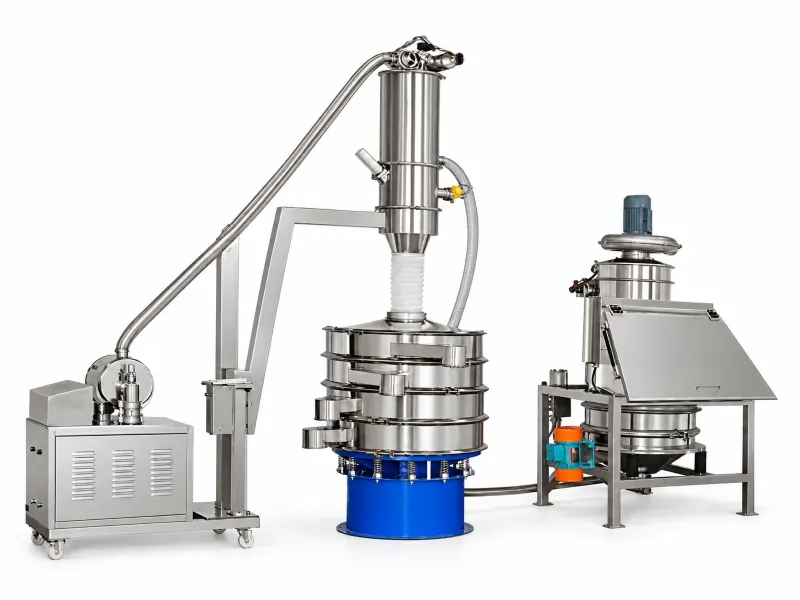
While the quote is open, pull up the layout drawing. Trace the material from your feed chute to the screen, then from each outlet to its bin. If you can’t tell which outlet feeds the packing line, settle that before you approve the drawing.
How Can You Check a Vibrating Screen Manufacturer’s Capabilities?
Find out who handles a drawing change
Suppose your maintenance team measures the feed chute again and finds it sits 100 mm lower than the drawing shows. Ask the vibrating screen manufacturer to walk you through that change. Which revised drawing comes back to you for approval? Who checks the finished inlet height against the version you signed?
Yuanjing’s manufacturing and service overview describes the company’s work in design, manufacturing, and installation. When you discuss your own layout, ask for the name of the person who will handle drawing revisions. That gives your maintenance team a contact if another dimension changes before fabrication.
What to look for in a screening project reference
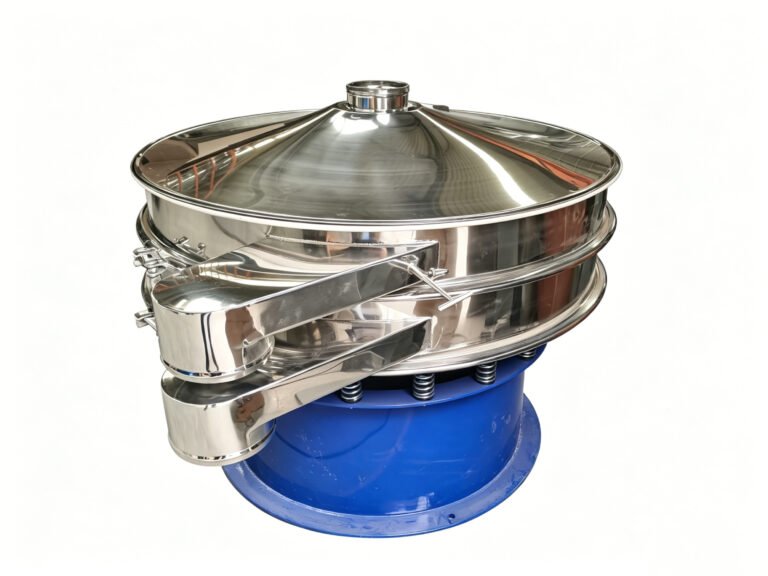
A project photo can show where the feed enters and how the outlets are arranged. To judge whether the machine is relevant to your line, look at what went through it and what the customer wanted to collect.
In Yuanjing’s four-deck screening project for dried coconut particles, the customer requested 1,200 kg/h for material with a bulk density of 400 kg/m³. The four decks were specified at 6, 12, 14 and 18 mesh. Those figures describe the customer’s requirement. If your material is denser or you only need two finished grades, ask which parts of that configuration the supplier would change for your line and why.
Will the Proposed Screen Fit Your Production Line?
Start with the product you want to keep
On a powder line with a screen just before filling, most of the feed should pass through. The operator needs a place to collect the occasional lumps and enough room to inspect them. Tell the supplier roughly how much oversize you see in a shift and whether the upstream equipment feeds steadily or empties a batch into the chute.
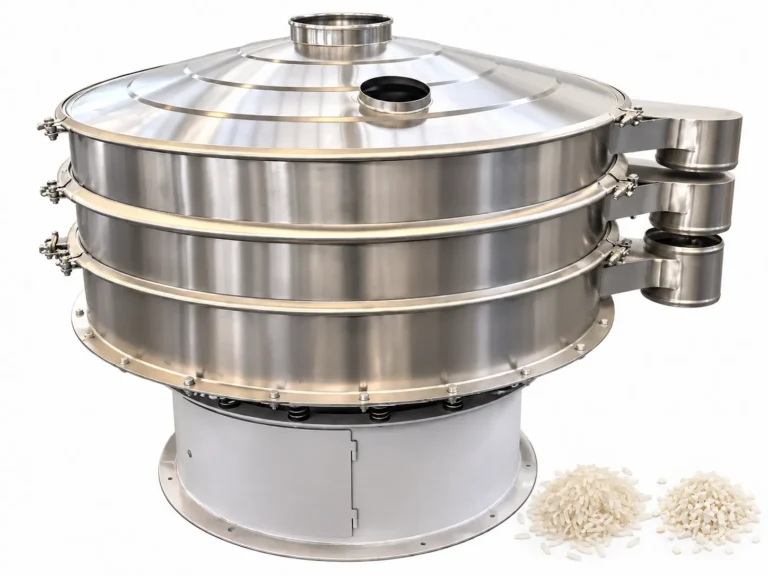
The choice gets more involved when the middle size fraction is the product you sell. Give the vibrating screen manufacturer both size limits, the hourly output you need between them, and the percentages of fines and oversize your buyer will accept. If the proposed machine is a rotary vibrating screen separator, have the supplier label each outlet on the drawing with the fraction it carries. Your installer should be able to identify the finished-product outlet without having to guess.
Leave room for the person who changes the mesh
A screen can fit neatly under a chute and leave the operator nowhere to put the cover. Give the drawing to the person who changes the mesh. Have them mark where they’ll stand, how far they need to lift the upper deck, and where they’ll set it down. Check those clearances with the discharge bins and conveyors in their working positions.
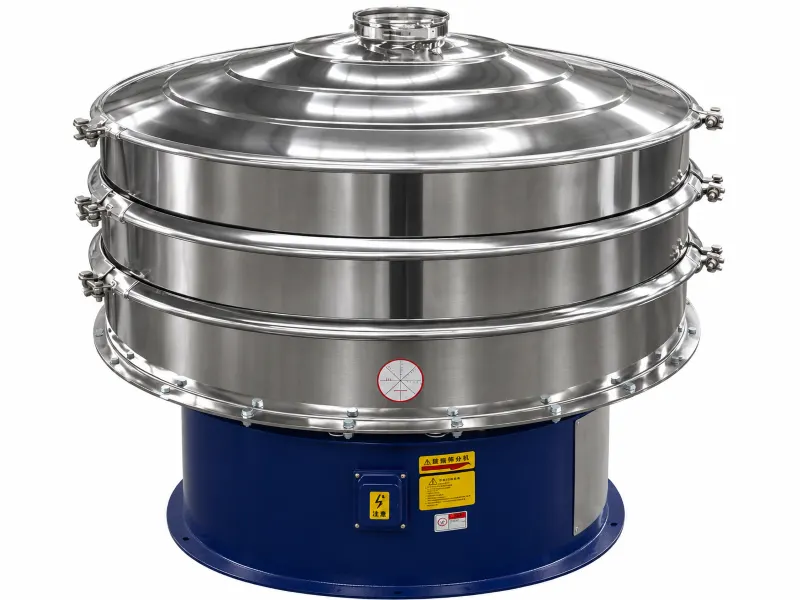
For a round machine, Yuanjing’s guide to rotary screen sizes and configuration options covers diameter, deck count, and construction. Include your measured inlet height and the space available for a screen change when you request the final layout.
What Does the Quoted Screening Capacity Actually Mean?
Separate feed rate from saleable output
Ask the vibrating screen manufacturer to state where it measures capacity. One question usually clears this up: At our specified screen opening, does the quoted kg/h refer to material entering the machine or to finished product within our size limits?
Suppose a screen receives 1,000 kg in one hour, and 850 kg reaches the intended product outlet during that hour. The feed rate was 1,000 kg/h. The collection rate at that outlet was 850 kg/h. You still need a particle-size check on a representative outlet sample to know how much of the collected material meets your buyer’s specification.
Agree on the trial record before sending a sample
If a vibrating screen manufacturer offers to test your material, agree on what the factory will record before you ship the sample. A video can show powder building up on one side of the mesh. To judge the effect on production, you need the weights and times from that same run.
| Trial detail | What to record |
|---|---|
| Sample condition | Material, moisture condition, and whether the sample represents a normal production batch |
| Screen setup | Opening in mm or µm for each deck, number of decks, and mesh-cleaning arrangement |
| Feed | Weight fed, elapsed time, and whether feeding was steady or intermittent |
| Output | Weight collected at each outlet and a particle-size check on a representative sample from the intended product outlet |
| Changes during the run | When buildup or blinding appeared, whether the collection rate fell, and any stops for cleaning |
I’d look closely at when the outlet sample was taken. If your operators usually stop halfway through a shift to clear the mesh, a sample taken just after startup won’t tell you much about that problem. Ask how long the trial ran and whether the factory recorded the collection rate again after material had been on the screen for a while.
What Should You Compare in Two Vibrating Screen Quotes?
Send each vibrating screen manufacturer the same written specification. When the offers come back, put the following items side by side. If one supplier leaves the spare-screen entry blank, get it filled in while you can still amend the order.
| Quotation item | What to check |
|---|---|
| Screening duty | Material condition, screen openings, feed rate, required finished grades, and output for the grade you sell |
| Machine configuration | Screen dimensions, number of decks, outlet arrangement, and mesh-cleaning system |
| Construction | Material grades for the mesh, frame, cover, outlets, and base |
| Spare parts | Quantity, specification, and part reference for replacement screens, seals, and other wear parts included |
| Delivery | Trade term, named delivery point, packing, freight covered by the price, and lead time |
| Service | Installation guidance, warranty coverage, and how to order replacement parts |
Check what “stainless steel” and “one spare screen” cover
If the quote says stainless steel construction, have the supplier identify the grade for each product-contact part and the material used for the base. Put those details on the configuration sheet both parties approve.
One spare screen also deserves a closer look. Will the factory send a piece of woven mesh or a framed assembly ready to install? The difference matters to the person doing the changeover. Ask for the part reference, replacement price, and lead time while the assembly drawing is in front of you.
Bring both prices to the same delivery point
One vibrating screen manufacturer may quote EXW at its factory while another includes freight to a named destination. Write the delivery point beside each price. If purchasing needs the cost of getting the machine to your plant, list the remaining transport and handling charges against each offer before comparing the totals.
What Should You Send a Vibrating Screen Manufacturer for a Quote?
Describe the job in the operator’s words
“We stop twice per shift to clear the mesh” gives an engineer more to work with than “we need higher efficiency.” Include the material, target opening, required throughput, finished grades, and normal operating hours. For an existing screen, give the opening and feed rate you actually run. For a new line, mark the figures that are still design targets.
If the inlet and outlet positions are fixed, attach a dimensioned sketch. Mark the upstream equipment, the destination of each fraction, and any restriction on access for cleaning or screen changes.
Copy this inquiry and fill in your figures
We process [material] and need to [remove oversize / separate the feed into specified grades]. Our target feed rate is [kg/h]. The required opening for each deck is [list openings in mm or µm]. We need [kg/h, if known] of finished product within [size limits].
The screen will sit between [upstream equipment] and [downstream equipment]. The available installation height is [height]. Our main operating issue is [describe what happens and when].
Please recommend a model and explain how you determined its capacity for our material. Include a layout drawing with the outlets labeled, identify the spare parts and services covered by the price, and state the delivery terms and lead time.
To request a vibrating screen recommendation from Yuanjing, send the material details, screen openings, and hourly output your line needs. If you have a layout sketch or a recent screening record, include it with your inquiry.
FAQ
How can I verify that a vibrating screen manufacturer builds the quoted machine?
During a factory visit or live video call, ask to see the quoted model or a similar build. Compare the deck layout and outlet positions with your drawing. Ask which parts the factory makes in-house and who checks the final dimensions.
How much material should I send for a vibrating screen trial?
Ask the vibrating screen manufacturer for the trial feed rate, run time, and extra material needed for setup. Send a representative production sample. If your mesh usually clogs after 30 minutes, request a trial long enough to see whether output drops.
Do I need an ultrasonic vibrating sieve if my powder clogs the mesh?
First check whether fine powder coats the mesh or damp lumps arrive from the hopper. If your powder sieving machine manufacturer recommends ultrasonics, ask for trials with the system off and on. Compare the weight passing through the same mesh over equal periods at the same feed rate.
Can a one-tonne-per-hour vibrating screen deliver 1,000 kg/h of finished product?
If 1,000 kg/h is the feed rate and only 85% of the feed meets your size specification, the maximum on-spec output is 850 kg/h, even with full recovery. Ask the supplier to state the finished-product rate separately in the quote.
What dimensions does a supplier need to fit a vibrating screen into an existing line?
Provide the inlet and outlet heights measured from the same floor level, their horizontal positions, and the connection sizes. Mark any overhead beams or pipes so the supplier can check clearance both for installation and for lifting the deck during a mesh change.
What should I specify when ordering a replacement screen for a vibratory sifter?
Give the vibratory sifter manufacturer your model, deck position, and part number if available. Confirm the mesh opening, material, frame dimensions, and seal profile. Check whether the price covers loose mesh or a ready-to-install framed screen.