Banana Powder Screening System: A Customer Case
The customer came to us with a clear requirement: screen banana powder through 20 mesh at 2 tons per hour. They also needed to feed the sieve through a dust-free feeding station and connect its bottom outlet to a vacuum conveyor.
The conveyor would carry the screened powder 2 meters horizontally and lift it 3 meters into a workshop processing tank.
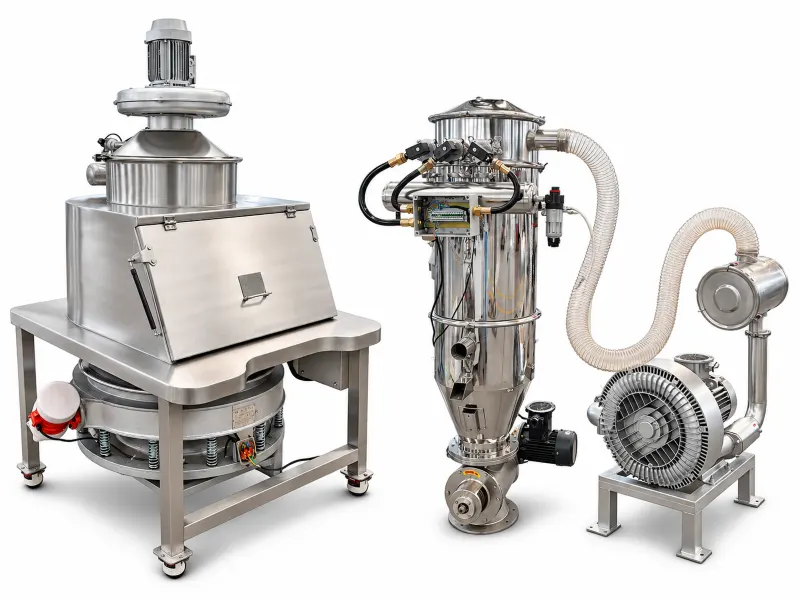
For this banana powder screening system, we recommended a Model 1200 dust-free feeding station, a 1200 mm diameter direct-discharge vibrating sieve, and a Model 450 continuous vacuum conveyor. All product-contact parts were specified in 304 stainless steel.
1. Project Overview
The banana powder screening system had to fit between manual bag feeding and the customer’s existing processing tank.
Dust during loading was one concern. The customer also wanted to avoid collecting the screened powder in a separate container before transferring it to the tank. We therefore included the feeding station and downstream conveyor in the equipment selection.
The material flow was:
Manual Feeding → Dust-Free Feeding Station → 20-Mesh Screening → Bottom Discharge → Vacuum Conveying → Processing Tank
Equipment connections were customized to match the customer’s production line.
2. Customer Requirements
When discussing the banana powder screening system, we worked from the customer’s screening specifications and the route to the receiving tank.
| Item | Customer Requirement |
|---|---|
| Material | Banana powder |
| Screen mesh | 20 mesh |
| Required screening capacity | 2 tons per hour |
| Feeding arrangement | Dust-free feeding station above the sieve |
| Screening outlet | Bottom discharge connected to a vacuum conveyor |
| Horizontal conveying distance | 2 meters |
| Vertical lift | 3 meters |
| Receiving equipment | Workshop processing tank |
| Product-contact material | 304 stainless steel |
The bottom outlet connection needed particular attention. Powder passing through the screen had to enter the vacuum conveying line, so the discharge arrangement formed part of the custom configuration.
3. Our Solution
Model 1200 Dust-Free Feeding Station
At the feeding end of the banana powder screening system, we selected a Model 1200 dust-free bag dump station.
Operators empty bags into the station, and the powder feeds into the sieve below. Dust extraction helps capture airborne powder during bag emptying, reducing dust around the loading area.When choosing a bag dump station for your powder, ask to see several bags emptied in succession so you can spot any buildup on the hopper walls or above the outlet.
1200 mm Direct-Discharge Vibrating Sieve
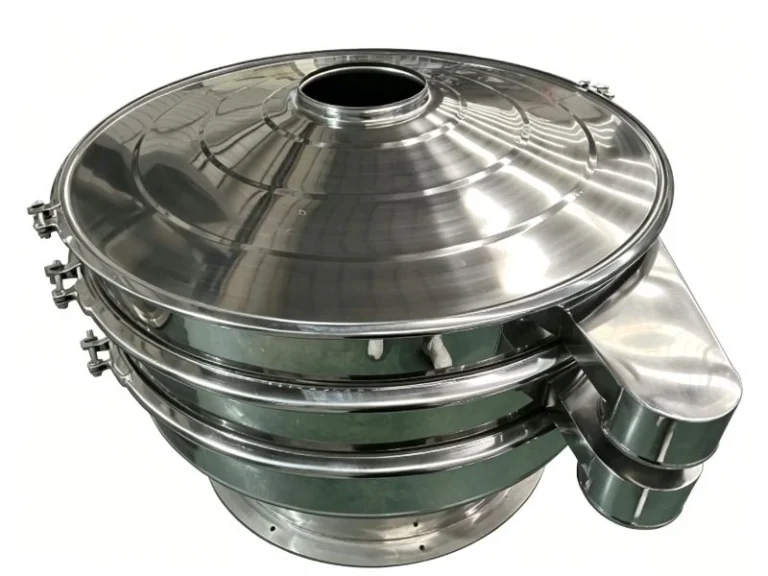
We recommended a 1200 mm diameter inline vibratory screen, also known as a direct-discharge vibrating sieve.
The banana powder screening system was fitted with a 20-mesh screen and selected around the customer’s 2-ton-per-hour requirement.
Powder passing through the mesh exits from the bottom. This outlet connects to the vacuum conveying line, allowing screened material to move to the next stage without separate collection and refeeding.
Model 450 Continuous Vacuum Conveyor
The conveying route was short horizontally but required a vertical lift: 2 meters across the workshop and 3 meters up to the processing tank.
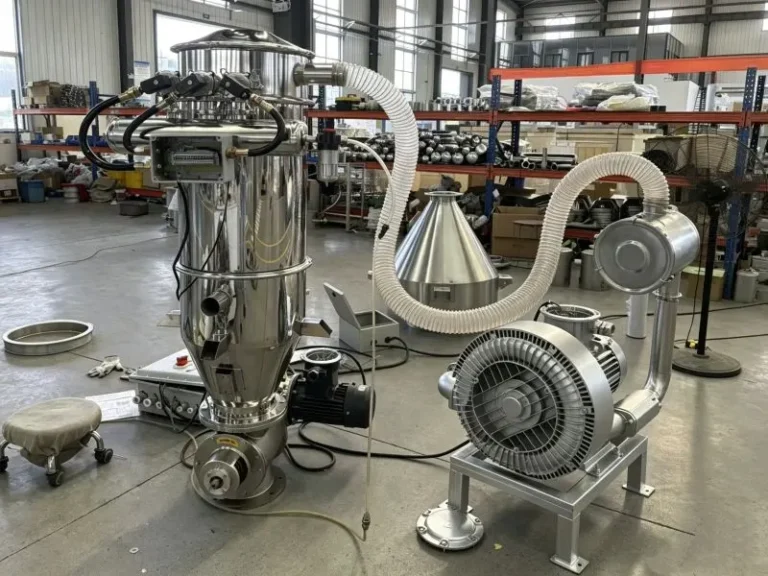
We matched a Model 450 continuous vacuum conveyor to this layout. The vacuum conveying system draws screened powder from the sieve’s bottom outlet and transfers it through enclosed piping to the tank.
The connections between the sieve, conveying line, and receiving equipment were customized for the installation.
4. Equipment Specifications
The banana powder screening system used the following configuration:
| Item | Project Configuration |
|---|---|
| Material handled | Banana powder |
| Screening requirement | 20 mesh |
| Design throughput target | 2 tons per hour |
| Feeding station | Model 1200 dust-free feeding station |
| Screening equipment | Direct-discharge vibrating sieve |
| Screen diameter | 1200 mm |
| Conveying equipment | Model 450 continuous vacuum conveyor |
| Horizontal conveying distance | 2 meters |
| Vertical lift | 3 meters |
| Discharge destination | Processing tank |
| Product-contact parts | 304 stainless steel |
| Customization | Equipment configuration and production-line connections |
The 2-ton-per-hour figure is the customer’s design requirement. For another installation, capacity would need to be checked against the powder condition, feeding rate, and conveying layout.
5. Equipment Features
The banana powder screening system addresses the points where the customer needed dust control and equipment connections.
- Dust extraction during bag emptying. The feeding station helps capture powder released while operators load material.
- Bottom discharge into the conveying line. Screened powder leaves through the sieve’s lower outlet, reducing intermediate collection and repeated pouring.
- Enclosed transfer to the tank. Piping limits open exposure to the workshop environment between screening and the next process.
- 304 stainless steel product-contact parts. These were specified for the customer’s food-processing application.
- Customized connections. The equipment interfaces were arranged to suit the existing production line.
Enclosed conveying does not make the process sterile or oxygen-free. Cleaning procedures and workshop hygiene controls are still required.
6. Customer Feedback
After using the banana powder screening system, the customer reported less dust around the feeding area and screening results that met the 20-mesh requirement.
The vacuum conveyor also completed the connection to the workshop processing tank. Screened powder could travel through the enclosed line without being collected and poured into the next machine by hand.
The customer was pleased with how the equipment fitted the production line, particularly the reduced feeding dust and the direct transfer from the sieve to the tank.
Discuss Your Banana Powder Screening System with Our Team
If you need a similar arrangement, send us your material name, mesh requirement, hourly capacity, conveying distance, and lift height. Details of the receiving tank or machine will also help us check the connections.
Contact our team to discuss equipment selection and a layout that fits your production line.