Biochar Screening in Finland
Project Overview
Our Finnish customer came to us with two details already settled. They needed to grade fine biochar at 50 and 100 microns, and they had chosen a 1,000 mm machine to suit the space available at their site.
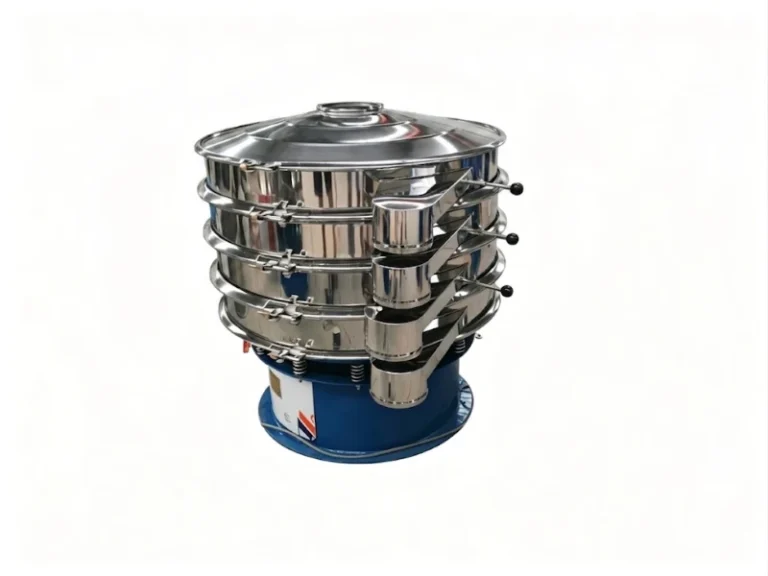
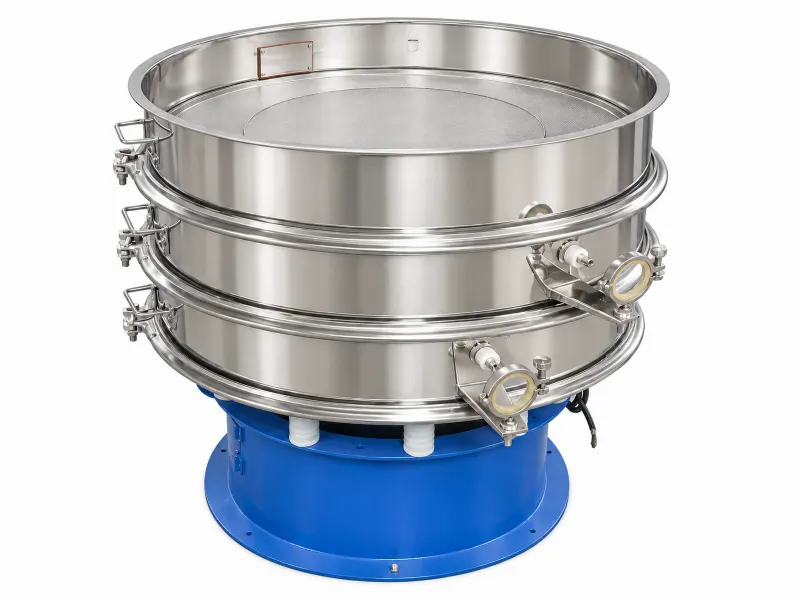
That gave us a clear starting point for the biochar screening project. We selected the YJ-1000-2, a two-deck rotary vibrating screen. With the diameter fixed, we could focus on what happened inside the machine: how the powder would move from one deck to the next, and how to keep both fine meshes clear.
What the Customer Needed
The two mesh sizes were the customer’s main biochar screening requirement. Using them in one machine would give the customer three fractions to collect: coarse material retained on the upper deck, a middle fraction retained on the lower deck, and fines passing through both.
The material itself raised another practical question. Biochar is light and porous, and the fine powder can become airborne as it falls. We wanted the layout to account for the whole route into the collection container, including the short drop after the powder leaves the screen.
How We Set Up the Two Decks
For this biochar screening setup, the 100-micron mesh goes on top. It receives the full feed and retains the coarse particles. Material passing through it reaches the 50-micron mesh below. The lower deck retains the nominal 50–100 micron fraction, while the finest powder passes through to the bottom outlet.
We fitted each deck with its own ultrasonic mesh-cleaning system. The upper mesh matters just as much as the finer one here. If its openings become blocked, particles small enough to reach the second deck can leave with the coarse fraction. Ultrasonic vibration helps keep the openings clear on both decks. Our ultrasonic vibrating sifter page shows how this type of mesh cleaning works.
Biochar Screening Equipment Specifications
| Item | Project details |
|---|---|
| Model | YJ-1000-2 |
| Material | Fine biochar powder |
| Nominal screen diameter | 1,000 mm |
| Number of screen decks | 2 |
| Upper deck opening | 100 µm (0.10 mm) |
| Lower deck opening | 50 µm (0.05 mm) |
| Mesh cleaning | One ultrasonic system per deck |
| Recommended construction | Enclosed screen body with stainless steel product-contact parts |
Equipment Features That Mattered on Site
For fine biochar screening, one detail we pay attention to is the bottom outlet. An enclosed screen body helps contain airborne powder during sieving, but an open drop into a bin still gives the finest material room to disperse. We recommended an enclosed connection at the fines outlet and stainless steel for the surfaces in contact with the powder, so residual material would be easier to clean away.
The two-deck arrangement also keeps both cuts within one machine. When planning the installation, the customer can use the 1,000 mm diameter as a starting point, then allow room for the three discharge outlets, collection containers and access for mesh changes.
For more on fine meshes and blinding, see our guide to ultrasonic sieving for fine powders. Our cassava starch screening case shows how we approached ultrasonic cleaning in a different powder application.
Customer Feedback
The clearest feedback from the Finnish customer came during selection: the machine diameter had to suit the space they had set aside. That detail shaped the biochar screening design from the beginning. The selected configuration kept the requested diameter and accommodated both mesh sizes, with ultrasonic cleaning on each deck. Operating figures such as hourly throughput and the yield from each outlet are still unconfirmed.
Planning a Biochar Screening Project?
If you’re working on biochar screening, tell us which fractions you want to collect and how much material you need to process per hour. If space is tight, a photo or sketch showing the feed point and collection bins will help us suggest a deck arrangement and outlet positions that fit your site. Contact our team.