How to Choose a Linear Vibrating Screen for Metal Powder: Configuration Differences for Iron, Aluminum, and Copper Powders
A linear vibrating screen for metal powder can carry a continuous feed of iron powder and still fall short of the required throughput if the discharge outlet is too narrow. With fine aluminum powder, the mesh itself may be the restriction. Copper powder presents a different problem: even when the decks separate the grades correctly, a poor seal at the outlet can cost you finished product.
The YJZXS configurations below cover three jobs: removing oversize particles from iron powder, screening aluminum powder in an enclosed system, and grading copper powder into separate fractions. If you are still deciding which type of screen suits your material, our metal powder sieving guide covers mesh selection, powder properties, and protection requirements.
Iron powder screening: size the deck and outlet for continuous discharge
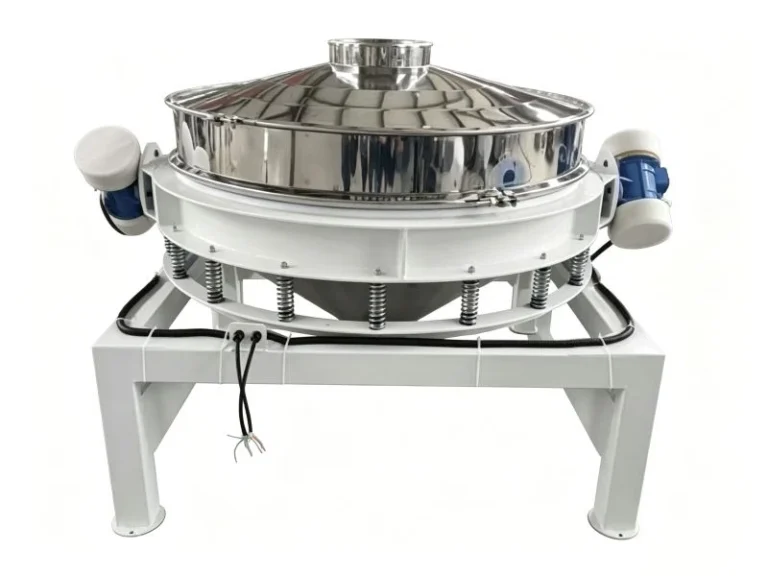
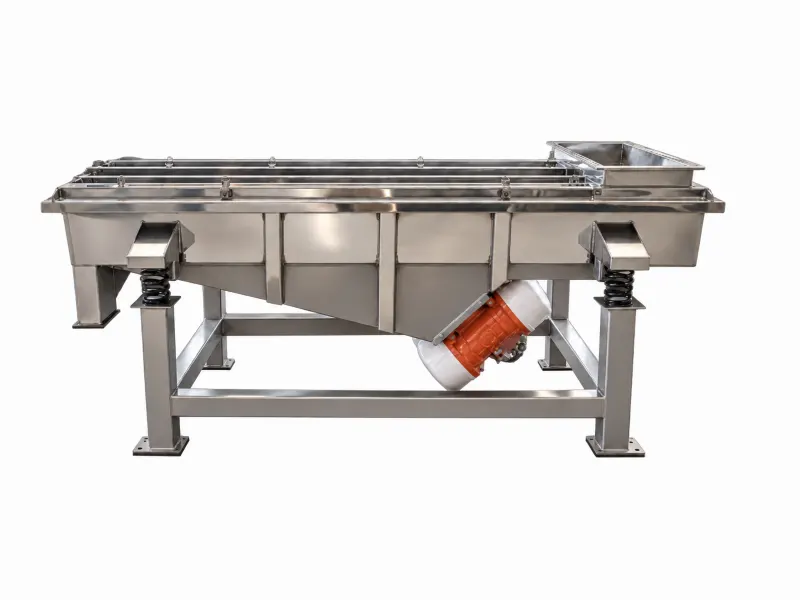
When sizing a linear vibrating screen for metal powder on a continuous iron powder line, follow the material all the way to the outlet. Dense iron powder settles quickly and can form a thick bed on the mesh. A reinforced deck carries that load, but if oversize material backs up at the discharge, increasing motor power does little to clear it.
The heavy-duty YJZXS configuration uses a thick carbon steel body, a reinforced frame, and load-bearing crossbeams. A wide outlet gives retained material room to leave the deck. This configuration is intended for applications such as oversize removal from reduced iron powder, metallurgical iron powder, and coarse iron powder. You can see the screen box, frame, and deck arrangement on our industrial linear vibrating screen product page.
Select the vibration motor for the expected material load. The bed needs enough movement to loosen and expose particles to the mesh. The deck angle also affects how steadily the powder travels toward the outlet.
For continuous service, specify both the mesh opening and the wire diameter. A heavier, wear-resistant wire must still leave the opening required for the cut. The iron powder configuration uses one or two decks, mainly for oversize removal.
Aluminum powder screening: contain the dust and keep the mesh clear
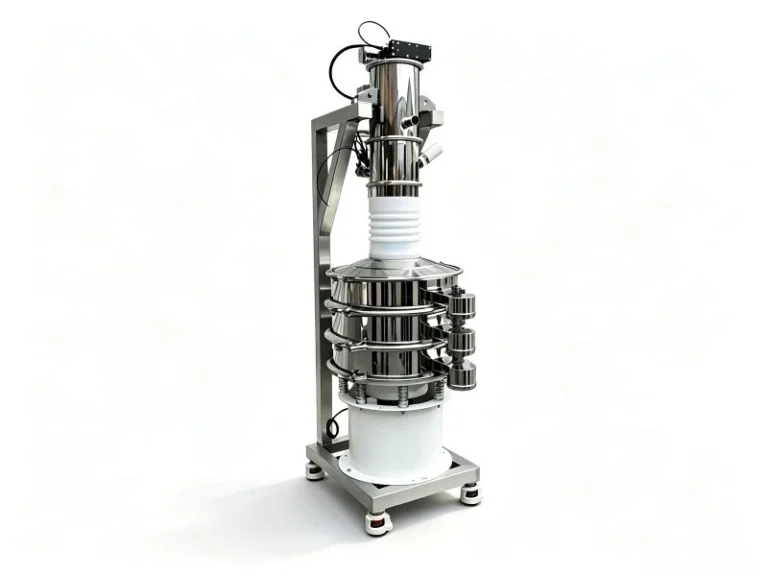
For atomized or industrial aluminum powder, an enclosed linear vibrating screen for metal powder needs close attention at the transfer points. The light-duty YJZXS model has a covered deck and a 304 stainless steel body. Its inlet and outlet connect directly to pipework to limit dust escape as powder enters and leaves the screen. If the line uses negative-pressure dust extraction, assess the screen, ductwork, and extraction connection together.
The enclosure handles dust containment. Static control and explosion protection have their own requirements. The aluminum powder configuration includes antistatic mesh, equipment grounding, and a motor selected for the installation. The equipment specification should identify the electrical components, motor protection rating, and grounding requirements for the actual powder and operating environment.
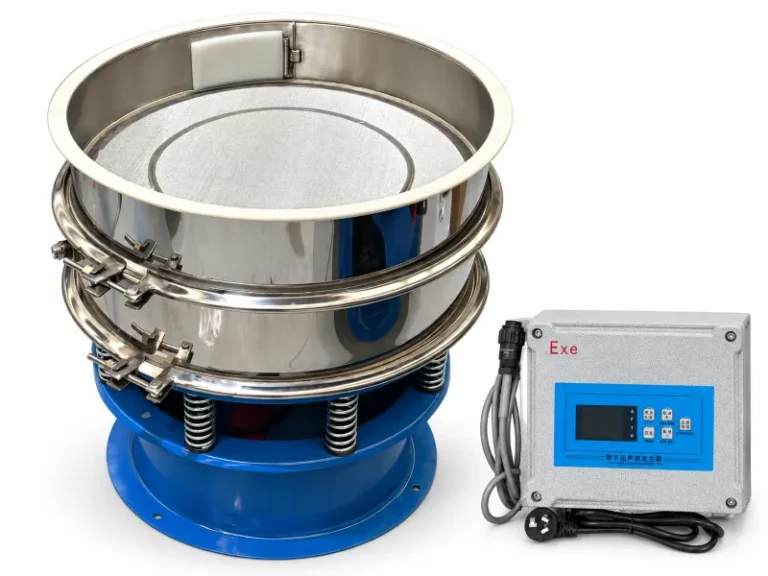
Fine aluminum powder can cling to the mesh or form agglomerates that block the openings. The reference configuration pairs ultrasonic mesh cleaning with bouncing balls. For ultrafine powder, check whether the material passes through the chosen aperture at the required feed rate and whether the cleaning arrangement keeps that rate steady. Our article on ultrasonic cleaning for 200–500 mesh powder screening explains how mesh blinding affects fine cuts.
Copper powder grading: work back from the fractions you need to collect
When specifying a linear vibrating screen for metal powder to grade electrolytic or conductive copper powder, list the finished particle size ranges first. Each cut determines a mesh opening. Each finished fraction needs its own discharge outlet and collection point.
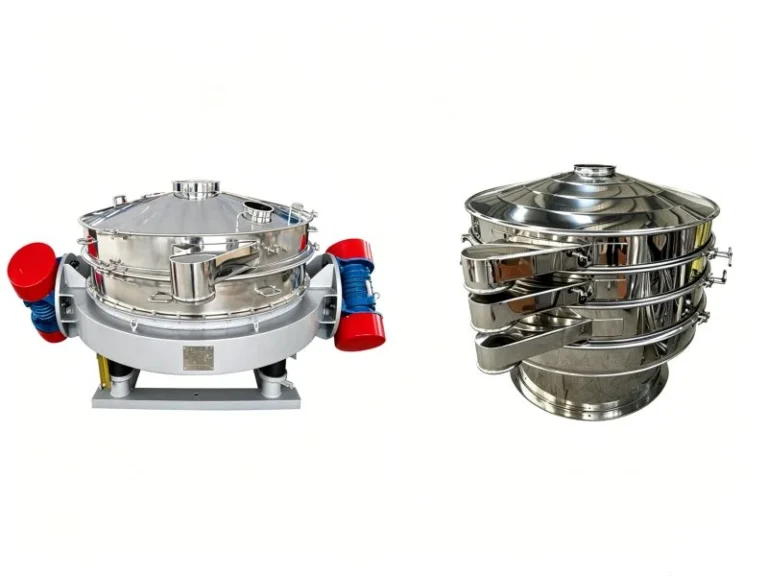
The YJZXS precision multi-deck configuration uses stacked screen frames in a 304 or 316 stainless steel body. For fine, high-value copper powder, check the joints between the frames and the seal at each collection point. A leak at either location means less saleable powder reaches the container.
At the feed end, a guide directs the powder onto the deck, while a cushioned inlet reduces impact. If the particles are prone to breakage, the vibration amplitude and frequency can be adjusted to suit the feed. For fine copper powder that blinds the mesh, assess ultrasonic cleaning at the intended cut size and throughput.
YJZXS specifications for iron, aluminum, and copper powders
The figures below are reference values for selecting a linear vibrating screen for metal powder. Confirm capacity and screening accuracy at the mesh opening you intend to use. The finest mesh and highest throughput in a column may come from different operating conditions.
| Specification | Iron powder | Aluminum powder | Copper powder |
|---|---|---|---|
| YJZXS configuration | Heavy-duty carbon steel | Light-duty enclosed stainless steel | Precision multi-deck |
| Body material | Thick carbon steel | 304 stainless steel | 304 or 316 stainless steel |
| Main features | Reinforced frame, vibration motor sized for the load, heavy-gauge wear-resistant mesh | Antistatic mesh, equipment grounding, motor protection selected for the installation | Adjustable vibration amplitude, fine mesh, cushioned inlet |
| Enclosure and discharge | Standard seals and wide discharge outlet | Fully enclosed body with negative-pressure dust extraction connection | Fully enclosed body with individually sealed outlets |
| Reference mesh-cleaning method | Bouncing balls | Ultrasonic cleaning and bouncing balls | Ultrasonic cleaning |
| Screen decks | 1–2, mainly for oversize removal | 1–4 | 1–7 |
| Reference mesh size | 20–200 mesh, depending on duty | 325 mesh listed. Confirm suitability for finer cuts. | Up to 400 mesh |
| Typical throughput | 15–20 t/h | 3–8 t/h | 2–5 t/h |
| Reference screening accuracy | Oversize removal duty. No percentage specified. | 98% or higher | 96% or higher |
Discuss your screening requirements
For a quotation on a linear vibrating screen for metal powder, send the powder type, target mesh or aperture, required tonnes per hour, and finished size ranges. If you are replacing an existing screen, describe where the problem occurs. “Iron powder builds up at the oversize outlet” gives the team a more useful starting point than a capacity figure alone. Contact the Yuanjing screening team.
FAQ
Can one linear vibrating screen for metal powder handle all three materials?
The YJZXS series includes configurations for all three. To assess an installed machine for a second material, check its deck load, mesh, seals, cleaning system, and protection features against the new duty. An iron powder machine may have ample load capacity while lacking the enclosure or electrical protection required for the proposed aluminum powder application.
Does fine aluminum powder always need ultrasonic cleaning?
Watch the mesh at the required feed rate. If powder continues to pass through and the openings stay clear, ultrasonic cleaning may be unnecessary. Repeated blockage from adhering particles or agglomerates is a reason to evaluate it.
How many decks does a copper powder grading screen need?
One deck makes one cut and produces two fractions: material retained on the mesh and material that passes through. Each additional cut requires another deck and a way to collect the resulting grade. The copper powder configuration lists up to seven decks. The number you need follows from the particle size ranges in your product specification.
What determines the capacity of a linear vibrating screen for metal powder?
A capacity figure is useful only when it comes with a feed material, a cut size, and a screening task. For example, the table lists 2–5 t/h for copper powder and a finest reference mesh of 400 mesh. If your process requires 5 t/h at 400 mesh, specify those figures together so the equipment supplier can assess that particular duty.
Why does iron powder build up at the discharge end of a linear vibrating screen?
If iron powder moves steadily across the deck but starts piling up at the oversize outlet, the outlet may be too narrow for the amount of material reaching it. Check whether it can discharge the retained powder continuously at the target feed rate. If a thick bed forms farther up the deck, check the vibration force and deck angle against the material load.
How can I reduce copper powder loss during multi-deck screening?
Check where the screen frames meet and where each discharge outlet connects to its collection container. Fine copper powder can escape through either joint even when the screen separates the grades correctly. Check the seals at those points and make sure each finished fraction has its own sealed discharge path.