Calcium Carbonate Powder Screening: Choosing a Sieve for Fine Grades
Calcium carbonate powder is screened before mixing or packing to remove oversized particles, lumps and larger foreign material. Fine grades used in coatings, plastics and fillers need a sieve that matches the required opening and throughput. A standard vibrating sieve may handle the job. If powder builds up on the mesh and output falls, ultrasonic assistance may help. The permitted oversize limit sets the starting point for screen selection; a trial with the actual powder confirms capacity.
What Should Calcium Carbonate Powder Screening Remove?
Look at what stays on the mesh. Coarse particles, lumps and foreign matter may need different treatment: rejection, regrinding or a separate process. Their size and condition determine what screening can remove.
Oversized Particles and Foreign Material
The screen retains coarse calcium carbonate and contaminants such as sand, quartz grains and other mineral fragments only when they are too large to pass through its openings. Finer impurities can pass with the usable powder. Iron contamination may need magnetic separation, while soluble salts require a suitable washing and separation process.
Loose Agglomerates vs Hard Lumps
Some of the retained material may be usable fine powder held in loose agglomerates. These can disperse during screening. Hard lumps may need a separate lump breaker or mill. Inspect them before reprocessing so that foreign matter is not ground back into the product.
Check Screening vs Particle Size Classification
Check screening removes a small amount of oversize from an otherwise acceptable powder, often before mixing or packing. Particle size classification separates the feed into defined size fractions and may need several screen decks. The task determines the openings and equipment required.

How to Choose the Screen Aperture for Fine Calcium Carbonate
To select an aperture, the supplier needs the feed particle size distribution, target opening and permitted coarse particle residue. Specify whether the job is to remove a little oversize or separate distinct size fractions. If the required separation falls outside the equipment’s working range, establish whether the process is feasible before discussing machine size.
Use the Permitted Oversize Limit
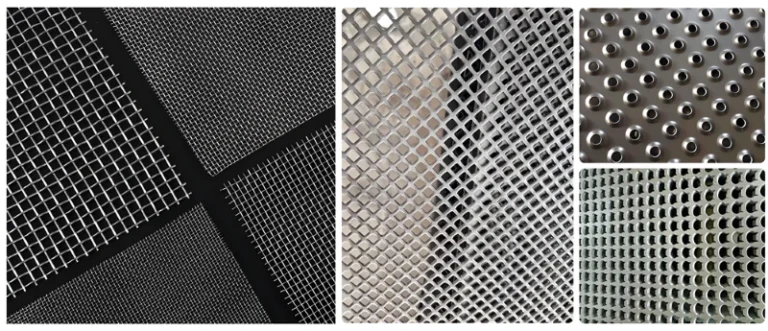
The downstream particle size limit and acceptable sieve residue define the screening requirement. Calcium carbonate screening options include 80, 100, 200 and 325 mesh:
| Mesh Size | Screening Duty |
|---|---|
| 80–100 mesh | Check screening and impurity removal from coarser powders |
| 200 mesh | Fine powder screening |
| 325 mesh | Finer screening of finished powder |
These mesh sizes are reference options for assessment. The appropriate choice varies by grade. Higher mesh counts generally mean smaller openings, so powder flow and mesh cleaning become more demanding.
Why Powder Grade Is Not the Same as Sieve Mesh
A powder’s commercial grade does not specify the screen opening. D50 and D97 describe points in a measured particle size distribution, whereas aperture is the size of a physical opening. Send the particle size report and test method to the supplier. The screen specification should state the aperture in microns, wire diameter and mesh standard.
Screen Aperture and Throughput
An unnecessarily fine screen can slow production and leave usable fines in the oversize fraction. A material trial should measure coarse particle removal, fine powder recovery and sustained output.
One deck may be enough for oversize removal. Two or more can separate several size fractions. Screen mesh is commonly made from 304 stainless steel for its corrosion resistance and ease of cleaning, where it suits the process.
For 200- or 325-mesh screening, the blockage observed will help determine whether bouncing balls or ultrasonic cleaning are suitable. Either system must be compatible with the mesh and screen assembly.
| Information to Provide | Why It Is Needed |
|---|---|
| Feed particle size distribution and test method | Assess fines and particles close to the screen opening |
| Target aperture and permitted coarse residue | Define separation and acceptance requirements |
| Sample of retained material | Identify coarse particles, agglomerates or foreign matter |
| Required throughput | Determine screen area through material trials |
When Does Calcium Carbonate Need an Ultrasonic Vibrating Sieve?
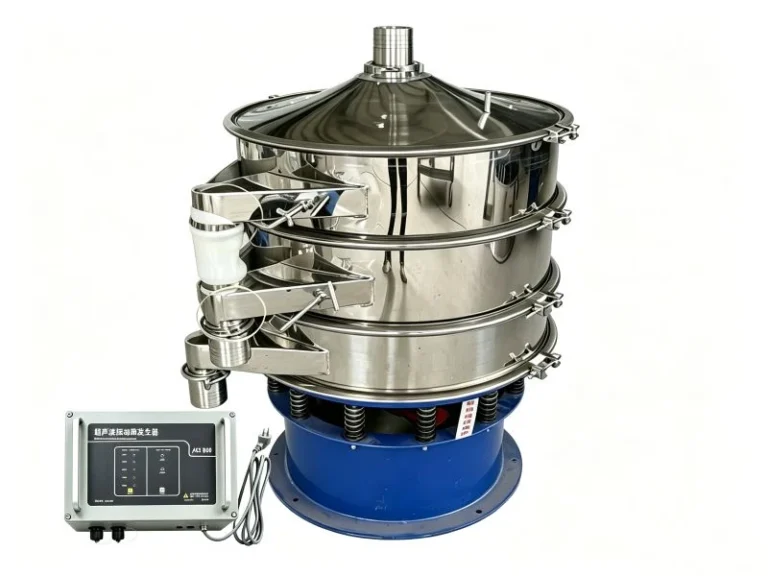
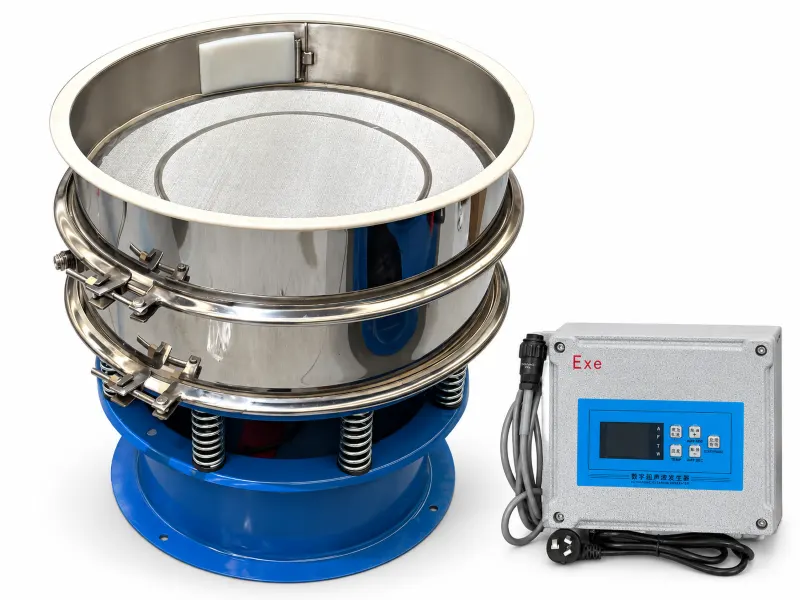
Repeated blockage and falling output are reasons to test an ultrasonic vibrating sieve. High-frequency vibration at the mesh helps reduce powder adhesion and keep openings clear. Whether it suits the job also depends on the separation required, powder moisture, throughput and installation space.
When a Conventional Vibrating Sieve Is Sufficient
There may be no need for ultrasound if the powder flows freely and a conventional sieve meets the output and oversize limits without frequent blockage. Before changing systems, check the feed rate, screen tension and existing mesh cleaning.
When Mesh Blinding Reduces Sustained Output
Output that falls during a run and briefly recovers after cleaning points to mesh blinding. Usable fines in the oversize fraction are another sign. If feed and screen adjustments do not resolve the problem, trial ultrasonic assistance with the calcium carbonate being processed.
Ultrasonic vibration may disperse loose agglomerates and help fines pass. Damp, sticky powder or hard lumps caused by moisture may still need drying or separate lump breaking.
How to Choose the Screen Design
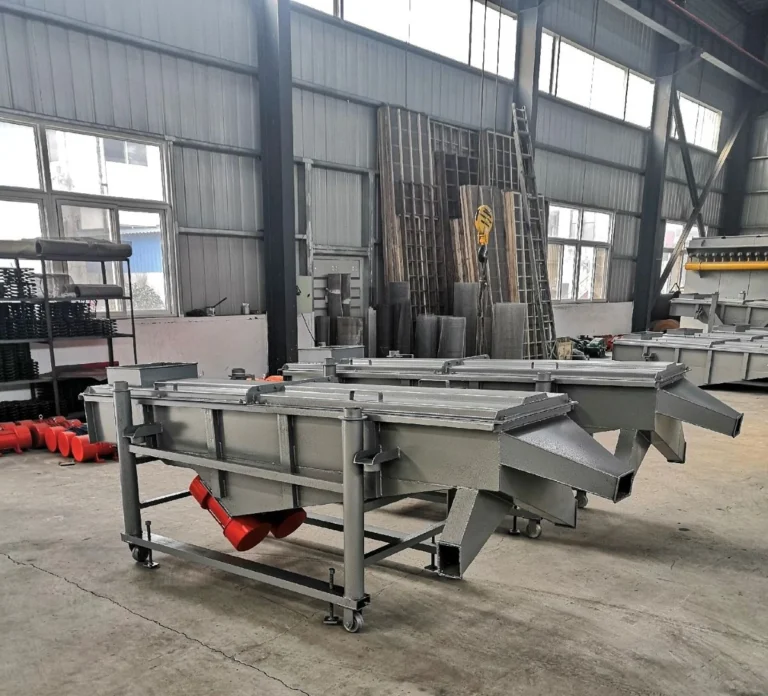
Compatible rotary, inline, linear and tumbler screens can be fitted with ultrasonic systems. The table below outlines where each design may suit the screening duty.
| Selection Factor | Selection Notes |
|---|---|
| Separation requirement | For 400-mesh and finer duties, assess an ultrasonic rotary or tumbler screen through trials. Confirm the actual aperture and required separation first. |
| Throughput | Inline screens can suit simple check screening with a high proportion of passing powder. Linear screens may suit higher-volume duties where the required aperture and powder flow allow. |
| Powder condition | For cohesive or agglomerated powder, test whether ultrasonic cleaning maintains passage. Screen motion alone does not resolve excessive moisture. |
| Installation space | Rotary and inline designs may suit compact layouts. Check the full footprint, installation height, outlet positions and maintenance access for every option. |
Limits of Ultrasonic Assistance
Ultrasound helps keep screen area available, but the aperture stays the same. It does not replace grinding or classification, guarantee the breakup of hard lumps, or control D50 and D97 on its own.
| Observed Condition | Option to Evaluate |
|---|---|
| Powder flows well and the mesh remains clear | Conventional vibrating sieve |
| Repeated blinding after feed and screen adjustments | Ultrasonic-assisted screening |
| Retained material consists mainly of hard lumps | Separate lump-breaking treatment |
| The task is to produce a specified ultrafine particle size distribution | Grinding and classification |
What to Confirm Before Selecting a Calcium Carbonate Sieve
For a quotation, send the feed particle size distribution, required tonnes per hour and site installation details, along with the target aperture and product specifications. The manufacturer uses these to select the screen area, decks and drive system. Ask for overall dimensions, an installation or foundation drawing, motor power and screen specifications in the technical proposal.
GCC, PCC and Coated Powder Characteristics
Identify the powder as ground calcium carbonate (GCC), precipitated calcium carbonate (PCC) or a surface-treated grade. Its moisture, bulk density, particle size distribution and tendency to agglomerate matter too; the grade name alone cannot establish how it will screen.
Deck count follows the feed and required size fractions. Extra decks add grading outlets, but increase machine height and can make cleaning and maintenance access more difficult. Use only as many as the product specifications require.
Required Capacity, Screen Area and Feeding Conditions
Give the required feed rate and expected output of acceptable powder separately. Screen area must accommodate the material load, and motor power must suit the machine. A larger motor alone does not guarantee more throughput.
Feed uniformity, powder bed depth, agglomeration, moisture and aperture also affect capacity. A supplier’s capacity figure should state the material and operating conditions it refers to.
Contact Materials, Sealing and Installation Space
Provide the available footprint and height, support details, and inlet and outlet connections. Any requirements for enclosed operation or explosion protection must be specified for the actual process and installation area.
When comparing proposals, look at how the screen is fastened, how it is cleaned, the seals and product-contact materials, and how wear parts are replaced. Operators need room to inspect, clean and change the screen. Extra components are useful only when they address a process need.
Validate the Configuration with a Material Trial
Run the trial with the actual powder and record sustained throughput, oversize proportion, acceptable fine powder recovery and cleaning frequency. Include the aperture, feed conditions and test duration so the results can be compared fairly.
Figures from other powders cannot confirm calcium carbonate capacity. Agree on the final configuration and acceptance conditions using the material trial results.
Discuss Your Calcium Carbonate Screening Requirements
Send Yuanjing your powder type, coating status, particle size report, target aperture and required capacity. Include any clogging problems and installation limits. We can review the details and recommend a sieve configuration, including whether ultrasonic assistance is worth testing.
FAQ
What Mesh Size Should I Use for Calcium Carbonate Powder Screening?
Choose the mesh based on the permitted oversize limit and acceptable sieve residue. Options include 80, 100, 200 and 325 mesh, but these are not fixed recommendations for every grade. Specify the actual opening in microns and test the powder to confirm separation and throughput.
Does Fine Calcium Carbonate Always Need an Ultrasonic Vibrating Sieve?
No. A conventional vibrating sieve may be sufficient when the powder flows freely and meets the required output without frequent blockage. Consider an ultrasonic vibrating sieve for calcium carbonate when mesh blinding continues after adjusting the feed rate, screen tension and cleaning system.
Can an Ultrasonic Sieve Break Up Calcium Carbonate Lumps?
Ultrasonic vibration may disperse loose calcium carbonate agglomerates and help usable fines pass through the mesh. Hard lumps or damp, sticky material may need separate lump breaking or drying. Inspect the retained material before reprocessing it to avoid returning contaminants to the product.
Can a Vibrating Sieve Control Calcium Carbonate D50 or D97?
A vibrating sieve removes particles according to the screen opening; it does not independently control D50 or D97. These values describe the measured particle size distribution. Producing calcium carbonate with a specified ultrafine distribution may require grinding and classification, with screening used to remove oversize material.
What Is the Screening Capacity for Calcium Carbonate at 200 or 325 Mesh?
There is no single capacity figure for 200- or 325-mesh calcium carbonate screening. Output depends on the actual aperture, screen area, particle size distribution, moisture, agglomeration and feed conditions. Ask for a trial using your powder, with sustained throughput and oversize residue recorded under stated conditions.
What Information Is Needed to Select a Calcium Carbonate Sieving Machine?
Provide the powder type, coating status, particle size report, target aperture, permitted coarse residue and required tonnes per hour. Include moisture, bulk density, current clogging problems and installation limits. These details help the supplier assess screen area, deck count, cleaning method and whether ultrasonic assistance is needed.