Talc Powder Screening at 325 and 400 Mesh
Project Overview
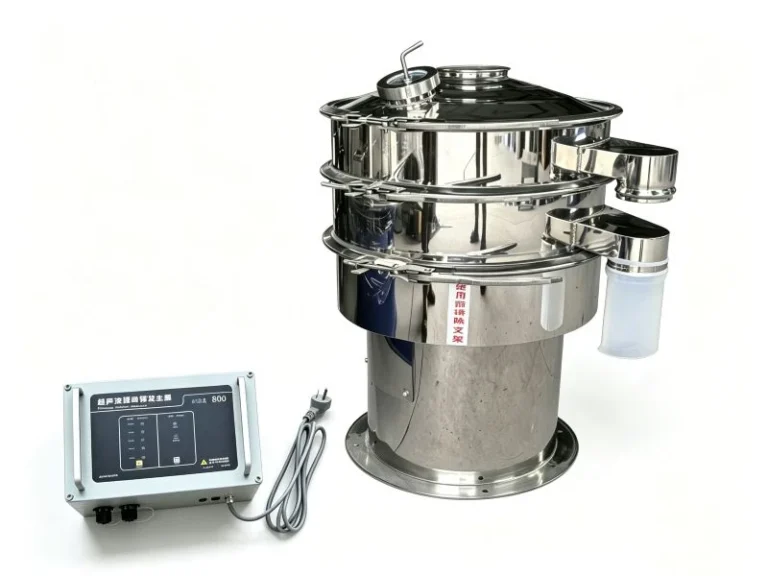
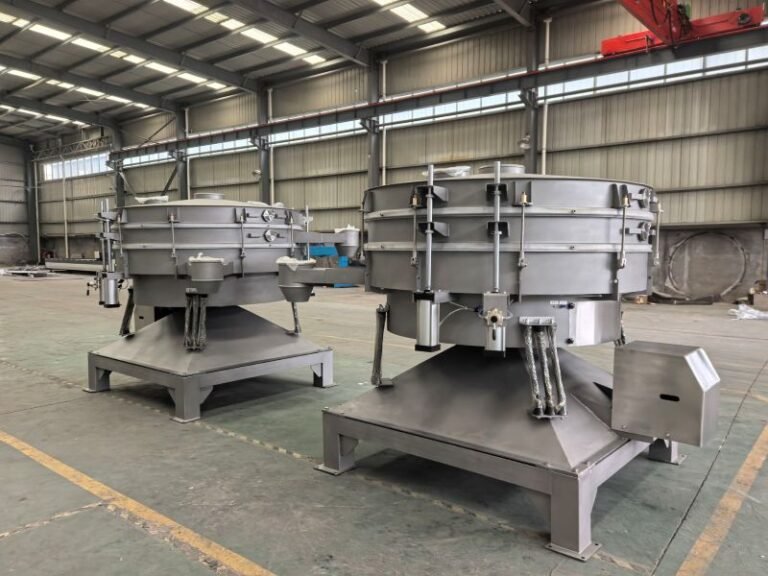
A customer contacted us about talc powder screening at 325 and 400 mesh, with a target throughput of 300 kg/h. We recommended a 1,000 mm double-deck ultrasonic sieving machine. Each deck has its own transducer, and both share one generator.

Customer Requirements
We used the customer’s 300 kg/h target to select the sieve diameter. The choice of cleaning system came down to what happens on the lower deck during a continuous run. Talc that passes through the 325-mesh screen lands on the finer 400-mesh screen. If powder starts to block those openings, the lower deck can hold up production even while the upper screen is running freely.
Our 200–500 mesh powder screening guide explains how mesh size, powder properties, and feed rate affect throughput.
Recommended Solution
We placed the 325-mesh screen above the 400-mesh screen in the proposed layout. Coarse talc stays on the upper screen and leaves through the first outlet. Material fine enough to pass through 325 mesh but too coarse to pass through 400 mesh leaves through the second. Powder that passes through both screens is collected at the bottom outlet.
We worked with the same two mesh sizes in a separate 325- and 400-mesh aluminum powder screening project.
For mesh cleaning, we specified one transducer per deck. Each transducer applies ultrasonic vibration directly to its screen to help dislodge powder from the openings. A single generator can drive both transducers in this configuration, saving the cost of a second generator.
Equipment Specifications
| Item | Recommended configuration |
|---|---|
| Material | Talc powder |
| Target throughput | 300 kg/h |
| Machine type | Double-deck ultrasonic vibrating sieve |
| Nominal sieve diameter | 1,000 mm |
| Upper screen | 325 mesh |
| Lower screen | 400 mesh |
| Ultrasonic system | One generator powering two transducers, one per deck |
| Machine construction | 304 stainless steel |
Equipment Features
With both screens in one housing, the operator can collect three fractions without transferring partially screened talc to a second machine. The lower deck has its own source of ultrasonic vibration where the mesh openings are smallest. After a batch, residual talc can be wiped from the 304 stainless steel surfaces, including the underside of the cover, the screen frames, and the discharge outlets.
For practical guidance on tuning the cleaning system, see how to set up and adjust an ultrasonic vibrating screen.
Customer Feedback and Follow-Up
So far, the customer has provided the mesh sizes and throughput requirement. We have yet to receive operating figures from their site. During follow-up, we would ask the operator how long it took to screen a weighed batch and whether they had to stop to clean the 400-mesh screen. The batch weight and elapsed time would give us the actual throughput, including any cleaning stops.
Sizing a Sieve for Your Talc Powder
If you need 300 kg/h of talc at the bottom outlet, let us know when you request a quote. Feeding 300 kg/h into the sieve will yield less than that at the bottom whenever either screen retains part of the feed.
Contact our screening team with your mesh sizes, hourly target, and the fraction you plan to collect. We’ll use those details to recommend a sieve diameter, deck arrangement, and ultrasonic cleaning system for your material.