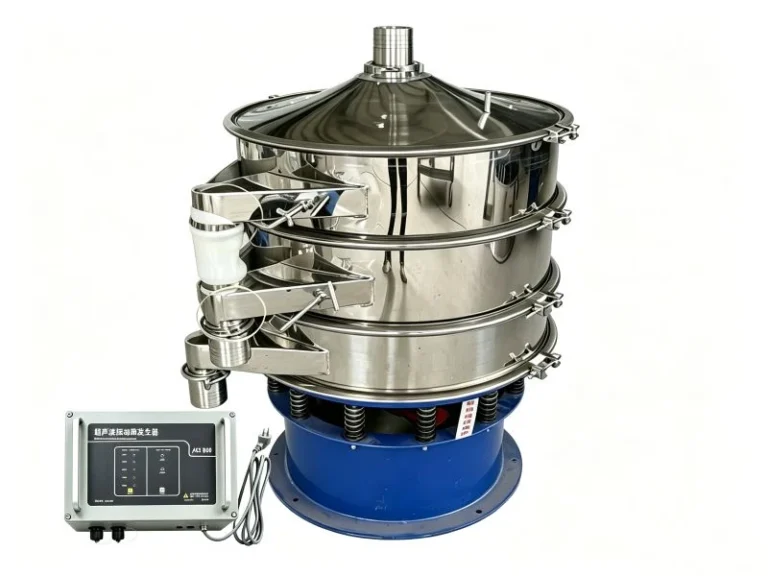
Buying an Enclosed Tumbler Screen: Seals, Separation and Screen Changes
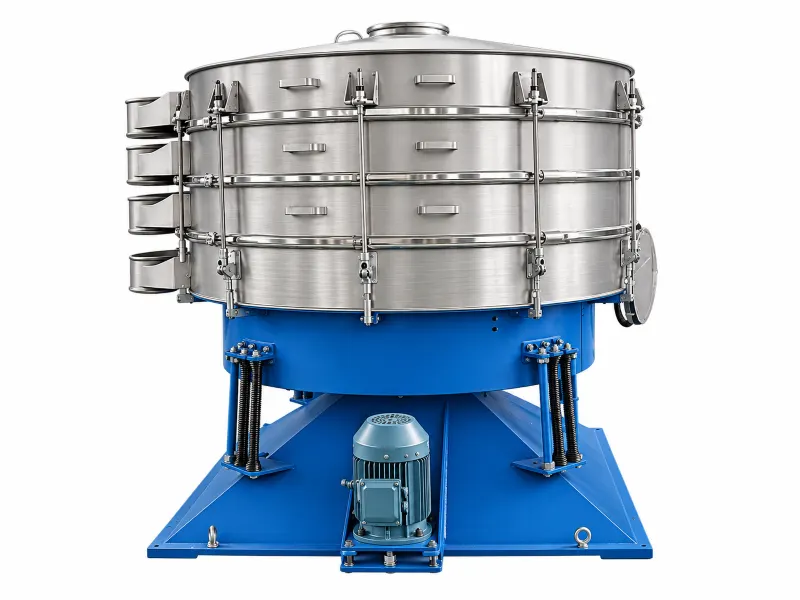
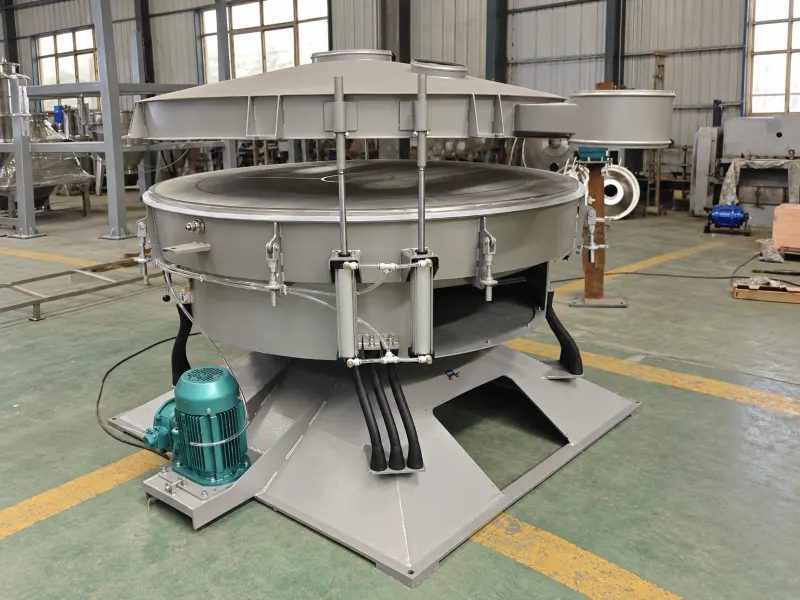
An enclosed tumbler screen moves material across the mesh in a tumbling motion, separating particles by size. The housing helps contain dust, but frame seals, pipe connections and dust extraction all affect what happens once material starts flowing.
A supplier will usually ask for the mesh specification, required capacity, number of decks and construction material. To confirm the configuration, they also need moisture content, bulk density, particle-size distribution and the space available for installation.
For starch, silica sand and PVC resin powder, a useful trial goes beyond weighing the total discharge. Each material brings different problems to the screen.
What to Check with Starch, Silica Sand and PVC Powder
| Material | Common screening concerns | What to watch during a trial |
|---|---|---|
| Starch and powdered sugar | Lumps, oversize and escaping dust | Whether lumps are removed, usable powder leaves with the rejects, or dust escapes at connections |
| Silica sand | Grading, mesh wear and lodged particles | Out-of-spec particles in the finished product, followed by mesh wear and blockage during continuous operation |
| PVC resin powder | Multiple size fractions, buildup and mixing between grades | Particle size and output at each outlet, along with the condition of seals between decks |
Tell the supplier which fractions you want to keep and which you want to remove. “Impurity removal” can mean different things in silica sand processing. Removing oversize alone is a different job from removing both oversize and fines.
Confirm the aperture and sieve standard behind the mesh designation. Fitting another mesh to the same machine can change its throughput. Smaller openings, more moisture or a higher proportion of particles close to the aperture size can make separation slower.
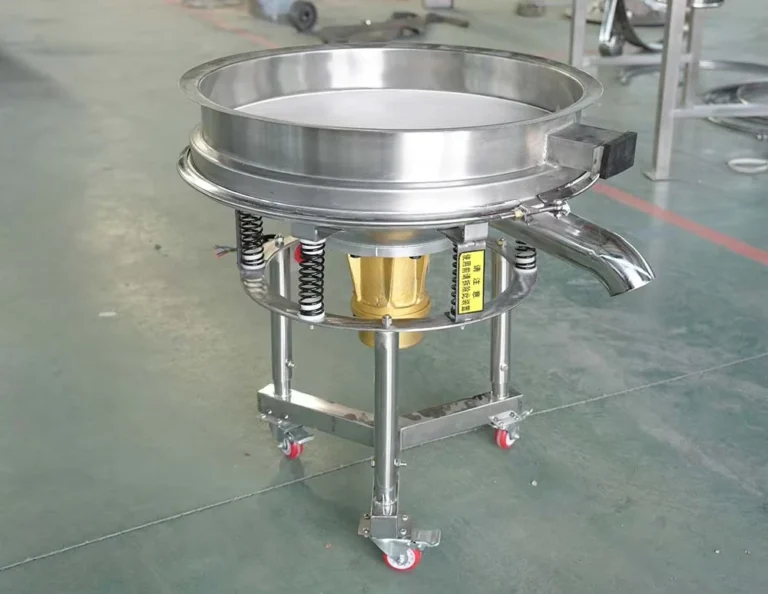
Yuanjing’s circular tumbler sieve offers configurable mesh, deck and sealing arrangements. Send a representative sample and the finished-product specification so those choices can be assessed against the material you actually process.
The Cover Is Closed. Where Is the Dust Coming From?
An enclosed tumbler screen still has joints, outlets and flexible connections. A closed lid tells you little about how these points behave under load.
Inspect the machine with its upstream and downstream connections fitted. Once feeding and discharge are running normally, look for persistent leakage around frame joints, flanges, clamps, flexible sleeves and extraction connections. Use the plant’s established measurement method to assess dust control. The absence of a visible dust cloud does not confirm that the required limit has been met.
Gaskets can deteriorate, and frames may be secured incorrectly after cleaning. Set inspection and replacement intervals around the material, temperature, cleaning method and frequency of use.
Ask the supplier to remove and refit a frame during the demonstration. Watch how it aligns and how the clamps close. After reassembly, check for twisted, displaced or pinched gaskets. Flexible sleeves also need enough allowance for machine movement.
Repeat the seal inspection after a screen change, including the seals between decks.
If the line changes products frequently, inspect the gasket grooves, frame edges and outlets for places where residue is difficult to reach. Good dust containment does not necessarily mean a quick cleanup.
Single Deck or Multiple Decks?
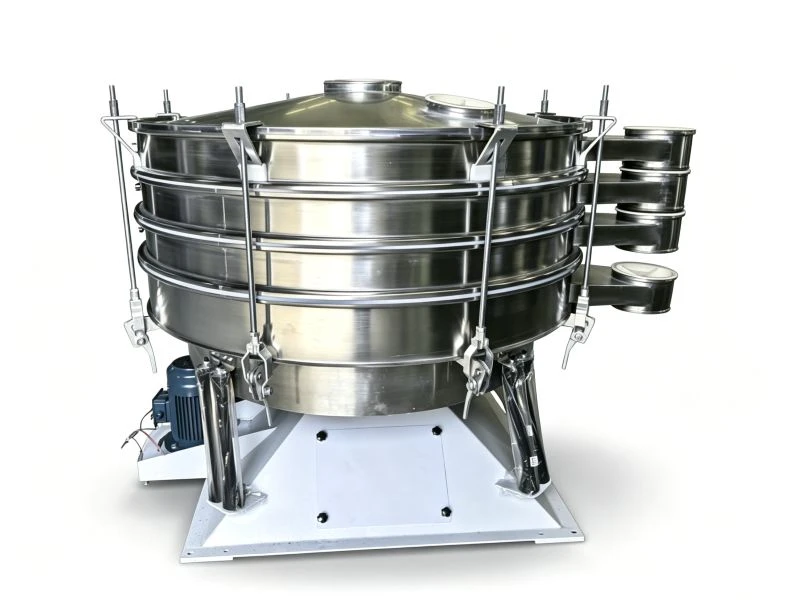
The deck count of an enclosed tumbler screen should follow the required separation cuts. In a standard sequential grading arrangement, N decks can produce N+1 size fractions. Some of those fractions may be rejects or material for reprocessing.
| Screening task | Configuration to consider | Check before accepting the result |
|---|---|---|
| Remove oversize and collect acceptable powder passing through the mesh | Single deck | How much usable powder leaves with the oversize |
| Remove oversize and fines, retaining the middle fraction | Two decks | Whether the retained product meets both size limits |
| Separate PVC resin powder into several grades | Multiple decks matched to the required cuts | Samples and output measurements from every outlet |
| Produce several grades with limited headroom | Deck arrangement matched to the available space | Access for screen removal after installation |
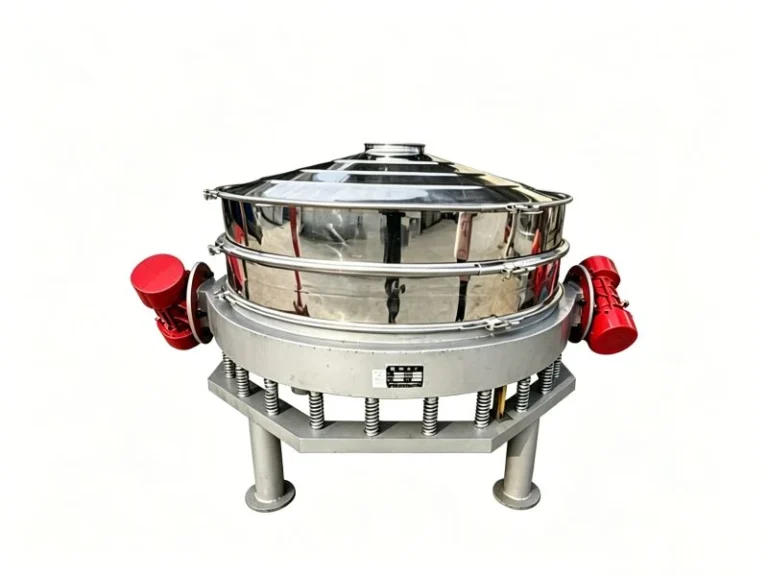
For several finished grades, use the multi-deck tumbler screen configuration to discuss the screen and outlet arrangement with the supplier.
Write down the number of decks, the number of outlets and what each outlet collects. “Three-stage classification” is open to interpretation: it could mean three screens or three finished grades.
Leave room for maintenance. The machine may fit beneath a hopper while leaving too little clearance to lift a frame or withdraw a screen. Discharge pipes need room for disconnection too.
Output Has Dropped. Check the Material Before Changing the Mesh
Look at where the material is sitting.
A nearly empty screen may be receiving too little feed. A heavily loaded screen points to a different problem; adding more material is unlikely to help. Blocked apertures, concentrated feeding and restricted outlets each need their own check.
Starch and Powdered Sugar
Compare the troublesome batch with one that ran well. Are there more lumps? Is powder coating the wires? Has the hopper started releasing a large charge instead of feeding steadily?
Moisture, stickiness, static and uneven feeding can all affect the result. If powder is piling up directly beneath the inlet, stabilize the feed before deciding that the mesh or cleaning device is unsuitable.
The distributor, hopper and discharge valve need to deliver at a rate the screen can sustain.
Silica Sand
A change in grading may come from blockage or wear. Particles lodged in the apertures reduce passage. Worn wires, holes and damage around the frame can let unwanted material into the product.
Do not stop the inspection because a new screen flows freely. Agree on checks after continuous running: aperture blockage, mesh condition and the finished-product size distribution.
PVC Resin Powder
The upper deck may run well while a lower one accumulates powder or becomes blinded. A poor seal between decks can also allow material to bypass the mesh and reach the wrong outlet.
Measure each fraction separately. If output from one outlet suddenly falls, inspect that deck and its discharge path before changing feed or machine settings.
Does the Cleaning Device Keep Working Through the Run?
Yuanjing lists bouncing-ball, rotary-brush and ultrasonic cleaning options. Test the proposed arrangement with the actual material.
| Cleaning method | During the trial | During maintenance |
|---|---|---|
| Bouncing balls | Check whether lodged particles are released and whether blockage returns as the run continues | Inspect ball wear, resilience and supporting components |
| Rotary brushes | Observe cleaning effectiveness and any effect on the product or mesh | Check bristle wear, contact condition and access for cleaning |
| Ultrasonic assistance | Check whether fine-powder adhesion decreases and acceptable-product output remains steady | Inspect frame compatibility, connections and system operation |
Mesh designation alone is not enough to decide whether an ultrasonic tumbler screen is needed. Yuanjing’s vitamin C powder screening case considers blinding alongside containment and cleaning. The selection approach is relevant to fine-powder handling, although the result still needs to be checked with your own material.
Measuring Capacity and Separation During Acceptance
For an enclosed tumbler screen acceptance trial, keep feed rate, total discharge and acceptable-product output as separate records. Material passing through the machine may still fail the finished-product specification.
| Acceptance item | What to record | Conditions to define |
|---|---|---|
| Acceptable-product capacity | Weight of compliant material from each product outlet per unit of time | Material condition, aperture, deck count and finished-product requirements |
| Separation quality | Out-of-spec particles in the product and usable material in the rejects | Sampling locations, procedure and test method |
| Continuous operation | Buildup, blinding, cleaning stops and output fluctuations | Trial duration and feeding conditions |
| Dust containment | Leakage around frames, interfaces and flexible connections | Extraction arrangement and the plant’s measurement method |
| Specific energy consumption | Energy used within the agreed equipment boundary relative to acceptable-product output | Whether feeding, screening and extraction equipment are included |
| Particle integrity | Particle-size distribution, additional fines and appearance before and after screening | Comparable feed samples |
When comparing machines, use comparable materials and the same product standard. Agree on the energy measurement boundary as well. A figure for the screener alone cannot be compared directly with one that includes feeding and dust extraction.
For fragile particles, examine samples before and after screening. Check for additional fines and visible damage. A machine that appears to move smoothly may still affect the product.
How Much Downtime Does a Screen Change Involve?
Screen change time on an enclosed tumbler screen depends on the frame design, deck count, cleaning requirements and working conditions. Swapping a preassembled frame takes different work from tensioning or bonding fresh mesh onto an existing frame.
Start the acceptance timing when the machine stops for emptying. Include dismantling, cleaning, replacement, reassembly, inspection and the return to compliant production. That gives you a usable figure for changeover and maintenance planning.
Watch the demonstration closely:
- Can the frames be opened without additional lifting equipment or tools?
- Are the frame surfaces and gasket grooves accessible for cleaning?
- Does the replacement assembly fit directly, or does the mesh need tensioning or bonding on site?
- After reassembly, do the seals or operating settings need further adjustment?
Loose mesh on a bonded frame cannot always be retensioned. Check the construction and follow the manufacturer’s repair procedure. Where rebonding or replacement is required, a forced temporary adjustment is unsuitable.
Operating Problems That Need Inspection
Stop the machine and isolate its energy sources before dismantling, cleaning or adjustment.
| Observed problem | Where to look first | Action |
|---|---|---|
| Wrinkled mesh or localized buildup | Frame fastening, mesh tension or bonding | Reinstall or replace components according to the frame design |
| Material mixing between grades | Mesh damage, inter-deck seals and frame assembly | Replace damaged mesh, restore sealing and sample again |
| Output gradually falling | Moisture, blocked apertures and cleaning-device wear | Compare batches, clean and inspect the cleaning system |
| Low output with little material on the screen | Upstream supply, hopper and discharge valve | Establish whether feed is insufficient |
| More feed without more acceptable product | Screen loading, distribution and discharge paths | Reduce localized buildup and rematch the feed rate |
| Abnormal twisting, noise or motion | Drive components, bearings and supports | Stop and have qualified personnel investigate |
| Belt slip or abnormal running speed | Belts and pulleys on applicable machines | Check tension and wear according to the manual |
| Cracked supports or uneven loading | The fitted support arrangement | Stop for assessment; ask the manufacturer whether grouped replacement is needed |
What to Send with a Quotation Request
An enclosed tumbler screen quotation needs more than a material name and an hourly tonnage. Include the conditions the machine will have to meet.
| Information | Details to provide |
|---|---|
| Material | Name, dry or wet condition, bulk density, agglomeration, abrasiveness and fragility |
| Feed particle size | Size distribution, oversize proportion and batch variation |
| Screening objective | Oversize removal, fines removal or multi-grade classification |
| Finished-product standard | Size limits for each grade, permitted out-of-spec content and test method |
| Capacity | Total feed rate and required acceptable-product output at each outlet |
| Installation | Available height, maintenance clearance, inlet and outlet positions, and connection dimensions |
| Cleaning and containment | Changeover frequency, cleaning method, contact materials and extraction connections |
| Acceptance trial | Material, duration, sampling locations, measurements and recording procedure |
If you are replacing a machine, send the Yuanjing technical team photographs of leakage points and blinded mesh, samples from each outlet, and production records. These can help distinguish a feeding or sealing problem from a mesh or machine-selection problem.
FAQ
Does an Enclosed Tumbler Screen Need Dust Extraction?
It depends on dust generation, the inlet and outlet connections, and the site’s containment requirements. The enclosure helps limit dust escape. Assess extraction needs with the surrounding production line included.
How Many Fractions Can Three Decks Produce?
Three decks can usually produce four size fractions in a standard sequential grading arrangement. The number of finished grades depends on whether any fraction is rejected or returned for reprocessing.
Will a Coarser Mesh Solve Blinding?
It may increase passage, but it may also let unwanted oversize into the product. Confirm the finished-product size limit first, then check material condition, feed distribution and the cleaning device before changing the aperture.
How Should Capacity Be Written into the Purchase Specification?
For an enclosed tumbler screen, state the material, aperture, deck count, product standard and continuous operating requirement. Make clear whether the figure refers to total feed or acceptable-product output. With multi-deck classification, specify the requirement for each product outlet.
How Can Two Machines Be Compared Fairly?
Use comparable material and the same product standard. Record acceptable-product output, rejects or reprocessing material, cleaning downtime and operating conditions. A brief high discharge rate does not show what the machine will sustain through a shift.
What Should a Screen Change Demonstration Cover?
Time the enclosed tumbler screen from emptying to the return to compliant production. Include cleaning, seal inspection and reassembly. Measuring only the removal and installation of the mesh leaves out part of the production stoppage.