Safety Screening vs Particle Classification: Which Sieving Process Do You Need?
Safety screening removes unwanted oversize from an otherwise acceptable product. Particle classification separates powders or granules into specified size fractions. A final check before mixing or packaging may only require safety screening; producing defined size grades calls for classification.
Choosing between safety screening and particle classification depends on what you need to remove, what you want to collect and the required production rate. Here, particle classification refers to separation through screens, rather than air or liquid classifiers.

Safety Screening vs Particle Classification: What Is the Difference?
Both processes use screen openings to separate material. The difference lies in the purpose of the separation and how the collected material is assessed.
What Is Safety Screening, or Check Screening?
Safety screening, also called check screening, allows the main product to pass while retaining unwanted oversized particles, lumps and foreign material that cannot pass through the openings.
Most of the feed is expected to be acceptable. The aim is to retain unwanted material while minimizing usable product loss and maintaining throughput.
What Is Particle Classification in Sieving?
Particle classification divides a mixed feed into fractions according to particle size. Each required fraction has a specification, and performance is judged by how well the collected material meets it.
Depending on the application, one or several fractions may be useful products.
Compare Process Goals, Outputs and Acceptance Criteria
| Comparison | Safety Screening | Particle Classification |
|---|---|---|
| Main purpose | Remove unwanted oversize | Produce specified size fractions |
| Feed expectation | Most material should pass the mesh | Different size fractions need separating |
| Typical outputs | Accepted material and retained rejects | Two or more size fractions |
| Screen configuration | Often single-deck | Single-deck, multi-deck or separate stages |
| Acceptance criteria | Retention, usable product loss and throughput | Size compliance, recovery and throughput |
Screen deck count alone does not define the process. A single-deck sieve can perform classification, while a multi-deck machine can include a safety screening stage.
Related videos
When Do You Need Safety Screening?
Use safety screening where oversize may enter or form during material handling. Common locations are after raw material feeding and before final packaging.
Checking Incoming Materials Before Processing
Bagged or stored ingredients may contain lumps or foreign material introduced during handling. Screening after feeding helps intercept material that should not enter the mixer or the next process.
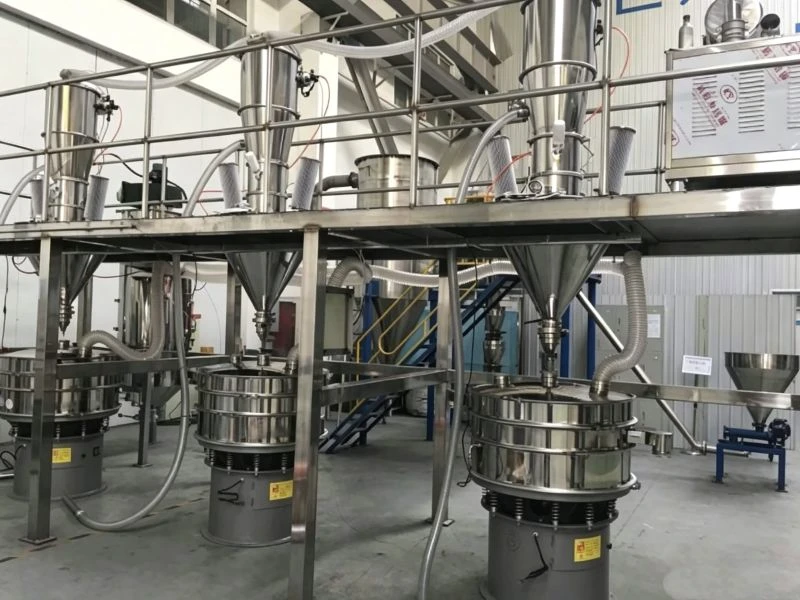
In Yuanjing’s flour screening and vacuum conveying project, an inline vibratory screen was positioned between the feeding station and vacuum conveyor to remove lumps and large impurities. The project used 40 mesh; this was an application-specific choice, not a general recommendation for flour.
Removing Oversize Material Before Packaging
A final screening step can retain oversized particles and lumps formed during processing or storage.
Inspect the reject stream to check whether usable product is being discarded. An unnecessarily fine opening can increase product loss and reduce output.
When screening kaolin powder before bagging, check whether the rejects are hard grains or lumps that crumble under light pressure. Crumbly lumps may contain usable powder that never passed through the mesh.
Understanding the Limits of Safety Screening
Foreign material smaller than the openings, or narrow enough to pass through in a particular orientation, may remain in the product. Removing oversize does not also remove excess fines.
Screening may disperse loose agglomerates, but it cannot replace grinding or restore deteriorated material.
For a practical example, see how to handle lumps during cocoa powder sieving, including when loose agglomerates may separate and when retained material needs further assessment.
When Do You Need Particle Classification?
Particle classification is useful when particle size affects downstream processing or finished product quality. It can produce a specified size range, separate several saleable grades or remove material that does not need further processing.
Meeting an Upper and Lower Particle Size Limit
For illustration, a target fraction of 100–300 μm requires separation of particles above 300 μm and below 100 μm where both are present in the feed.
These figures describe an example product range. Actual screen openings and separation results should be confirmed through testing.
For a material-specific example of how particle size requirements influence selection, see our metal powder sieving guide.
For a detergent application, see how to separate oversized lumps and fines from detergent granules. The guide shows how two screen openings can collect a target size fraction and explains what to check at each outlet.
Producing Multiple Grades from One Feed
A powder producer may collect fine and coarse grades for different customers, while returning oversized material for further grinding.
Retained material is not automatically waste: it may meet another specification or be suitable for reprocessing. Separating already acceptable particles before grinding can also avoid unnecessary processing.
Checking Recovery and Off-Size Material in Each Fraction
Assess classification against three results:
- Size compliance: Does each fraction meet its specification, including permitted oversized particles and fines?
- Recovery: How much of the target-size material in the feed reaches the correct outlet?
- Throughput: Can the screen maintain the required production rate while meeting those limits?
A fraction can meet its size specification even while usable material is lost through another outlet. Check all three results together.

How to Choose the Right Sieving Process and Equipment
When comparing safety screening vs particle classification for your production line, first define the required output. Specify what must be removed, which fractions should be collected and the required hourly capacity. These requirements guide the choice of screen openings, deck configuration and equipment.
Start with the Required Product Specification
List what must be removed, which fractions should be collected and the acceptable amount of off-size material in each product.
Specify normal and peak feed rates in kg/h or t/h, along with any limits on usable product loss.
Match Screen Openings and Decks to the Separation Duty
State the actual aperture in microns or millimeters. If specifying a mesh number, also confirm the mesh standard and wire diameter.
In a conventional stacked arrangement, one deck can produce two fractions and two decks can produce three. Assign each outlet a purpose and select the separation points accordingly.
Screen material should suit the product’s abrasion, corrosion, cleaning and contamination requirements.
Once the required fractions are defined, see how to match screen decks to product fractions and assign a separate outlet to each material stream.
Match the Equipment to Material Behavior and Throughput
Review particle size distribution, bulk density, moisture, flowability and mesh-blinding tendency. These influence usable capacity and the configuration worth testing.
| Process Requirement | Equipment to Evaluate |
|---|---|
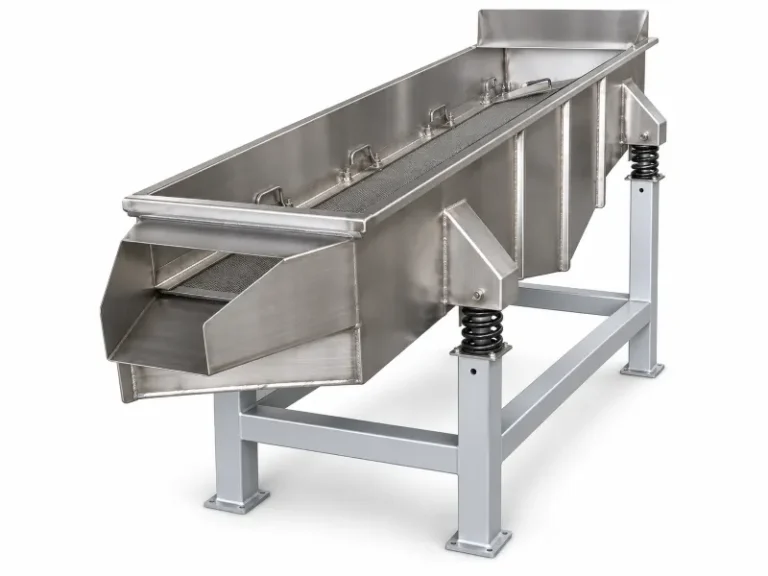
| Continuous production-line check screening | Inline vibratory screen |
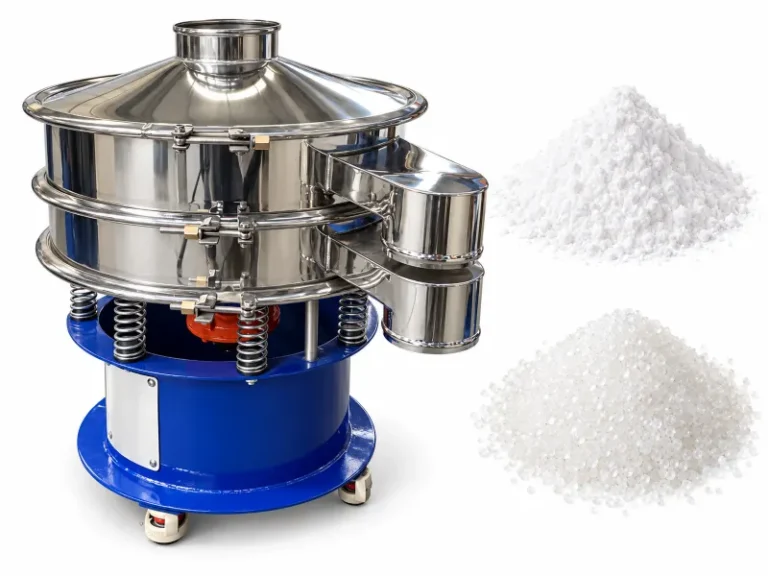
| General powder screening or size separation | Rotary vibrating screen |
| Several separation points and product grades | Multi-deck vibratory sifter |
| Persistent adhesion or blinding in fine powders | Mesh-cleaning options, including an ultrasonic vibrating sieve where testing supports its use |
These are starting points for evaluation, not fixed assignments. Size the screening area for the material, aperture and expected feed variations. A catalog capacity range is not a guaranteed output for every powder.
Confirm the Choice with a Representative Material Test
Use a sample that reflects production conditions. Record feed rate, output and particle size at each outlet, and usable product lost in the rejects.
Run the test long enough to observe buildup, mesh blinding and changes in throughput. Confirm that the selected configuration maintains the required separation and recovery over the run.
Request a Screening Recommendation
Still weighing safety screening vs particle classification for your material? Send us your material name, feed particle size, target size range or retention requirement, required capacity and installation conditions. We can help assess the separation duty and recommend a suitable screening configuration.
FAQs
Is Check Screening the Same as Safety Screening?
Generally, yes. In industrial powder processing, both terms describe checking material for unwanted oversize, commonly after bag emptying or before mixing and packaging. They do not imply removal of every contaminant.
Can One Vibrating Sieve Perform Both Processes?
Yes, with a suitable configuration. Switching duties may require different mesh openings, outlets or decks. Confirm that the machine meets the separation and throughput requirements for each task.
Does Particle Classification Always Require a Multi-Deck Sifter?
No. One screen can separate a feed into oversize and undersize fractions. Multiple decks or stages are useful when additional separation points are required, such as removing both coarse particles and fines from a target product.
Is Safety Screening Enough Before Powder Packaging?
It may be enough when the powder already meets its size specification and only needs an oversize check. If excess fines also make the product unacceptable, classification may be needed before packing.
How Do I Choose the Mesh Size for Powder Check Screening?
Start with the material you need to retain and the size distribution of the usable powder. Test a suitable aperture at the required feed rate, checking both reject content and throughput before finalizing the mesh.
When Is Ultrasonic Sieving Needed for Fine Powder Classification?
Consider it when adhesion or persistent blinding prevents a conventional sieve from maintaining output. Check feeding, moisture and screen condition first, then compare performance using the same powder and aperture. Fine mesh alone does not make ultrasound necessary.